Introduction
Welcome to the final lesson in our module on risk-neutral pricing in discrete time. In previous lessons, we built a solid foundation using binomial trees to price European and American options, and we interpreted the replicating portfolio as a powerful method for dynamic hedging. Today, we'll apply these skills to a more complex class of derivatives: barrier options.
Unlike standard options whose payoffs depend only on the asset's price at expiration, barrier options are path-dependent. Their value, and indeed their very existence, depends on whether the underlying asset's price has touched or crossed a predefined "barrier" level during the option's life. Your background in probability theory will be particularly useful here, as we will see how adding this condition is akin to introducing a conditional probability into our payoff structure.
This lesson will guide you through the classification of barrier options and demonstrate how to adapt our familiar binomial tree methodology to price them. This is a crucial skill for the CM2 exam and deepens your understanding of how derivative pricing models can be extended to handle more intricate contract features.
What are Barrier Options?
Barrier options are a type of "exotic" option. They behave like standard options, but with a critical twist: they are either activated or extinguished if the underlying asset price hits a specific barrier level, .
This path-dependency makes them different from the European options we've priced so far. We can't just look at the price at expiration; we must consider the entire price path taken by the asset.
To understand the core concepts and classifications, let's start with a short video.
Barrier Option Pricing with Binomial Trees || Theory & Implementation in Python
This video from QuantPy provides an excellent introduction to barrier options, their path-dependent nature, and how their payoff structure is defined.
Please watch the first four and a half minutes of the video, paying attention to these key ideas: Path Dependency: What it means for an option's payoff to depend on the path of the underlying price (introduction). Discrete vs. Continuous Monitoring: Binomial trees inherently model discretely monitored barriers, where the price is checked only at the end of each time step (monitoring types). The Indicator Function: How the barrier condition can be formally expressed using an indicator function, which switches the payoff on or off (payoff formula).
As the video and the FasterCapital article explain, there are two main categories of barrier options, which are then subdivided based on the barrier's location relative to the initial stock price.
-
Knock-Out Options: These options cease to exist (they are "knocked out") if the underlying price touches the barrier.
- Up-and-Out: The barrier is above the initial stock price . The option is knocked out if the price rises to hit .
- Down-and-Out: The barrier is below the initial stock price . The option is knocked out if the price falls to hit .
-
Knock-In Options: These options only come into existence (they are "knocked in") if the underlying price touches the barrier. Before the barrier is hit, the option is worthless.
- Up-and-In: The barrier is above . The option is activated if the price rises to hit .
- Down-and-In: The barrier is below . The option is activated if the price falls to hit .
An interesting relationship that stems from this is that a standard European option is equivalent to the sum of a knock-in and a knock-out option with the same strike, maturity, and barrier level.
This is because, for any price path, one and only one of the two barrier options will have a payoff identical to the European option, while the other will have a zero payoff.
Pricing Barrier Options on a Binomial Tree
Pricing a barrier option with a binomial tree follows the same backward induction process we've already mastered. The only difference is that at each node, we must check if the barrier condition has been triggered. This check modifies the value at the node.
Let's formalize the adjustment to our pricing algorithm.
The Modified Backward Induction Process:
-
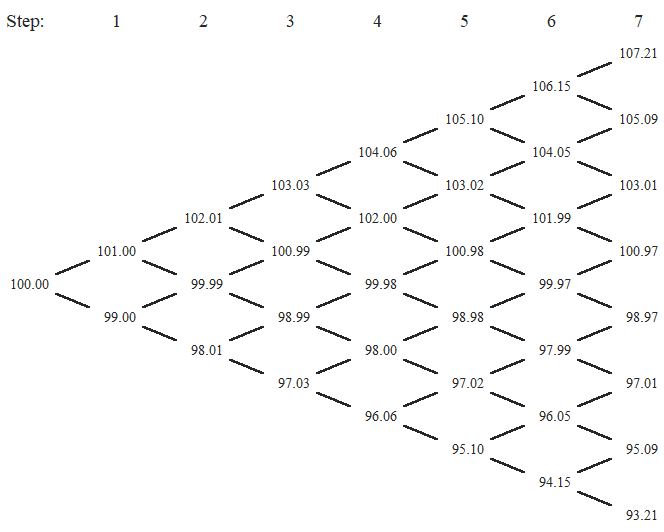
Construct the Stock Price Tree: Build the binomial tree of underlying asset prices for all time steps and states , just as you would for a standard option.
-
Determine Terminal Payoffs: At the final time step , calculate the option's intrinsic value at each node (e.g., for a call). Then, apply the barrier rule:
- For a knock-out option, if the price at any step on the path to that terminal node has crossed the barrier, the payoff at that node becomes zero.
- For a knock-in option, if the price has not touched the barrier on the path to that terminal node, the payoff becomes zero.
-
Perform Backward Induction: Work backward from the penultimate time step () to time 0. At each node :
- First, check the barrier condition at the current node's stock price .
- For a knock-out option, if breaches the barrier (e.g., for an up-and-out), the option value at this node, , is immediately set to zero.
- For a knock-in option, the logic applies at expiry. During backward induction, once the option is "knocked in" on a path, it's treated like a standard option from that point onward along that path's subsequent nodes.
- If the option is not knocked out (or has been knocked in), calculate its value using the standard risk-neutral valuation formula: where and are the values at the subsequent up and down nodes, which have already been calculated and barrier-adjusted.
- First, check the barrier condition at the current node's stock price .
The crucial modification is that a barrier can render an option worthless before expiration.
Worked Example: Pricing a Down-and-In Put Option
Let's apply this logic to a concrete, exam-style problem. We will price a down-and-in put option. This option only becomes active if the stock price drops and hits the barrier. If the barrier is never hit, the option expires worthless.
The following resource provides a solved problem that is perfect for our purposes.
[PDF] Binomial option pricing (review). - UT Math
This problem set from the University of Texas at Austin contains a concise, worked example of pricing a barrier option on a two-period binomial tree.
Please read Problem 1.6 and its solution. Focus on how the barrier condition is used to determine which terminal payoffs are non-zero. Read the problem setup and the payoff logic, then review the final calculation.
Let's break down the solution step-by-step using our backward induction method, which is more transparent than the direct formula used in the PDF.
Problem Parameters:
- Option Type: 1-year, Down-and-In Put Option
- Initial Stock Price (): $100
- Strike Price (): $110
- Barrier (): $90 (down-and-in)
- Volatility (): 0.25
- Risk-free rate (): 4% (continuously compounded)
- Binomial Tree: 2 periods (), so each step is years.
Step 1: Calculate Tree Parameters
The problem uses a forward tree, where and when there are no dividends.
- Risk-neutral probability:
Step 2: Construct the Stock Price Tree
Step 3: Determine Terminal Payoffs ()
This is the key step. The option is a down-and-in put with a barrier at $90.
- Path uu: (100 121.75 148.23). The path never went below $90. Option not knocked in. Payoff .
- Path ud: (100 121.75 104.09). The path never went below $90. Option not knocked in. Payoff .
- Path du: (100 85.49 104.09). The path hit $85.49, which is below the $90 barrier. Option is knocked in. Payoff is .
- Path dd: (100 85.49 73.09). The path hit $85.49. Option is knocked in. Payoff is .
Step 4: Backward Induction to
- Node u: The subsequent payoffs are and . Therefore, the value at this node must be .
- Node d: The subsequent payoffs are and . We calculate the discounted expected value:
Step 5: Backward Induction to
Finally, we find the price today by discounting the expected value from the nodes at .
The price of the down-and-in put option is $11.91.
This example shows that by carefully modifying the payoffs at the nodes based on the barrier condition, our existing binomial pricing framework works perfectly.
Conclusion
In this lesson, we have extended our binomial pricing model to handle path-dependent barrier options. This required only a simple but critical modification to our algorithm: checking at each node whether a barrier has been breached and setting the option's value to zero if it has been knocked out or has failed to knock in.
Key Takeaways:
- Barrier options are path-dependent derivatives whose payoff is contingent on the underlying asset's price crossing a predetermined barrier level.
- They are classified as knock-out (expire if barrier is hit) or knock-in (activate if barrier is hit), with sub-types based on the barrier's location (up or down).
- Pricing on a binomial tree involves applying the standard backward induction process, but with an added rule: at each node (both terminal and intermediate), the option's value is set to zero if a knock-out condition is met.
- For knock-in options, the terminal payoffs are zero for all paths that failed to hit the barrier. The backward induction then proceeds from this modified set of terminal values.
This lesson concludes our module on risk-neutral pricing in discrete time. You have built a robust toolkit, starting from the one-period model and progressing through multi-period European, American, and now Barrier options.
Our next module will transition from discrete to continuous time as we explore the celebrated Black-Scholes-Merton model, a cornerstone of modern financial engineering. We will see how the ideas of replication and risk-neutrality that we developed here form the conceptual bedrock of this continuous-time framework.