Introduction
In our previous lesson on put-call parity, we established a crucial static relationship that links the prices of European call and put options. This principle of no-arbitrage showed us that if we know the price of a call, we can determine the fair price of its corresponding put, and vice versa. That provided a snapshot of prices at a single point in time. Now, we will shift our focus from this static equilibrium to the dynamic forces that cause option prices to change.
This lesson explores the primary factors that drive the value of an option. We will identify six key variables and analyze how a change in each one—holding the others constant—affects the price of call and put options. Understanding these relationships is fundamental to pricing, hedging, and trading derivatives. We will also introduce the "Greeks," which are the names given to the measures of an option's sensitivity to these factors, a topic we will explore in great depth in a later module.
Decomposing an Option's Price
Before we dive into the specific factors, it's helpful to understand that an option's price, or premium, can be broken down into two components: intrinsic value and time value.

-
Intrinsic Value: This is the value an option would have if it were exercised immediately. It is the amount by which the option is "in-the-money."
- For a call option:
- For a put option:
An option can never have a negative intrinsic value.
-
Time Value (or Extrinsic Value): This is the portion of the option's premium that is not intrinsic value. It arises from the possibility that, over time, the underlying asset's price will move favorably, increasing the option's intrinsic value. Time value is essentially the price of uncertainty and opportunity. The longer the time until expiration and the more volatile the underlying asset, the greater the time value.
As we analyze the six key pricing factors, think about how each one influences these two components of an option's value.
The Six Factors Influencing Option Prices
An option's value is a function of six major variables. For a clear and intuitive explanation of how each one works, the following video is an excellent starting point. It uses logical reasoning and connects back to the basic payoff formulas for calls and puts.
Factors affecting Option Values (Calculations for CFA® and FRM® Exams)
This video, "Factors affecting Option Values" from AnalystPrep, is specifically designed for professional exams like the CFA and FRM, making its content highly relevant for your CM2 preparation. It provides concise explanations for each of the six factors.
Please watch the following segments. For each one, focus on the logic behind why a factor's increase causes the call or put value to move in a specific direction. Introduction of Factors: Watch the overview of the six factors and their notation. Underlying Price (S): Impact of stock price. Strike Price (X or K): Impact of strike price. Time to Expiration (T): Impact of time. Volatility (σ): Impact of volatility. Risk-free Rate (r): Impact of interest rates. Dividends (D): Impact of dividends.
Let's consolidate and expand upon the key points from the video.
1. Underlying Asset Price (S)
- Call Options: The value of a call option increases as the underlying asset price increases. This is the most intuitive relationship. A call gives you the right to buy at a fixed price (), so the higher the market price (), the more valuable that right becomes.
- Put Options: The value of a put option decreases as the underlying asset price increases. A put gives you the right to sell at a fixed price (), so the higher the market price, the less valuable that right is.
The sensitivity of an option's price to a change in the underlying's price is measured by Delta ().
2. Strike Price (K)
- Call Options: The value of a call option decreases as the strike price increases. A higher strike price means you have to pay more to exercise the option, making it less profitable and therefore less valuable.
- Put Options: The value of a put option increases as the strike price increases. A higher strike price means you get to sell the underlying for more, making the put more valuable.
3. Time to Expiration (T)
- American Options: For both calls and puts, more time to expiration is always more valuable. This is because the option holder has more time for the underlying price to move in a favorable direction.
- European Options: Generally, more time is also more valuable. The insurance analogy from the video is very effective: a two-year policy offers more protection than a two-month policy and thus costs more. However, there's a nuance for European puts. A longer-dated put can sometimes be worth less than a shorter-dated one, particularly for deep-in-the-money puts when interest rates are high. This is because you must wait longer to receive the strike price, which has a lower present value.
The rate at which an option's value decreases as time passes is measured by Theta (), often called time decay.
4. Volatility of the Underlying's Price ()
- Call and Put Options: The value of both calls and puts increases as volatility increases. This is a crucial point that connects to your background in probability. An option holder benefits from large price swings but has limited downside risk (the premium paid). Higher volatility increases the probability of a large, profitable price swing. Since the potential loss is capped, the increased chance of a large gain outweighs any other consideration. Therefore, volatility is always beneficial for the option holder.
The sensitivity of an option's price to a change in volatility is measured by Vega.
5. Risk-Free Interest Rate (r)
- Call Options: The value of a call option increases as the risk-free interest rate increases. The video provided an excellent intuitive explanation: buying a call option allows you to defer the cash outflow of buying the stock. Higher interest rates mean you can earn more interest on that deferred payment, making the call a more attractive alternative to buying the stock outright.
- Put Options: The value of a put option decreases as the risk-free interest rate increases. Conversely, a put option delays a cash inflow you would have received from selling the stock today. Higher interest rates mean you are forgoing more potential interest, which makes holding the put less attractive.
The sensitivity of an option's price to a change in the risk-free rate is measured by Rho ().
6. Dividends (or other benefits from the underlying)
- Call Options: The value of a call option decreases as expected dividends increase. When a stock pays a dividend, its price drops by roughly the dividend amount on the ex-dividend date. Since a call option's value is positively related to the stock price, this expected price drop reduces the call's value.
- Put Options: The value of a put option increases as expected dividends increase. The same expected price drop that hurts the call option benefits the put option, making it more valuable.
This effect is consistent with the dividend-adjusted put-call parity formula from our last lesson: . An increase in must be offset by a decrease in or an increase in .
Summary of Relationships
This table provides a concise summary of the relationships we've just discussed. It's a critical piece of information to commit to memory.
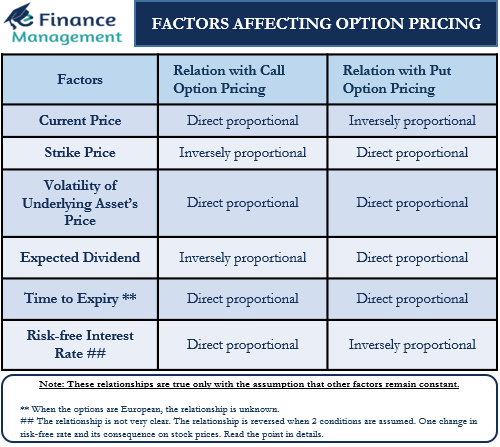
For a good text-based summary and a slightly different perspective using simplified formulas, you can review the following article.
Factors Influencing Option Value | CFA Level 1 - AnalystPrep
This article from AnalystPrep provides a concise written summary of all the factors.
Read the sections titled Value of the Underlying, Exercise Price, Time to Expiration, Risk-Free Rate, The Volatility of the Underlying, and Income or Cost. Pay attention to the summary table at the end, which neatly recaps all the relationships.
Preview: The Greeks as Measures of Sensitivity
We've mentioned that the sensitivity of an option's price to each of these factors is measured by a set of variables called the "Greeks." While we will dedicate an entire module to calculating and applying them later, it's useful now to formally introduce them as a concept. Understanding that these relationships are not just qualitative but are quantified is a key step toward advanced financial engineering.
The Greeks - Stock Option Price Factors Explained
The video "The Greeks - Stock Option Price Factors Explained" by The Plain Bagel offers a great high-level introduction to what the Greeks are and what they represent.
Watch the following segments to connect the factors we've discussed to their corresponding Greek letter: Introduction: Watch this segment for an overview of the Greeks. Delta (for Stock Price): Watch the explanation of Delta. Theta (for Time Decay): Watch the explanation of Theta. Vega (for Volatility): Watch the explanation of Vega. Rho (for Interest Rates): Watch the explanation of Rho.
Conclusion
In this lesson, we have moved from the static world of put-call parity to the dynamic one of changing option prices. We have systematically examined the six factors that determine an option's value and established the direction of their influence on calls and puts.
Key Takeaways:
- An option's premium consists of intrinsic value and time value.
- The six key factors influencing an option's price are the underlying price (S), strike price (K), time to expiration (T), volatility (), risk-free rate (r), and dividends (D).
- Volatility and Time are the primary drivers of an option's time value. Greater volatility and more time almost always increase an option's price for the holder.
- The effect of each factor on calls vs. puts is often symmetrical (e.g., an increase in S helps calls and hurts puts).
- The sensitivity of an option's price to these factors is quantified by the Greeks (Delta, Theta, Vega, Rho, etc.), which are essential tools for risk management.
So far, we have discussed what influences option prices. In our next lesson, we will begin to explore how to calculate an option's price by building a model that incorporates these factors. We will start with the binomial model, a powerful and intuitive framework for pricing derivatives in a discrete-time setting.