Hello! Welcome to the final lesson in our module on Advanced OOP Concepts.
In our last lesson on namespaces, we saw how to organize our code and prevent naming collisions. We ended with a question: what if you want to share a specific piece of functionality, like a logging method, between two completely unrelated classes? For example, a User class and an Order class might both need to log actions, but an Order is not a User, so inheritance (extends) doesn't make sense.
This is a common challenge in object-oriented programming. PHP's answer is Traits. Today, you will learn how to organize and use traits to reuse code across unrelated classes. Traits are a powerful tool that allows you to "mix in" methods and properties into classes, helping you write clean, DRY (Don't Repeat Yourself) code, which is essential for building professional-grade applications.
1. The Problem: Code Reuse Without Inheritance
PHP uses a single inheritance model, meaning a class can only extend one other parent class. This is generally a good thing, as it avoids the complexities and ambiguities of multiple inheritance found in some other languages (like the "Diamond Problem"). But it leaves us with the problem of sharing code between classes in different inheritance hierarchies.
Let's start with a short video that explains this limitation and introduces traits as the solution.
PHP Traits - How They Work & Drawbacks - Full PHP 8 Tutorial
This video from the Program With Gio channel clearly illustrates why PHP doesn't support multiple inheritance and how traits provide an alternative for code reuse.
Watch the first 2 minutes of the video (00:00 - 02:00). Focus on understanding the coffee maker example and the 'Diamond Problem,' which highlights the ambiguity that multiple inheritance can create.
A trait is essentially a bundle of methods (and properties) that you can import into a class. You can think of it as a compiler-assisted copy-paste. Instead of inheriting features, a class consumes them from a trait. A single class can consume multiple traits.
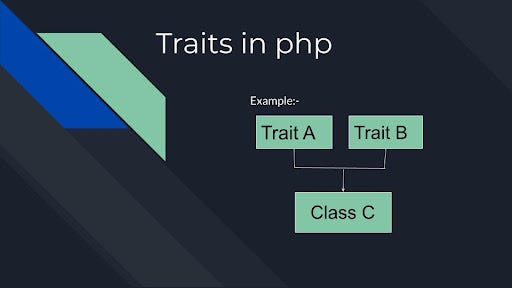
2. How to Define and Use Traits
Defining a trait is very similar to defining a class, but you use the trait keyword. To use it in a class, you use the use keyword inside the class body.
Here's a classic, practical example: a LoggerTrait that can be used by any class that needs to write log messages.
// Define the trait
trait LoggerTrait
{
    public function log(string $message): void
    {
        $className = __CLASS__; // A magic constant that gives the class name
        echo date('Y-m-d H:i:s') . " [{$className}]: {$message}\n";
    }
}

// Define two unrelated classes
class Customer
{
    use LoggerTrait;

    public function create()
    {
        // ... logic to create a customer ...
        $this->log("New customer created.");
    }
}

class Invoice
{
    use LoggerTrait;

    public function process()
    {
        // ... logic to process the invoice ...
        $this->log("Invoice processed.");
    }
}

// Use the classes
$customer = new Customer();
$customer->create(); // Outputs: 2023-10-27 10:30:00 [Customer]: New customer created.

$invoice = new Invoice();
$invoice->process(); // Outputs: 2023-10-27 10:30:01 [Invoice]: Invoice processed.
Notice how Customer and Invoice are completely unrelated, yet they can both use the log() method. This is the primary power of traits.
Let's watch a video segment that walks through this exact scenario, showing why inheritance is the wrong tool for the job and how traits solve the problem perfectly.
PHP Traits - How They Work & Drawbacks - Full PHP 8 Tutorial
This segment from Program With Gio provides a fantastic real-world example of using a trait to share functionality (sending an email) between Customer and Invoice classes.
Watch from 28:35 to 31:30. Pay close attention to the explanation of why extending a Mail class is a poor design choice and how using a MailTrait is the correct approach.
3. Key Features and Conflict Resolution
As you start using traits, you'll encounter more advanced situations. Here are the most important ones to master.
Method Precedence
What happens if a method is defined in multiple places? PHP has a clear order of precedence:
- Methods from the current class override methods from a trait.
- Methods from a trait override methods inherited from a parent class.
This allows a class to customize its behavior while still reusing code from traits and parent classes. The official PHP manual provides concise examples of this.
The official PHP documentation is the ultimate source of truth. This page provides clear examples of how method precedence works.
Read the section titled 'Precedence' and review the two code examples. This will solidify your understanding of which method gets called when names overlap.
Conflict Resolution
A fatal error occurs if you try to use two traits that both contain a method with the same name. You must explicitly tell PHP which one to use. You can do this with the insteadof and as keywords.
insteadof: Specifies which trait's method to use.as: Creates an alias, allowing you to access the "other" method with a new name.
Let's see how this works in practice.
PHP Traits - How They Work & Drawbacks - Full PHP 8 Tutorial
This is a critical skill for using traits effectively. This clip from Program With Gio demonstrates exactly how to resolve naming conflicts when using multiple traits.
Watch from 10:57 to 13:34. The example shows two coffee maker traits with a conflicting makeLatte() method. Observe how insteadof resolves the conflict and how as provides access to the conflicting method under a new name.
Other Powerful Features
Traits have other capabilities that are useful to know:
- Properties and Constants: Traits can define properties and, as of PHP 8.2, constants.
- Trait Composition: Traits can
useother traits. - Visibility Control: You can change the visibility of a trait method within the consuming class (e.g., make a
publicmethodprivate). - Abstract Methods: A trait can require a class to implement a certain method by defining it as
abstract. - Static Members: Traits can contain static methods and properties.
The video you've been watching covers these features in detail. While you don't need to memorize them all right now, it's good to be aware of what's possible.
4. Best Practices for Using Traits
With great power comes great responsibility. When used properly, traits lead to clean, reusable code. When misused, they can make code confusing and hard to maintain.
Traits in PHP – a powerful yet underused tool?
This article from the DEV Community offers excellent, concise advice on using traits professionally.
Read the sections '3. Best practices' and '4. Pitfalls to avoid'. These guidelines are crucial for writing maintainable code as a professional developer.
The most important takeaways are:
- Single Responsibility: A trait should do one thing well (e.g., logging, soft-deleting). Avoid creating a massive
UtilsTraitwith dozens of unrelated methods. - Use for Behavior, Not Contracts: Traits are for reusing a concrete implementation. If you want to enforce a contract (i.e., guarantee that a class has certain methods), you should use an interface.
Conclusion
Congratulations on completing the Advanced OOP Concepts module! You've learned how to build flexible systems with inheritance and abstract classes, organize your project with namespaces, and now, how to share code horizontally with traits.
Key Takeaways:
- Traits solve the problem of code reuse in a single-inheritance language like PHP.
- They are ideal for sharing functionality between unrelated classes where an "is-a" relationship (inheritance) doesn't apply.
- You define a trait with the
traitkeyword and include it in a class withuse. - PHP has a clear precedence order: Class methods > Trait methods > Inherited methods.
- You must resolve naming conflicts between two traits using the
insteadofandaskeywords. - For professional code, traits should have a single, clear responsibility.
Preview of the Next Lesson:
We've now covered all the core building blocks of modern object-oriented PHP. But how do you manage all these files and seamlessly include code from third-party developers? In our next module, we'll dive into Dependency Management with Composer. You'll learn how to initialize a project, pull in external packages, and set up an autoloader that automatically loads your classes, tying together everything we've learned about namespaces and code organization.