Hello and welcome back!
In our last lesson, you trained your ear to distinguish liquid drum and bass from other subgenres by focusing on its unique sonic signature: the smooth basslines, soulful melodies, and rolling rhythms.
Today, we're moving from the "what" to the "how." The goal of this lesson is to identify the essential elements and structure of liquid drum and bass tracks. Think of a track not as one continuous piece of music, but as a journey with distinct stages. For a DJ, understanding this journey is everything. It’s your map for mixing. In your event management work, you know the importance of a schedule—the opening act, the main performance, the cool-down period. A track's structure is its schedule, and knowing it allows you to create a seamless experience for the listener.
The Blueprint of a Drum & Bass Track
At its core, most drum and bass music, including liquid, follows a predictable energy curve. It builds up, peaks, drops down for a breather, and then often peaks again before fading out. This is intentional and designed specifically for DJs.
These energy changes create distinct sections within the song. Let's look at a visual representation of this.
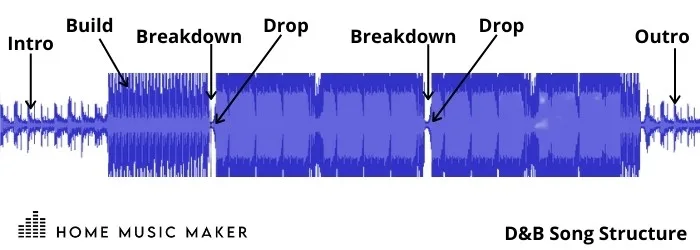
The main sections you need to learn to identify are:
- Intro: The beginning of the track. It's usually sparse, focusing on percussion and atmospheric sounds. Its primary job is to give a DJ enough time and a clear rhythm to mix it in with the previous track.
- Drop: This is the main event—the high-energy core of the track where the full drum beat and the main bassline "drop" in. This is the part of the track that gets people moving on the dancefloor.
- Breakdown: After the intensity of the drop, the breakdown provides a release. The drums and heavy bass are often removed, leaving melodic and atmospheric elements. It serves as a bridge, a breather, and a way to build tension before the next drop.
- Outro: The mirror image of the intro. Elements are gradually removed, leaving a simple, rhythmic pattern that a DJ can easily mix the next track over.
Visualizing the Structure in Practice
Reading definitions is one thing, but seeing the structure is much more intuitive. Since you're starting with software, getting familiar with how tracks look in a Digital Audio Workstation (DAW) is a great head start.
Let's watch a video that shows a very practical way to map out a song's structure.
This video from DJ and producer Becky Saif demonstrates how to analyze a track's structure by looking at its waveform. This is a skill you will use constantly, whether you're DJing or producing.
Watch from 1:01 to 4:19. Pay close attention to how she uses visual cues. The 'drop' is the fattest part of the waveform, while the 'breakdown' is where it gets much thinner. This visual analysis is a powerful tool.
This method of "reading the waveform" is a fundamental skill for digital DJs. You can see where the energy is before you even hear the track, which helps you plan your mixes.
Deconstructing the Sections
Now that you have a mental map, let's zoom in and understand the musical purpose of each section.
The Intro and Build-Up
The intro isn't just empty space; it's a carefully crafted ramp. It introduces sounds one by one, giving the listener's ear time to adjust and building anticipation for what's to come.
Let's return to Becky Saif's video, where she explains how an intro is typically constructed. Understanding this producer's perspective is invaluable for a DJ.
Watch from 5:49 to 10:52. Notice her key advice: the intro avoids heavy bass to prevent clashing with the track currently playing. Instead, it layers higher-frequency sounds like percussion (hats, shakers) and teases melodic elements to create tension. The build-up right before the drop often uses filter effects and 'risers' (sounds that build in pitch and volume) to maximize impact.
The Drop
The drop is the payoff. In liquid D&B, this is where you'll hear the groovy two-step drum pattern and the signature rolling bassline working together in full force, accompanied by the main melodic themes. Tracks often have two major drops, and the second one usually contains a variation to keep things interesting.
No more loops! DNB Tutorial - Song Structure (Episode 1)
To see how a drop is built, let's analyze a track with producer Isaac Simpson. You don't need to catch every production detail; focus on how he describes the layering of different bass sounds and synth patterns to create energy and variation within the drop.
Watch from 3:22 to 5:57. Listen for how the bassline evolves and new sounds are introduced. This is what makes a drop feel dynamic rather than just being a repetitive loop.
Test your understanding!
You are listening to a track and want to find the perfect place to start your mix. You hear a section with just a drum beat and a light atmospheric pad. After 30 seconds, a piano melody comes in, but there's still no bass. Is this likely the Intro, the Drop, or the Breakdown?
Show answer
This is almost certainly the Intro. The key clues are the sparse arrangement (just drums and pads) and the lack of a main bassline. This provides a clean, rhythmic foundation that is easy for a DJ to mix over.
The Standard Arrangement Formula
While artists always find ways to be creative, there is a very common, DJ-friendly structure that serves as a reliable blueprint. This formula is often described in "bars." A bar is a basic unit of time in music, typically containing 4 beats. We'll dive deep into counting bars later, but for now, think of it as a way to measure musical paragraphs.
The following guide provides a clear, text-based summary of this common structure.
How To Make Drum & Bass: The Complete Guide
This guide from EDMProd neatly summarizes the standard D&B track structure, including the typical length of each section in bars.
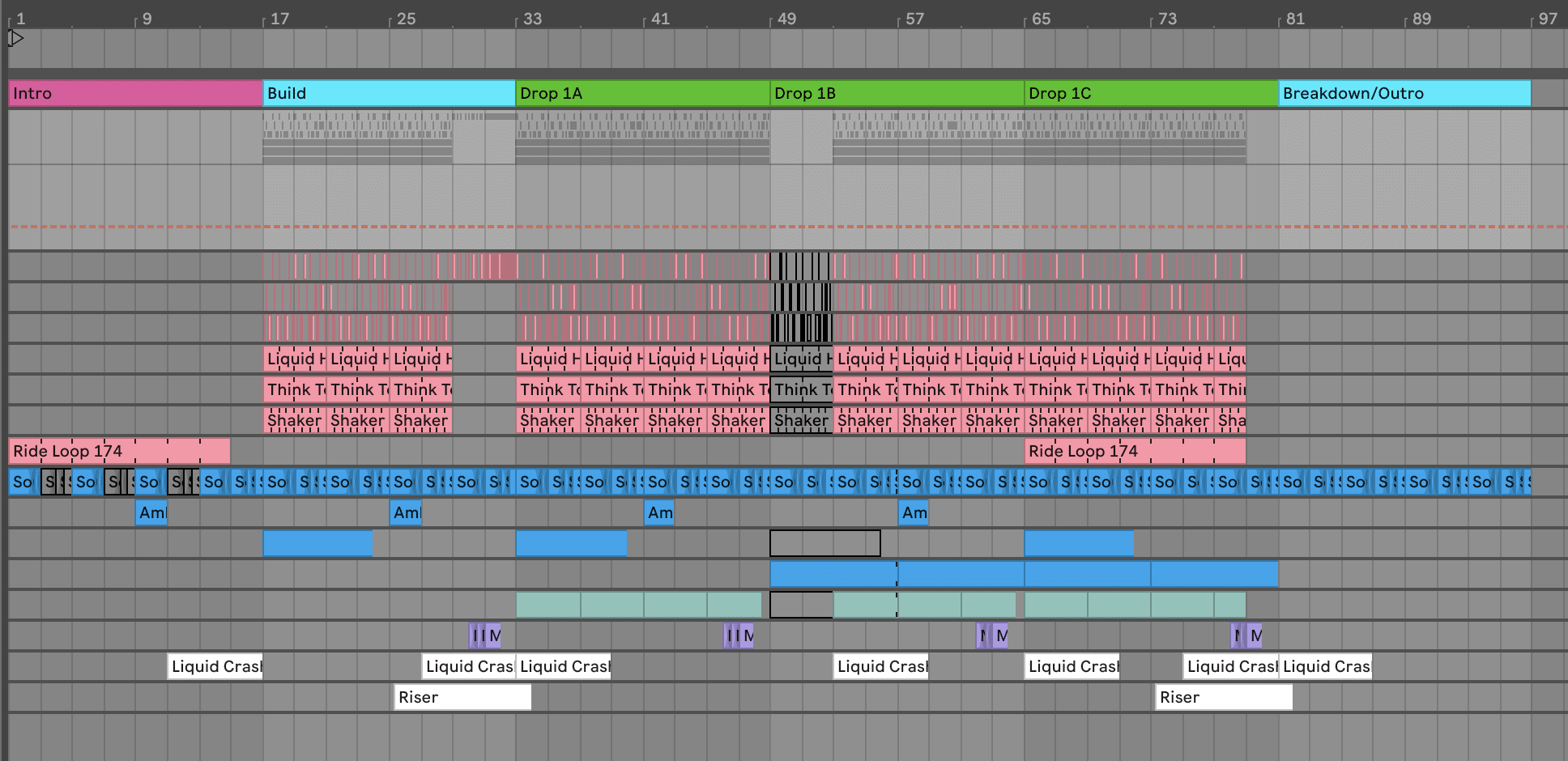
Read the section titled 'Structure'. Note the typical arrangement: Intro (often 32 bars) -> Breakdown/Build -> Drop -> Breakdown -> Second Drop -> Outro. This pattern is the foundation of most DJ mixes.
Here is another view of this structure, this time from within a music production project. This connects the abstract formula to the concrete layers of sound.
Key Takeaways
You've done great work today, moving from just hearing a genre to understanding its internal architecture.
- D&B tracks have a predictable structure: Intro, Drop, Breakdown, and Outro are the core building blocks.
- This structure is functional: It's designed to help DJs create smooth transitions by providing dedicated mixing sections (intros/outros) and clear energy shifts (drops/breakdowns).
- You can identify sections visually and aurally: The waveform's shape gives you immediate clues about energy levels, while listening for the addition or removal of key elements (especially drums and bass) confirms each section.
Next time
Now that you can identify liquid D&B and understand how tracks are structured, you're ready to start building your toolkit. The next lesson is a crucial practical step: Find and acquire high-quality digital music files from reputable sources. A DJ is nothing without their music collection, and we'll cover the best places to start building a library worthy of your goal to become the next Makoto.