Hello! Welcome back to your course on becoming a set pieces coach.
In our last lesson, we focused on preparing and presenting your tactical plans using clear language and compelling visual aids like diagrams and video. We covered how to get your ideas across to players in the meeting room. Today, we take the next logical step: coaching those ideas on the training pitch.
This lesson addresses the learning outcome: Provide concise, actionable feedback during live set piece drills. The goal is to learn how to correct mistakes and reinforce good habits in the heat of the moment, without overwhelming your players with information. Effective live feedback is what turns a good plan into a flawlessly executed routine.
1. The Difference Between Noise and Information
As a player, you've likely heard a lot of shouting from the touchline. While the intent is often good, the messages can be vague, emotional, or confusing. This is a common pitfall for coaches.
How to deliver effective verbal instructions during a game
Let's start by looking at examples of common, but ineffective, instructions. This post from coach Adam Clark on LinkedIn provides a great list of phrases you've probably heard before.
Read the main post by Adam Clark. Note his examples like 'We need to work hard' or 'Be more dynamic'. Then, read the first comment by Rick Fenoglio, which discusses the consequence of 'shouting too much'.
As Clark points out, statements like "Give us something special" or "Keep it simple" express a desire for what should happen, but they fail to explain how to do it. This isn't actionable information. Furthermore, as Rick Fenoglio's comment highlights, excessive shouting leads to players "tuning out" the coach entirely.
Your goal on the training pitch is not to be a narrator or a cheerleader, but a surgeon. Your interventions must be precise, timely, and focused on improving performance.
2. A Framework for Effective Feedback
To move from vague shouts to precise instructions, we can use a simple framework that categorises different types of feedback. This helps you become more intentional with your language.
The Practice Environment—How Coaches May Promote ...
This research paper on coaching behaviour provides a fantastic table that defines different types of instruction and feedback. It gives us a clear, evidence-based vocabulary to work with.
First, carefully study Table 2. Pay close attention to the definitions and examples for: Specific feedback—positive General feedback—positive Corrective feedback \nNext, read the section immediately following the table, titled 'Feedback'. It discusses which types of feedback are most effective for learning.
The key takeaway from this reading is the distinction between feedback that builds morale and feedback that builds skill.
- General Positive Feedback ("Well done," "Good effort"): This is useful for motivation but provides no technical information. It tells a player you're happy, but not why.
- Specific Positive Feedback ("Great timing on your run to block the defender!"): This reinforces a specific, correct action. The player now knows exactly what to repeat.
- Corrective Feedback ("You went a second too early. Next time, wait for the taker's signal."): This is the most critical tool for fixing errors. It identifies the problem and provides a clear solution for the next attempt. It is not negative; it is constructive.
While general encouragement has its place, your focus during a drill should be on specific positive and corrective feedback. This is the information that actually improves performance.
3. When and How to Deliver Feedback
Knowing what to say is half the battle. Knowing when and how to say it is the other half. Delivering the right message at the wrong time can be just as ineffective as delivering the wrong message.
The Practice Environment—How Coaches May Promote ...
Let's return to the research paper, which offers practical recommendations on how to deliver feedback without constantly stopping the session.
Read the section titled 'Practical Application/Future Direction'. Focus on the advice given to coaches about reducing inactivity, providing 'feedback on the run', and the 'less is more' approach.
Based on this, we can identify three primary methods for delivering live feedback:
-
Concurrent Feedback ("On the Run"): This is a short, verbal cue delivered while the drill is live.
- Best for: Minor individual adjustments or reminders that don't require a full stop.
- Examples: "Higher, John!" (to adjust the defensive line), "Check your shoulder!" (to a zonal marker), "Attack the ball!"
- Principle: Must be 1-3 words. It's a cue, not a conversation.
-
Stopping the Drill ("Freeze"): This involves blowing the whistle and having all players freeze in position.
- Best for: Correcting a systemic issue involving the shape, spacing, or timing of the whole group.
- Example: A corner routine fails because the attackers' movements are not synchronised. You freeze the play as the ball is delivered and point out the incorrect spacing and timing.
- Principle: Use it sparingly. It is a powerful tool but kills the flow of the session and can lead to too much player inactivity if overused.
-
The Pull-Aside: Quickly speaking to an individual or small group on the side while the rest of the players reset for the next repetition.
- Best for: Feedback that is too complex for a quick shout but doesn't warrant stopping the entire group.
- Example: A player is consistently mistiming their run. You can pull them aside and say, "Watch my hand, not the ball. When I drop it, you go. Let's try that next."
- Principle: Maximises efficiency by keeping the rest of the group active.
The guiding principle for all three methods is "less is more." Your job is to let the drill teach the players. Intervene only when necessary to guide learning, correct a recurring fault, or reinforce excellence.
4. Practical Application
Let's put this theory into practice. Below are two scenarios. For each one, think about what you would say and how you would say it.
Scenario 1: Attacking Corner
You are practicing the 'Stack' routine shown below. The goal is for the players in the stack to attack the 'Service Area' at speed. The player highlighted in red is meant to block the first defender to create space, but they are starting their run too early, before the corner taker gives the signal.

The block is ineffective, and the routine breaks down. What is your feedback?
Your Task:
Think about how you would address this. A good approach would be to use corrective feedback. For example:
- Using a "Freeze": Stop the play and say, "Freeze! [Player's Name], you've started your run before the signal. The defender read it easily. Everyone, remember the trigger for the movement is the taker's signal, not the run-up. Let's reset."
- Using a "Pull-Aside": While players reset, say to the individual, "[Player's Name], your job is crucial. You're moving on the run-up, not the signal. Watch the taker, not the ball. Wait for their hand to drop, then make your block. Got it?"
Scenario 2: Defending a Corner
Your team is using the defensive setup shown below. The player in the 'Marker' role is responsible for the opponent standing near the corner taker, but they must also be positioned to intercept a short pass into the box. For two repetitions in a row, the 'Marker' has followed their opponent too far wide, opening up a large passing lane into the corner of the box.
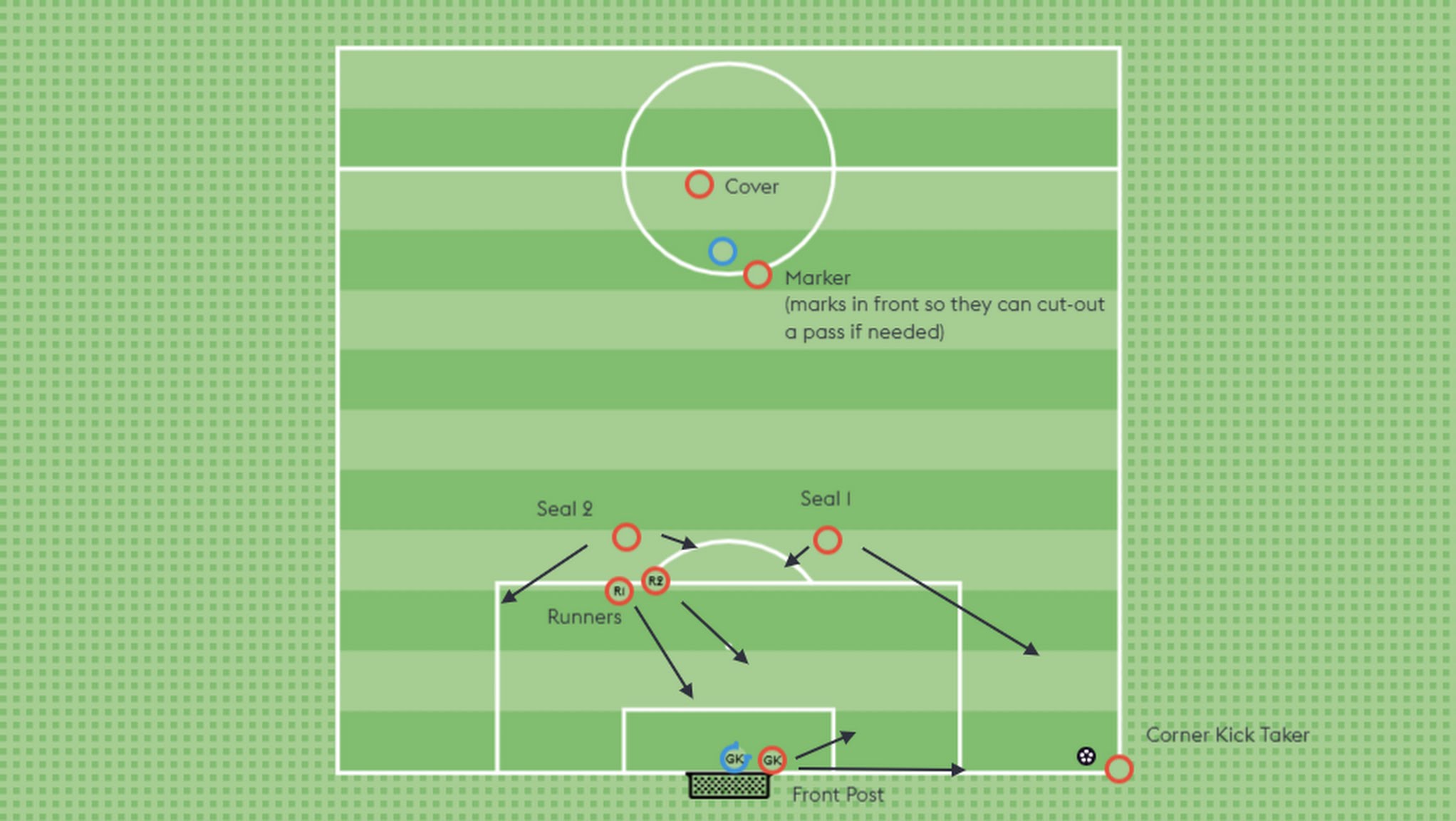
Your Task:
What concise, corrective feedback would you give to the 'Marker', and which method (on the run, freeze, or pull-aside) would you use?
- Model Answer: A pull-aside or concurrent feedback is likely best here, as it's an individual error.
- Concurrent ("On the Run"): Before the next corner, shout: "[Player's Name], goal-side! Don't get dragged wide!"
- Pull-Aside: "Hey, you're doing a good job staying with your player, but you're opening up the pass inside. Your priority is to protect that space first. Force them wide, away from the goal. Stay a few yards inside your player."
This type of specific, solution-oriented feedback empowers the player to make the right decision on the next attempt.
Conclusion
Effective live feedback is a skill that separates good coaches from great ones. It's about delivering the right piece of information to the right player at the right time. By moving away from generic, emotional shouts and embracing a structured, intentional approach, you turn every moment on the training pitch into a valuable learning opportunity.
Key Takeaways:
- Be Specific, Not Vague: Avoid generic phrases. Provide clear, actionable instructions.
- Prioritise Corrective Feedback: While praise is important, corrective feedback ("Next time, do X instead of Y") is the primary driver of improvement during a drill.
- Reinforce with Specific Praise: When a player executes a detail correctly, tell them. ("Excellent timing on that block!") This solidifies the learning.
- Choose Your Moment: Use a mix of concurrent feedback ("on the run"), drill stoppages ("freeze"), and individual "pull-asides" to deliver your message efficiently.
- Coach Less, Observe More: Resist the urge to talk constantly. Allow players to attempt the action, make mistakes, and self-correct. Intervene with purpose.
Preview of the Next Lesson:
We have now covered how to deliver feedback in the moment on the training ground. In our next lesson, we'll explore the post-training review process. You will learn how to use video and performance data to provide constructive feedback in post-training reviews, allowing for deeper analysis and player reflection away from the pitch.