Hello! Welcome to your next lesson.
In our last session, you learned how to use scouting intelligence to design specific defensive adjustments for free kicks, tailoring your team's structure and personnel to counter an opponent's key threats. You now know what to do to nullify their plan.
Today, we focus on making that plan a reality on the pitch. This lesson addresses the learning outcome: Define communication protocols for organising the defence during free kicks. We will establish the clear, concise, and consistent language and signals needed to get your players organised quickly and correctly, even in the most high-pressure moments of a match.
1. The Foundations of Effective Set-Piece Communication
In the chaotic moments after a free kick is awarded, speed and clarity are everything. A well-drilled communication protocol prevents confusion, stops players from arguing over responsibilities, and ensures your defensive adjustments are implemented before the whistle blows.
To build an effective protocol, all communication should adhere to four core principles.
PRESENTING YOUR COACHING POINTS
The 'Advanced Coaching Manual' provides an excellent summary of the principles for effective communication from a defensive leader, like a goalkeeper.
Please read the section titled 'COMMUNICATION'. Focus on the sub-sections 'Why do goalkeepers have to take this responsibility?' and 'How to Communicate'.
As the resource outlines, your communication must be:
- Loud & Clear: The instructions must be audible and unmistakable.
- Calm: An authoritative, calm voice inspires confidence; a panicked one spreads chaos.
- Concise: Use short, pre-agreed words or phrases. Full sentences are too slow and get lost in the noise.
- Timely: Information must be given early enough for players to react.
The goalkeeper is often the primary communicator because they can see the entire field. However, they can't be the only one responsible. A professional setup designates leaders (usually the goalkeeper and a central defender) who have the authority to organise the team. Your protocol must establish who says what, and when.
2. The Communication Toolkit: Verbal and Non-Verbal Commands
To achieve the speed required, you need a pre-defined vocabulary and set of signals that every player understands instinctively.
Non-Verbal Communication: The Goalkeeper's Role
A common mistake is for players in the wall to turn and look at the goalkeeper for instructions. This takes their eyes off the ball and can lead to a quick free-kick being taken, catching them unprepared. The solution is for the goalkeeper to use clear, simple hand signals.
SoccerCoachTV - Organizing Your Defensive Wall.
The 'Organizing Your Defensive Wall' video by SoccerCoachTV demonstrates this vital concept perfectly.
Watch the segment from 03:32 to 04:17. Observe how the coach explains that the goalkeeper should use hand signals to direct the wall, preventing players from turning their backs to the ball.
As the video shows, a simple hand gesture to move the wall left or right, or a "hold" signal, is far more effective and safer than shouting.
Building a Verbal Command Library
While the keeper directs the wall non-verbally, verbal commands are essential for organising the rest of the defence. These calls must be short, specific, and consistent.
Goalkeeper Communication - Keeperstop
The article 'Goalkeeper Communication' from Keeperstop provides a great list of common, effective commands that can form the basis of your team's vocabulary.
Read the section starting with 'My philosophy is work smarter not harder' and focus on the list under 'Common Commands'. Pay attention to how one- or two-word phrases convey specific instructions.
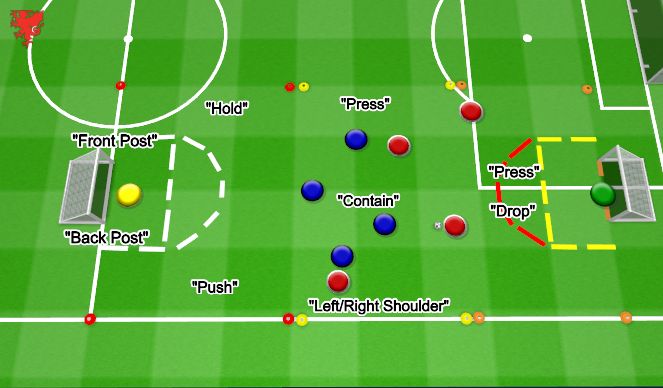
Based on these principles, here is a foundational set of communication protocols for different phases of defending a free kick:
| Phase | Command | Who Says It | Meaning / Action |
|---|---|---|---|
| Initial Setup | "Wall!" or "Three-man wall!" | Goalkeeper / Leader | Initiates the formation of the wall with the specified number of players. |
| Wall Position | (Hand signals) | Goalkeeper | Adjusts the wall's position left or right without players turning around. |
| Line Position | "Hold!" / "Drop!" | Goalkeeper / Leader | Tells the defensive line to hold their position or drop deeper towards their own goal. |
| Player Marking | "[Player Name], track [#]!" | Goalkeeper / Leader | Assigns a specific man-marking responsibility to a teammate. |
| Short Option | "Press!" or "Threaten!" | Goalkeeper / Leader | Signals the designated player (the 'threatening player') to close down a short pass option. |
| Clearance | "Step up!" or "Out!" | Goalkeeper / Leader | Commands the entire defensive line to push up together after the ball is cleared to catch attackers offside. |
This vocabulary forms the core of your on-field communication system.
3. Pre-Game Preparation: The Most Important Communication
The key to seamless in-game organisation is to decide almost everything before the match. This eliminates confusion and saves critical seconds.
Watch the following video to see how a coach establishes these non-negotiable roles in training.
SoccerCoachTV - Organizing Your Defensive Wall.
This video from SoccerCoachTV is excellent for showing how to pre-assign roles and practice rapid organisation.
Watch the video, focusing on these key moments: 00:22 - 00:55: The coach stresses the need to pre-determine who is in the wall (player #1, #2, etc.) to ensure organisation in under 5 seconds. 04:17 - 04:46: He introduces the role of the 'threatening player'—a specific job to counter short options. 06:29 - 06:41: The coach reinforces that these roles must be known before the game even kicks off.
Your pre-game communication protocol should define:
- Wall Order: A ranked list of players for the wall (e.g., #1 is always the shortest winger, #4 is the bravest midfielder, etc.). If you need a 3-man wall, players 1, 2, and 3 go automatically. No discussion needed.
- Wall Size by Location: A rule based on the free kick's position. For example:
- Wide areas: 1 or 2-player wall.
- Edge of the box (angle): 3-player wall.
- Central, 20-25 yards out: 4 or 5-player wall.
- The "Threatening Player": Who is responsible for pressing short free-kick options? This is a specific role, often given to an energetic forward or midfielder.
- Marking Priorities: If you are using man-marking, who is responsible for the opponent's primary aerial threat? This matchup should be decided based on your scouting from the previous lesson.
When these roles are clearly defined and practiced, your in-game commands become simple triggers for pre-learned actions, rather than complex new instructions.
4. Training the Protocol
Defining the protocol is the first step; drilling it until it's automatic is the goal. A simple but highly effective drill is to simulate the time pressure of a real game.
This video demonstrates a high-tempo drill designed specifically to practice quick wall organisation and communication.
Watch the drill from 04:12 to 06:54. Notice how the coach gives the players a 5-second countdown to get organised, forcing them to communicate quickly and rely on their pre-agreed system.
To implement this in your own sessions:
- Have your players jog around the penalty area.
- Suddenly, place a ball down at a specific spot.
- Shout "FREE KICK!" and start a 5-second countdown.
- Your players must react instantly, with the designated leaders using the communication protocol to organise the correct number of players in the wall, assign marking duties, and position the threatening player.
Repeating this drill from different locations builds the speed and mental recognition needed for match day.
Conclusion
You now have a complete framework for establishing and coaching defensive communication for free kicks. The goal is to move from a state of chaotic reaction to one of disciplined, automatic organisation.
Key Takeaways:
- Communication must be Planned: The most effective communication happens before the game, by pre-assigning roles for the wall and other key duties.
- Establish a Clear Vocabulary: Use a simple, consistent set of verbal and non-verbal commands that every player understands. Your calls should be Loud, Calm, Concise, and Timely.
- Define Leadership Roles: The goalkeeper and a designated outfield player must have the authority and responsibility to organise the defence.
- Practice Under Pressure: Use timed drills to force players to communicate quickly and efficiently, making the protocol second nature.
Preview of the Next Module:
This lesson concludes our deep dive into free-kick strategy. In the next module, "Tactical Throw-ins & Transitions," we will turn our attention to the most frequent but often most neglected set piece. You'll learn how to use throw-ins not just to retain possession, but as a strategic tool to build attacks across all three thirds of the pitch.