Hello! Welcome back to the training centre.
In our last lesson, you did the exciting work of designing attacking set-piece routines to exploit an opponent's weaknesses. That's one half of a complete game plan. Now, we turn our attention to the other, equally critical, half: defence.
This lesson will equip you to achieve the learning outcome: Formulate a defensive game plan to counter an opponent's primary set piece threats. We will build directly on the scouting and analysis skills you've developed. You will learn how to translate your knowledge of an opponent's set-piece strategy into a robust defensive structure, assigning specific roles and planning for their most dangerous plays.
1. From Analysis to Action: Building Your Defensive Framework
A defensive game plan isn't created in a vacuum. It's a direct response to the intelligence you gathered in your opposition scouting report. Your analysis of their routines, key players, and delivery types must inform every decision you make.
To begin, let's look at the key questions your defensive plan must answer. This article provides a concise checklist that serves as an excellent framework for moving from scouting to planning.
How To Effectively Scout Your Opposition - Scout Reports
The article 'How To Effectively Scout Your Opposition' contains a fantastic section that bridges the gap between analysis and defensive planning.
Please read the subsection titled 'Defensive Set Pieces'. This list of questions (e.g., 'Does the opponent use zonal, semi-zonal or man-oriented marking?', 'do they place players on the posts?', 'Is the goalkeeper aggressive?') is precisely what your defensive game plan needs to address based on what you know about your next opponent.
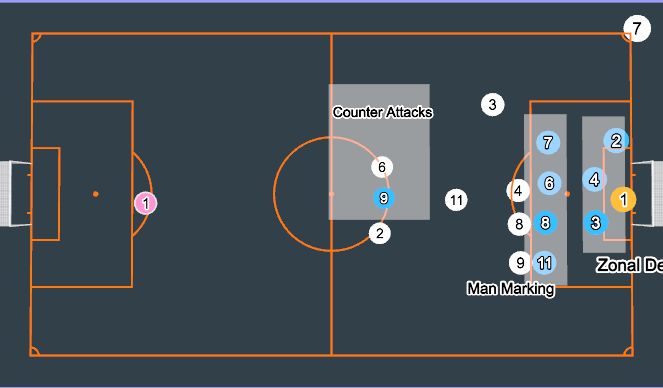
Answering these questions requires you to choose a defensive system. The three primary systems are:
- Man-Marking: Each defender is assigned a specific attacker to mark.
- Zonal-Marking: Each defender is responsible for a specific area of the pitch.
- Hybrid-Marking: A combination of the two, where some players mark zones and others mark key attackers.
The choice is not about which system is "best" in general, but which is best for countering the specific threats you've identified. This short video offers a great summary of the strengths and weaknesses of each system.
How to DEFEND Corner Kicks - Zonal, Man or Hybrid Marking? | Football Tactics Explained
Let's get a quick, high-level overview of the three core defensive systems from The Tactics Guy.
Watch the entire video. It's short and provides a clear summary of the pros and cons of man, zonal, and hybrid marking. This will help you decide which system to employ based on your scouting.
For example, if your scouting reveals the opponent relies heavily on one dominant aerial player, a hybrid system where you man-mark that specific player while defending zonally with the rest of the team could be an effective counter.
2. Deep Dive: Organising a Zonal Defence
While man-marking is conceptually simple (though difficult in practice), zonal and hybrid systems require a much more detailed level of organisation. Every player must understand not just their own role, but how it fits into the collective structure.
The following video from England Football Learning provides an exceptional level of detail on how to structure a zonal defence for corners. We will break it down into key components.
Defending Set Plays | FA Learning Course Resource
Let's explore the detailed organisation of a zonal system with expert coaches from the FA. This is the level of detail required at the professional level.
Please watch the following segments. Focus on the specific roles, responsibilities, and player attributes discussed for each position. The Foundation (11:38 - 15:58): Understand the roles of the goalkeeper, the players on each post, and the first zonal player in the near-post space. The 'First Bank' (15:58 - 24:30): This is crucial. Pay attention to how the three central defenders are profiled. The player in the middle (the 'five') needs a great standing jump, while the player at the far post (the 'six') needs to be comfortable attacking a ball with more flight time and dealing with contact. The 'Second Bank' (24:30 - 28:30): Learn about the role of the midfielders as 'blockers'. Their job is not necessarily to win the header, but to legally impede and divert the runs of the most dangerous attackers. Edge of the Box Player (36:08 - 37:48): This often-overlooked player has multiple jobs: stopping a driven pass, cleaning up clearances, pressing a short corner, and starting a counter-attack.
As a coach, your job is not just to draw these positions on a whiteboard. It's to select the right player for each job based on your team's personnel. Your best aerial duelist might not be the best 'blocker', who needs to be disciplined and positionally aware. This is where your deep knowledge of your own squad becomes vital.
3. Planning for Contingencies
A static defensive plan is a fragile one. Elite opponents will have multiple routines and will try to exploit your setup. Your game plan must include clear instructions for the most common "what-if" scenarios.
Based on your scouting report, you should anticipate their variations. Do they overload one area? Do they like to play short corners?
Let's return to the FA video to see how to plan for these situations.
Defending Set Plays | FA Learning Course Resource
The same coaches will now walk us through how to adapt the zonal structure to two common attacking variations.
Watch the segment from 48:50 to 55:04. This covers two critical 'what-if' scenarios: Opponent Overloads the Far Post (49:33 - 52:45): Note the simple verbal cue ('Load far!') and the collective adjustment. The entire defensive block shifts back and out to counter the threat, with the near-post player tucking in to cover the space. Opponent Plays a Short Corner (53:15 - 55:04): Observe the discussion about who goes to press the ball. The key principle is to avoid disrupting the core defensive unit in the six-yard box. Sending the player from the edge of the box (the 'seven') and a player from the second bank (the 'eight') is a common solution.
Your defensive game plan should document these adjustments. The players need to know that "IF they play short, THEN Player A and Player B go to press, and everyone else shuffles across." This removes hesitation in the heat of the moment.

Conclusion
You have now completed the core tactical work for a match week. By combining your analysis of the opposition with a clear defensive philosophy, you can construct a resilient plan that not only anticipates the opponent's primary threats but also has contingencies for their variations.
Key Takeaways:
- A Defensive Plan is a Counter-Plan: It must be formulated in direct response to the threats identified during opposition analysis.
- System Selection is Strategic: Choose between man-marking, zonal, or a hybrid system based on the opponent's style and your players' abilities.
- Roles Must Be Detailed: A defensive structure is only as strong as the players' understanding of their specific roles. This includes positional details, movement triggers, and the physical/mental attributes required for each job.
- Anticipate and Rehearse: Your plan must include pre-agreed solutions for common attacking variations like short corners and overloads.
Preview of the Next Lesson:
You've formulated the attacking and defensive strategies. The next step is to consolidate this information for others. In the next lesson, "Create a concise set piece game plan document for the coaching staff," you will learn how to synthesise your work into a professional, easy-to-understand format for the head coach and other staff members.