Hello and welcome back.
In our last lesson, we focused on the crucial skill of building player buy-in and confidence, establishing that this is founded on credible, evidence-based plans. Today, we turn our attention to creating that evidence base. We are now entering the first phase of a professional match week cycle: opposition analysis.
This lesson is designed to help you achieve the learning outcome: Synthesise video and data to create a scouting report on an opponent's set piece tendencies. You will learn how to structure your analysis, what to look for in both attack and defence, and how to combine quantitative data with qualitative video evidence to build a comprehensive picture of your next opponent. This report will be the foundation for everything that follows in the game-planning process.
1. The Framework of a Set Piece Scouting Report
Before you can analyse an opponent, you need a system. A good scouting report isn't just a collection of random observations; it's a structured document that organises information logically so that you can draw clear conclusions. The most fundamental way to structure this is by splitting the analysis into two main phases: Offensive Set Pieces (what the opponent does when they have a set piece) and Defensive Set Pieces (how they set up when you have one).
A fantastic resource that outlines this professional workflow is an article by Manuel Núñez, a former analyst at Real Betis. Let's start by familiarising ourselves with the key questions you should be asking in each phase.
How to Create a Report on Opponents Set-Pieces
The article 'How to Create a Report on Opponents Set-Pieces' from Nacsport provides a comprehensive checklist for your analysis. It breaks down what to look for in both attacking and defensive situations.
Please read two key sections of the article: The Opponent in Attack: Start under the heading 'Offensive Set-Pieces' and read through the subsections on 'Corners' and 'Free-Kicks'. An Opponent's Defense: Start under the heading 'Defensive Set-Pieces' and read through the subsections on 'Corners' and 'Free-Kicks'. \nAs you read, focus on building a mental checklist of the key variables for both attack and defence (e.g., delivery type, key players, marking system, number of players in the box).
This framework gives you a clear structure. For any given opponent, you now have a template to follow:
- Offensive Analysis:
- Corners (inswing/outswing, short/long, target zones, key movements)
- Free Kicks (direct/indirect, wide/central, key movements)
- Defensive Analysis:
- Corners (marking system, players left forward, vulnerabilities)
- Free Kicks (wall setup, defensive line height, marking system)
Now, let's explore how to populate this framework using data and video.
2. Synthesising Data and Video
Modern analysis doesn't rely on video alone. The process typically starts with data to get a high-level overview, which then guides a more focused video analysis to uncover the tactical details.
Starting with Data
Data can quickly tell you if an opponent is unusually strong or weak in set-piece situations, helping you prioritise your analysis.
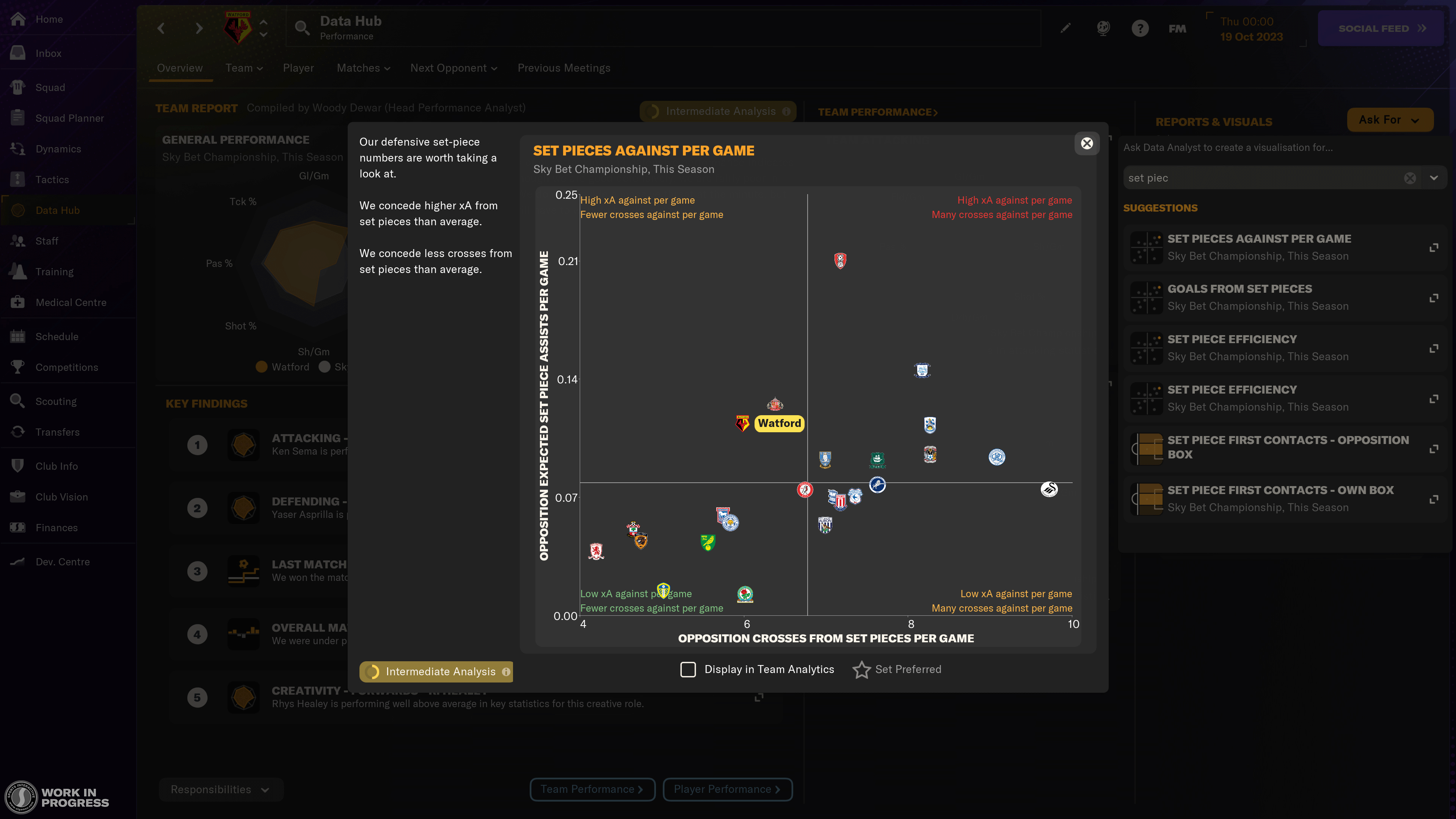
Look at the highlighted team, Watford. The key findings note they concede a higher than average Expected Assists (xA) from set pieces, but face fewer crosses than average. What could this tell you? One hypothesis might be: "Watford are generally good at preventing opponents from delivering set-piece crosses, but when a cross does get into the box, they are particularly vulnerable."
This data-driven hypothesis gives your video analysis a clear purpose: to find out why they are so vulnerable when a cross is delivered.
Deep Dive with Video: Identifying Tendencies
With your hypothesis in hand, you turn to video to find the specific, repeatable patterns—the tendencies—that explain the data. Let's look at an example of what to search for when analysing an opponent's attacking corners.
Arsenal's CORNER TACTICS Explained | Tactical Analysis
This analysis of Arsenal's corner tactics is an excellent demonstration of identifying sophisticated attacking patterns. Imagine you are scouting Arsenal for an upcoming match.
Watch from 00:38 to 02:21. As you watch, identify the specific, repeatable actions Arsenal use. Look for: Pinning the first defender (00:38 - 00:54): How do they prevent the first defender from clearing the ball? The 'Shield' and Goalkeeper Disruption (00:54 - 01:43): How do they use blockers to create a protected zone? How do they stop the goalkeeper from claiming the cross? The Trap (01:50 - 02:21): How do they manipulate the defence by repeatedly attacking one zone before switching to another?
From that short analysis, your scouting notes on Arsenal's attacking corners might include:
- Tendency 1: Use a player to physically pin the near-post zonal defender.
- Tendency 2: Create a 'shield' of blockers around the penalty spot to protect the target area.
- Tendency 3: A designated player is tasked with blocking/disrupting the goalkeeper.
- Tendency 4: Will often deliver to the front zone multiple times to draw defenders forward, before suddenly targeting an overloaded back zone.
This is the essence of synthesising video. You're not just watching the game; you're deconstructing it into its core, repeatable components. The same process applies to all set pieces. For instance, an analysis of Cheltenham Town's throw-ins, as detailed in the video "Long Throws Explained", would reveal key tendencies like crowding the goalkeeper, aiming for near-post flick-ons, and positioning players to win the second ball.
When analysing an opponent's defensive tendencies, you are looking for the inverse. Are they using a zonal, man-marking, or hybrid system? Where do they leave space? Who is their weakest individual defender in the air? The Nacsport article you read earlier provides the perfect checklist for this.

3. A Practical Method for Observation and Note-Taking
Identifying all these details, especially during a live match, can be overwhelming. Developing a systematic way to watch and record information is crucial for efficiency and accuracy.
The following article offers a practical method called "deliberate practice" to improve your observational skills.
How to analyze set piece details on “one look”
The blog post 'How to analyze set piece details on “one look”' from Opposition Scouting provides an excellent drill for training your eye, as well as tips for efficient note-taking.
Read from the heading 'Set piece practice drill' to the end of the section 'Use a checklist to fill in the gaps'. Focus on these practical takeaways: The step-by-step process for the practice drill. The 'super-efficient note-taking' shorthand (e.g., '2-4-1'). The idea of using a checklist after the event to fill in details you may have missed.
This methodical approach is key. You can create your own shorthand and checklist based on the Nacsport article. For example, when scouting a defensive corner, your quick notes might look like this:
- Setup:
1-4-3-1(1 at post, 4 zonal across 6-yard box, 3 man-markers, 1 at edge of box) - Marking: Hybrid
- Counter: 1 player left upfield (striker)
- Vulnerability: Zonal players are very ball-focused; space is created behind them as they step forward.
This turns a chaotic moment into structured, actionable data for your report.
Conclusion
Creating a professional scouting report is a systematic process of synthesising information. You move from a high-level data overview to detailed video analysis, all within a structured framework, to identify an opponent's habits and vulnerabilities.
Key Takeaways:
- Structure is Key: Organise your report into Offensive and Defensive phases for corners, free kicks, and throw-ins.
- Synthesise Data and Video: Use data to form a hypothesis (the "what") and video to uncover the tactical reasons (the "how" and "why").
- Identify Tendencies: Your goal is to find repeatable patterns of movement, delivery, and defensive organisation.
- Be Methodical: Develop a systematic approach to observation and note-taking using drills, shorthand, and checklists to ensure you capture the crucial details efficiently.
Preview of the Next Lesson:
This report is not an academic exercise; it's a tool for winning matches. Now that you know how to identify an opponent's tendencies, the next logical step is to formulate a plan to exploit them. In our next lesson, we will focus on how to design specific attacking routines to exploit an opponent's defensive vulnerabilities, using the intelligence you've gathered in your scouting report.