Hello! Welcome back to your advanced study of Gian Lorenzo Bernini.
Introduction
In our last lesson, we explored how Bernini transformed the crossing of St. Peter's into a unified theological stage with the four pier saints. We saw him orchestrate a "psycholiturgical drama" where architecture and sculpture conspire to create a powerful emotional experience for the viewer. This orchestration of different art forms into a single, overwhelming whole is the essence of Bernini's mature style.
Today, we journey to the very end of the basilica's nave, to the apse, where Bernini created his final, spectacular contribution to St. Peter's: the Cathedra Petri, or the Throne of St. Peter. This work is arguably the most complete embodiment of his concept of the 'bel composto' (the beautiful whole), where sculpture, architecture, painting, and even light itself are fused into one breathtaking vision.
Today's Learning Outcome: By the end of this lesson, you will be able to deconstruct the composition of the Cathedra Petri, analyzing how Bernini uses bronze, stucco, and light to create a vision of divine authority.
Time to complete: Approximately 50 minutes.
1. The Throne as a Statement of Authority
Before we deconstruct the work, we must understand its purpose. The Cathedra Petri is not merely a decorative altarpiece. It is a monumental reliquary, designed under Pope Alexander VII to house one of the most sacred relics in Christendom: a simple wooden chair believed to have been used by St. Peter himself.
In the context of the Counter-Reformation, where Protestantism challenged the authority of the Pope, asserting the legitimacy of the papal lineage tracing back to Peter was of paramount importance. The Cathedra Petri is a powerful, unmissable declaration of that authority.
To grasp the full conceptual weight of this project, please begin by reading from Irving Lavin's essential text.
Bernini at St Peter's by Irving Lavin
- Read: The sections titled "Cathedra Petri: Concept and Symbolism" and "Iconography and Reliefs of the Cathedra Petri."
- Focus on: The threefold significance of the "cathedra" (regal, priestly, teacher) and how the entire project was conceived to celebrate the divinely ordained authority of the Church, vested in the successor of Peter.
- Reading time: ~8 minutes.
As Lavin explains, the feast of the Chair of St. Peter celebrates his role as Prince of the Apostles, arbiter of faith, and foundation of the Church. Bernini translates these abstract theological claims into a tangible, spectacular reality. He takes the historical ritual of carrying the Pope's throne (sedia gestatoria) and transforms it into a permanent, divine event.
2. Deconstructing the 'Installation Extravaganza'
The power of the Cathedra Petri lies in its masterful fusion of different materials to create what feels less like a sculpture and more like a divine miracle unfolding before your eyes. The Smarthistory video below offers an excellent introduction to this multi-media approach.
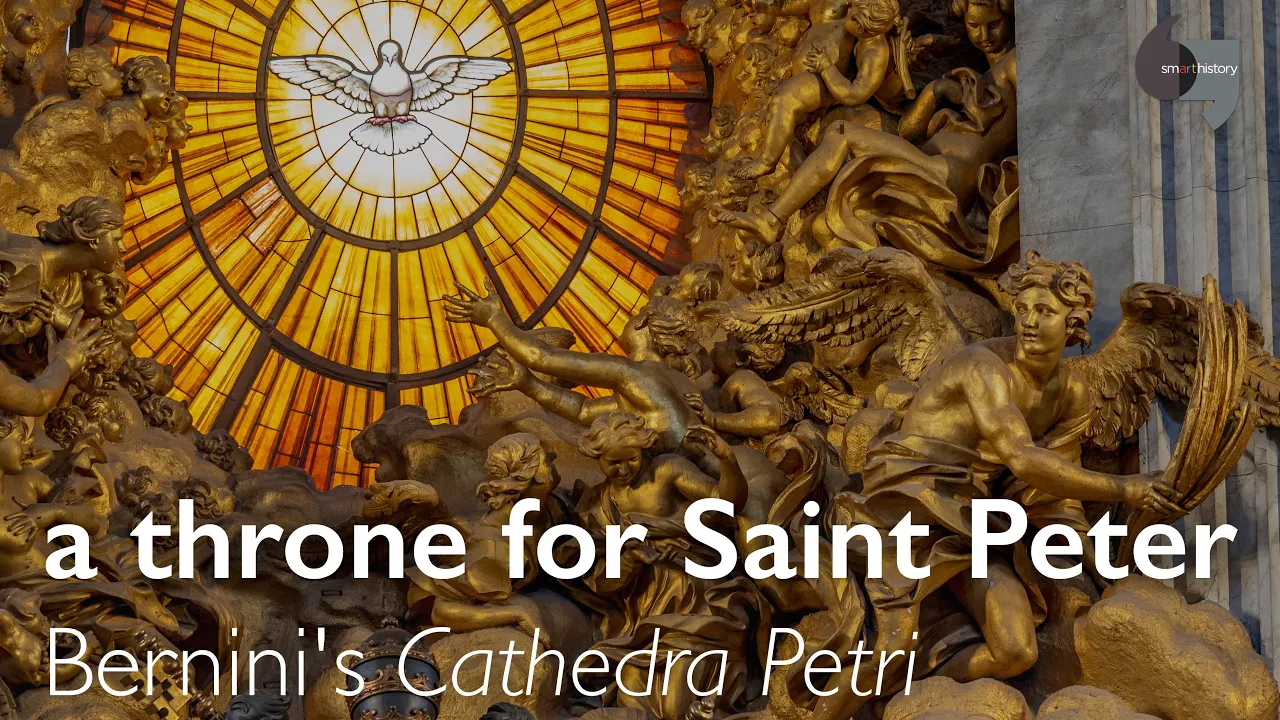
- Watch: From the beginning to 03:01.
- Focus on: The narrator's description of the work as an "installation extravaganza" and the explanation of how Bernini blends gilded bronze, stucco, and glass to make it seem as if "the fabric of the church itself... has dissolved under the power of spirituality."
This video gives you a feel for the overwhelming visual effect. Now, let's deconstruct the composition, analyzing how Bernini uses each material to build his vision of divine authority.
 Bernini's Cathedra Petri (1657-66). Note the distinct yet fused zones: the dark bronze of the figures and throne at the bottom, the golden explosion of stucco above, and the central window of light.
3. The Compositional Elements: A Symphony of Materials
Building on the visual introduction, we can now turn to a more detailed analysis. Irving Lavin deconstructs the work into four interconnected elements. We will use his framework to analyze Bernini's use of materials.
Bernini at St Peter's by Irving Lavin
- Read: The section titled "Compositional Elements and Use of Light."
- Focus on: The description of the four parts (altar, chair-altarpiece, platform with Doctors, and the stucco glory with the window). Pay close attention to the idea of a progression from the divine will to its earthly manifestation.
- Reading time: ~5 minutes.
Lavin’s analysis provides the key to understanding the work's genius. Let's examine these parts through the lens of their materials.
Part 1: The Bronze Core (Earthly Authority & Doctrine)
At the base of the composition, we have the elements representing the earthly and historical foundation of the Church, all rendered in dark, heavy, gilded bronze.
- The Reliquary Throne: The bronze casing encloses the ancient wooden relic. As the resource St Peter's - Cathedra Petri notes, its bas-reliefs depict key biblical moments conferring authority: Christ Giving the Keys to Peter, Feed my Sheep, and the Washing of the Feet. The throne is the physical symbol of the divine mandate.
- The Doctors of the Church: Four colossal bronze figures surround the throne. They are not merely supporting it; they seem to guide it, energized by a higher power. By including two Doctors from the Latin (Western) Church (Ambrose and Augustine) and two from the Greek (Eastern) Church (Athanasius and John Chrysostom), Bernini creates a powerful symbol of the universal, unified doctrine that upholds the Petrine succession. They represent the weight of theological history.
Part 2: The Stucco Explosion (Heavenly Glory)
Exploding into the apse from above is a whirlwind of golden stucco. Stucco, being much lighter and more plastic than bronze, allows Bernini to create a sense of dynamic, weightless energy that is ethereal and supernatural.
- The Gloria: Billowing clouds and a multitude of angels and cherubs cascade down, physically linking the heavenly vision to the earthly throne below. This isn't a serene, ordered heaven; it's an energetic, explosive eruption of divine glory into the physical space of the church. The writhing ribbons that seem to connect the throne to this glory transmit this divine energy to the Doctors.
Part 3: The Light Divine (The Incorporeal Source)
This is the brilliant, unifying element. Bernini treats light itself as a sculptural material, the source from which the entire vision emanates.
- The Alabaster Window: At the heart of the stucco explosion is an oval window of yellow-toned glass. At its center is the Dove of the Holy Spirit. This is not just a window; it is the visual manifestation of God's grace and divine will. As Lavin argues, this is the origin point of the entire event.
4. Synthesis: A Vision of Divine Authority
The true genius of the Cathedra Petri is how these distinct material zones—bronze, stucco, and light—are seamlessly fused into a single, coherent narrative. Bernini creates what Lavin calls an "imperceptible progression from two-dimensional, translucent polychromy, representing the pure spirit, through progressively... three-dimensional orders of reality, to reach, ultimately, our own."
Your philosophical background will appreciate this profoundly. The composition is a metaphysical argument made visible:
- The Source: The pure, incorporeal light of the Holy Spirit enters the church through the window.
- The Manifestation: This divine energy explodes into a semi-physical form in the golden stucco clouds and angels of the Gloria.
- The Transmission: This power is transmitted to the heavy bronze throne, the symbol of the Papacy, which is upheld and guided by the foundational doctrines of the Church embodied by the four Doctors.
The viewer, standing on the floor of the basilica, looks up and witnesses this entire flow of authority, from God directly to the office of the Pope. The stone of the apse seems to dissolve, the laws of physics are suspended, and a miracle is made permanent. This is the ultimate expression of the bel composto—a total work of art that completely envelops the viewer in its theological and emotional power.
Conclusion
Today, we have deconstructed Bernini's Cathedra Petri, seeing it not as a single sculpture but as a masterful composition that strategically uses different materials to tell a story. You can now analyze how bronze, stucco, and light are employed to create a seamless and overwhelming vision of divine authority flowing from heaven to earth.
Key Takeaways:
- The Cathedra Petri is a monumental reliquary designed as a powerful statement of papal authority during the Counter-Reformation.
- Its composition is a 'bel composto' that fuses bronze, stucco, and light into a unified whole.
- Bronze is used for the earthly elements: the throne (symbol of the office) and the Doctors (symbol of doctrine).
- Stucco is used for the celestial elements: the explosive, dynamic Gloria of angels and clouds.
- Light from the central window, with the Dove of the Holy Spirit, is treated as an active, incorporeal material representing the divine source of all authority.
- Together, these elements create a visual narrative of a metaphysical progression, from the pure spirit of God down to the institutional Church, validating its power.
Preview of the Next Lesson:
Creating a work as complex as the Cathedra Petri—involving massive bronze casting, intricate stucco work, and architectural modification—was a colossal undertaking. It required more than a single artistic genius; it required a highly efficient, large-scale production facility. In our next lesson, we will examine the organization and management of Bernini's large workshop and its crucial role in the execution of major commissions like those in St. Peter's, looking at the practical reality behind the artistic vision.