Hello! Welcome to the eighth module of our course, where we shift our focus from building agents to making them Production-Ready.
In our last lesson, we explored how to manage state and facilitate communication in multi-agent systems using LangGraph. We saw how patterns like a shared scratchpad versus supervised delegation affect the flow of information. Those architectural choices have a direct and significant impact on the topics we'll cover in this module.
Today, we take the first and most crucial step toward production deployment: understanding the landscape of challenges. Moving an agent from a Jupyter notebook to a live, reliable application is a massive leap. This lesson is designed to equip you with the foresight to anticipate these hurdles. Specifically, you will learn to identify the key challenges in deploying agents to production, focusing on reliability, cost, and latency.
1. The Production Triad: Reliability, Cost, and Latency
As a software engineer, you're familiar with the standard requirements for production systems: they must be reliable, scalable, and secure. For AI agents, these requirements manifest in a unique triad of interconnected challenges: Reliability, Cost, and Latency.
Let's start with a concise overview from Google Cloud that frames these core requirements for any agent runtime environment.
Building AI agents on Google Cloud
The video 'Building AI agents on Google Cloud' provides a succinct summary of what's expected from a production-grade agent system. This will establish our three main themes for this lesson.
Watch the section from 02:47 to 03:52. Pay attention to the four key needs of an agent runtime: scalability, cost-effectiveness, latency, and reliability.
As the video highlighted, any production agent system must address:
- Reliability: How consistently does the agent achieve its goal without errors or nonsensical outputs? Unlike traditional deterministic software, LLM-based agents are probabilistic. A prompt that works nine times might fail on the tenth for no obvious reason. This is often the single biggest barrier to production deployment.
- Cost: Each step an agent takes involves an LLM call, which costs money based on token usage. An inefficient agent that gets stuck in a loop or takes too many steps can quickly become prohibitively expensive. This also includes the compute cost for hosting the agent and any costs associated with the tools it uses.
- Latency: How long does the user have to wait for an answer? An agent that performs a multi-step reasoning process with several tool calls can take seconds or even minutes to respond, which is unacceptable for many real-time applications.
These three challenges are deeply intertwined. For example, an unreliable agent that gets stuck in a loop will drive up both cost and latency. Let's dive deeper into the root causes of these problems.
2. A Taxonomy of Production Woes
To understand how to solve these problems, we first need to dissect them. We'll use a practical guide that breaks down the common failure modes seen in the industry.
This video outlines five of the most common problems developers face when trying to productionize agents. As you watch, think about how each problem contributes to failures in reliability, cost, or latency.
5 Problems Getting LLM Agents into Production
In '5 Problems Getting LLM Agents into Production,' Sam Witteveen provides a field-level view of what goes wrong with agents. This will form the backbone of our discussion.
Watch the video from 00:54 to 09:18. This covers the core problems: reliability, long loops, tool issues, and lack of self-checking. We'll discuss the fifth problem, explainability, in our next lesson.
Now, let's unpack these challenges, supplementing them with insights from a detailed article on the topic.
Challenge 1: The Reliability Gap
As the video stressed, reliability is the number one issue. A success rate of 60-70% is common for complex agent prototypes but is far below the "four nines" (99.99%) of availability expected of many production software services. This unreliability stems directly from the probabilistic nature of LLMs.
To explore this further, let's read about what makes agents so unpredictable.
LLM Agents in Production: Architectures, Challenges, and ...
The article 'LLM Agents in Production' from the ZenML blog provides a fantastic, in-depth look at this challenge, framing it as 'prompt brittleness' and unpredictability.
Read just the section titled 'Reliability' (the first bullet point under Part III). Focus on the concept of 'prompt brittleness' and how small input changes can lead to large output changes.
This "prompt brittleness" means that extensive testing, which you're used to in traditional software development, becomes both more critical and more difficult. You can't just write a few unit tests for expected inputs; you need to test against a wide range of phrasings and edge cases to build confidence in the agent's robustness.
Challenge 2: The Runaway Agent (Cost & Latency)
The video highlighted agents getting stuck in "excessively long loops." This is a classic failure mode where the agent repeatedly attempts the same step or cycles between a few steps without making progress. This happens for several reasons:
- The tool fails, and the agent decides to simply try again.
- The LLM isn't satisfied with the output from a tool or another agent and decides to re-run the previous step.
- The overall goal is ambiguous, leading the agent to wander aimlessly.
This directly connects to our previous lesson. An improperly designed StateGraph with a vague conditional edge can easily create a scenario where an agent loops indefinitely. Each loop incurs another LLM call, driving up cost, and each cycle adds to the total execution time, increasing latency.
Now, let's read about the broader cost implications beyond just loops.
LLM Agents in Production: Architectures, Challenges, and ...
The same ZenML article also details the broader challenges of cost and scalability. This goes beyond loops and looks at the fundamental resource needs of LLMs.
Read the section titled 'Scalability & Cost'. Note the mention of inference costs, API rate limits, and optimization techniques like caching and quantization.
The key takeaway is that agent design isn't just about correctness; it's about efficiency. Choosing a smaller, fine-tuned model over a massive, general-purpose one, or caching the results of common tool calls, are engineering decisions that directly impact the financial viability of your agent.
Test your understanding!
Imagine you've built a research agent that uses a web search tool. To improve reliability, you prompt it to "always double-check its sources by searching for the same information on three different websites." How might this instruction negatively impact the cost and latency of your agent?
Show answer
This instruction, while well-intentioned for improving reliability, would significantly increase both cost and latency.
- Cost: It triples the number of search tool calls. More importantly, it requires at least three additional LLM calls to initiate those searches and likely another LLM call to synthesize the results. This could easily quadruple the cost per query.
- Latency: Each search and subsequent analysis adds time. The three searches would likely run sequentially, and the final synthesis step adds another delay, making the agent much slower for the end-user.
This illustrates the constant trade-off between reliability, cost, and latency that you must manage when designing agents.
Challenge 3: Weak Foundations (Tools & Self-Correction)
Many reliability problems don't originate in the LLM's reasoning but in the tools it's given. As the video pointed out, an agent is only as good as its tools. If a tool:
- Returns an error or unexpected output, the agent might get confused.
- Provides incomplete information (e.g., a search result without the source URL), the agent can't perform necessary follow-up actions.
This is why building custom, "intelligent" tools is a common practice in production environments. A good tool doesn't just execute an API call; it validates its inputs, handles potential errors gracefully, and formats its output in a way that is most useful for the LLM.
Furthermore, even with good tools, the agent needs a way to validate its own work. This is the idea of "self-checking." An agent generating code should have a tool to execute that code and check for errors. An agent that finds a URL should have a tool to verify that the URL actually works. Building these validation loops is a key strategy for improving reliability.
3. Visualizing the Challenge Landscape
The problems we've discussed are part of a broader landscape of challenges in agent development. This diagram provides a helpful visual summary.
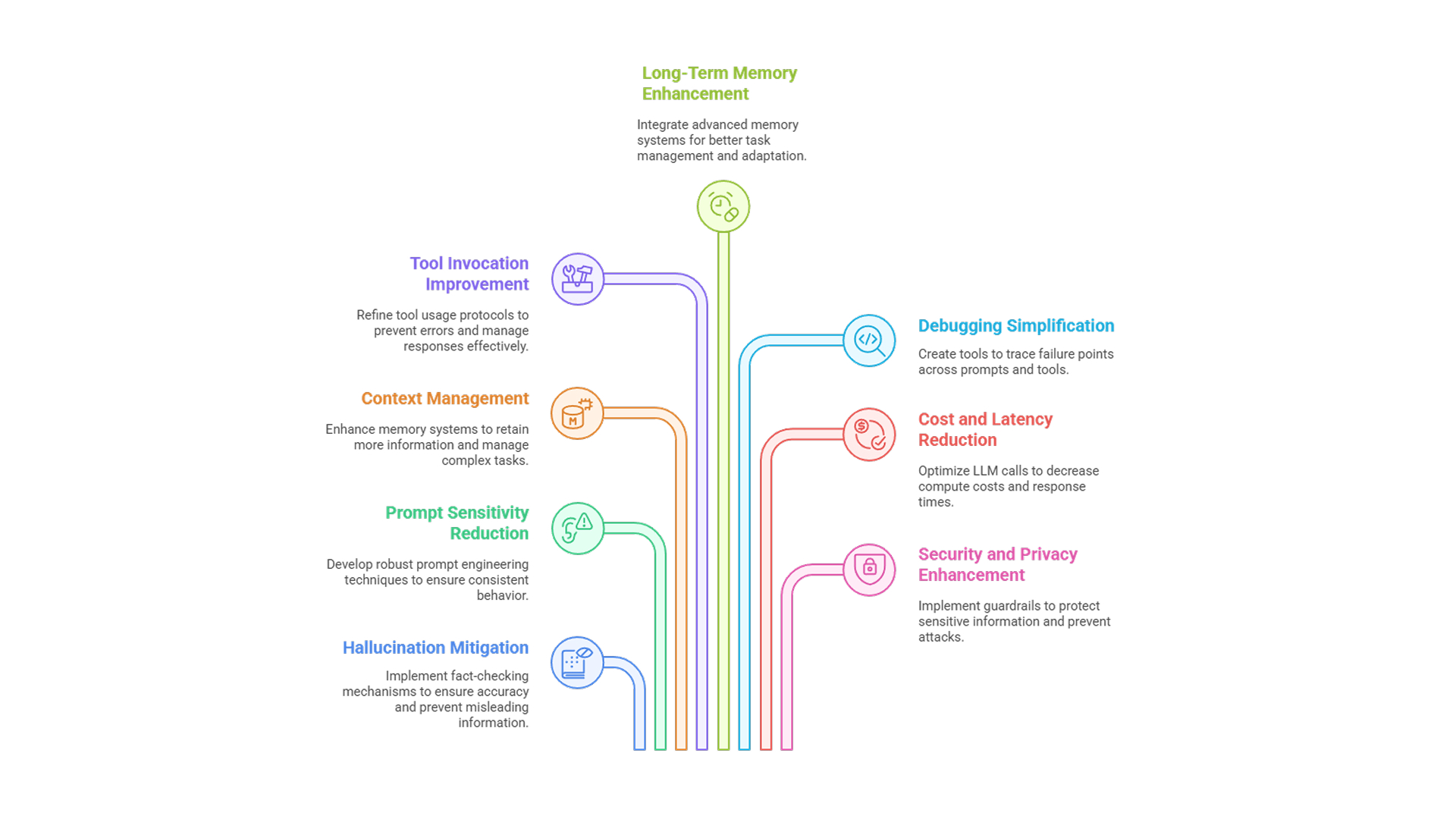
Notice how interconnected these are. Poor Tool Invocation leads to higher Cost and Latency. A failure to mitigate Hallucination makes the agent unreliable. And the difficulty in Debugging makes all of these problems harder to solve.
Conclusion
You now have a clear-eyed view of the primary obstacles to deploying AI agents in production. This isn't meant to be discouraging; rather, it's the professional's first step—understanding the problem space. As a software engineer, you can now approach agent development not just as a prompt engineering exercise, but as a systems design challenge.
Key Takeaways:
- The journey from prototype to production is defined by three core, interconnected challenges: Reliability, Cost, and Latency.
- Reliability is the top challenge, stemming from the probabilistic nature of LLMs and their "prompt brittleness." Agents often fail in non-deterministic ways.
- Cost and Latency are driven by the number of LLM and tool calls. Inefficient agents, especially those that get stuck in loops, can become too expensive and slow to be practical.
- The root causes of these issues often lie in brittle tools that don't handle errors well and a lack of self-correction mechanisms for the agent to validate its own work.
Now that we can identify what goes wrong, our next lesson will focus on how to see it happening. We will explore common failure modes and the monitoring strategies to detect them, such as tracing and logging. This is the foundation of observability, and it's the essential next step before we can implement strategies to fix these problems.