Hello! Welcome back to our course on high magnetic field physics and construction.
In our last lesson, we established a critical link between the electromagnetic field and the mechanical forces it generates. We found that the field exerts an enormous outward pressure, , which in turn creates a significant tensile hoop stress () in the magnet's windings. Our calculations showed that for a 50 T magnet, this stress can easily reach values like 746 MPa—a level that challenges even high-strength materials.
This brings us to a crucial question: how does a material actually respond to such immense stress? Knowing the stress is half the story; understanding the material's reaction is the other half. Today's lesson provides the essential vocabulary and physical laws to answer this. Our learning outcome is to define stress, strain, and elastic modulus, and apply Hooke's law to calculate deformations in conductors under load.
We will formalize the concepts of stress and deformation (strain), and introduce the material property that connects them: the elastic modulus. This will allow us to move from calculating the forces on a magnet to predicting the physical deformation of the magnet, a foundational step in robust mechanical design.
1. Stress and Strain: The Cause and Effect of Forces
The terms "stress" and "strain" are often used interchangeably in everyday language, but in physics and engineering, they have precise and distinct meanings. Stress is the internal force that particles of a material exert on each other, while strain is the measure of the deformation that results from this stress.
To get a clear and intuitive introduction to these fundamental concepts, please watch the following video. It provides excellent visual explanations of normal stress, shear stress, and their corresponding strains.
An Introduction to Stress and Strain
This video from 'The Efficient Engineer' provides a concise and clear introduction to the fundamental concepts of stress and strain, which are the cornerstone of solid mechanics.
Please watch the video from the beginning to 08:28. Pay close attention to: The definition of normal stress (\sigma) as force per unit area. The definition of normal strain (\epsilon) as the fractional change in length. The introduction to the stress-strain diagram and Hooke's Law. The distinction between normal stress/strain and shear stress/strain.
To summarize the key definitions from the video:
-
Normal Stress (): The intensity of an internal force acting perpendicular to a surface. It's calculated as , where is the normal force and is the cross-sectional area.
- Tensile stress (positive) occurs when a material is being stretched. The hoop stress in our solenoid is a tensile stress.
- Compressive stress (negative) occurs when a material is being squeezed.
- The unit of stress is the Pascal (Pa), where 1 Pa = 1 N/m². Given the large values in magnet design, we typically use Megapascals (MPa) or Gigapascals (GPa).
-
Normal Strain (): The measure of deformation in the direction of the normal stress. It's a dimensionless quantity calculated as the change in length divided by the original length: . It is often expressed as a percentage.
-
Shear Stress () and Shear Strain (): These relate to forces acting parallel to a surface, causing a change in the angle of the material's geometry. While important, the dominant stresses in a simple solenoid are normal (hoop, radial, axial), so we will focus on those for now.
2. The Stress-Strain Curve and Hooke's Law
The relationship between stress and strain for a given material is its mechanical "fingerprint" and is captured by a stress-strain curve. This curve is typically obtained by stretching a standardized sample of the material in a machine that records the applied force and the resulting elongation.
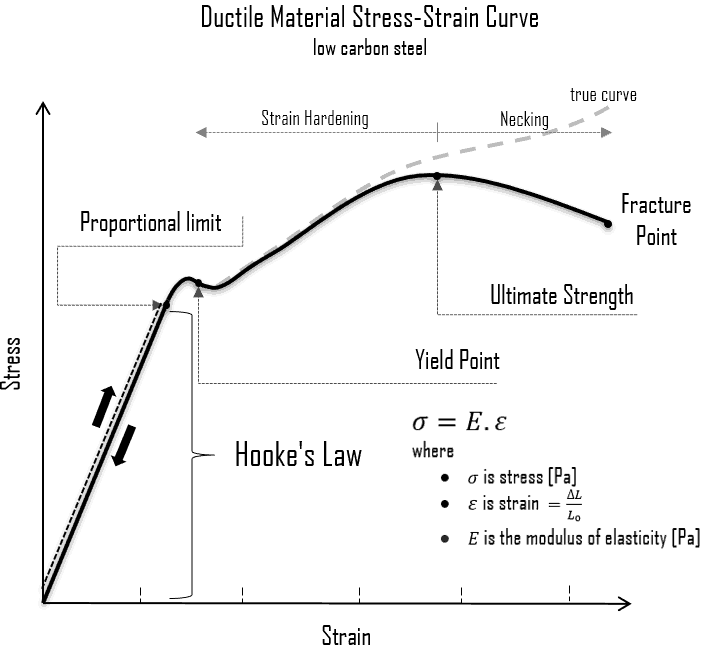
For the initial portion of this curve, most structural materials exhibit a linear relationship between stress and strain. This region is known as the elastic region. If the stress is removed while the material is in this region, it will return to its original shape, just like a spring.
This linear relationship is described by Hooke's Law:
The constant of proportionality, , is called the Modulus of Elasticity or, more commonly, Young's Modulus.
- Young's Modulus (): This is a measure of a material's stiffness or resistance to elastic deformation. A material with a high Young's modulus (like steel or tungsten) is very stiff and will deform very little for a given amount of stress. A material with a lower Young's modulus (like aluminum or plastic) is more flexible. Since strain () is dimensionless, has the same units as stress (Pascals).
3. A Deeper Look at Elastic Properties
For a more rigorous treatment that will resonate with your physics background, let's explore the key elastic constants and the generalization of Hooke's law to three dimensions.
This text from a course at Georgia Tech provides a more formal, physics-oriented derivation of the elastic constants and Hooke's Law. It's an excellent resource for moving from the simple 1D case to a full 3D description.
Please study the following sections: Section 8.1, 'Young’s modulus and Poisson’s ratio' (pages 126-128): Focus on the definitions of Young's modulus (E) and Poisson's ratio (( u)). Note the table of typical values for common materials. Pay special attention to the definition of Poisson's ratio, as it's key to understanding 3D deformation. Section 'Inverting Hooke’s law' (page 131): This section is crucial. It gives the equations (8.17a, 8.17b, 8.17c) for calculating the strain components from a 3D state of stress. Understand how the strain in one direction is affected by stresses in the other two directions.
Key Concepts from the Reading:
-
Poisson's Ratio (): When you stretch a material in one direction (axial strain), it tends to contract in the two perpendicular directions (transverse strain). Poisson's ratio is the negative of the ratio of transverse to axial strain:
For most metals, is around 0.3. This effect is crucial in thick-walled structures like magnet coils, where stresses exist in all three directions (radial, axial, and hoop).
-
Generalized Hooke's Law: In a 3D object, the strain in a particular direction depends not only on the stress in that direction but also on the stresses in the perpendicular directions due to the Poisson effect. For an isotropic material, the relationships are:
These equations are fundamental for calculating the true deformation in a complex mechanical system like a magnet coil.
4. Application: Calculating the Deformation of a Pulsed Coil
Let's now apply these concepts to the example from our last lesson. We had a pulsed coil with:
- Inner radius mm
- Hoop stress MPa
- The coil is made of a high-strength copper alloy (e.g., CuAg), for which we can assume:
- Young's Modulus GPa = MPa
- Poisson's Ratio
Our goal is to calculate the radial expansion of the coil at the bore due to this stress.
Step 1: Calculate the hoop strain ()
If we were to make a naive 1D approximation, we would simply use .
However, we know this isn't the full picture. The hoop strain is also affected by the radial stress () and axial stress (). A full analysis (which we will touch upon in future lessons using models from resources like LINK) shows that inside the winding, the radial stress is compressive () and the axial stress is also compressive ().
Let's use the generalized Hooke's Law. In cylindrical coordinates, the hoop strain is:
Because and are compressive (negative), the term becomes positive. This means the compressive radial and axial stresses add to the hoop strain, causing the coil to expand even more than the 1D approximation would suggest! This is a key insight in magnet design.
For a quantitative example, let's assume the analysis gives an average radial stress MPa and an average axial stress MPa.
As you can see, the 3D effects increased the calculated strain by about 14%.
Step 2: Calculate the change in radius ()
The hoop strain is, by definition, the change in circumference divided by the original circumference: .
The circumference is . The change in circumference is .
Therefore,
The hoop strain is simply equal to the fractional change in the radius. We can now find the absolute radial expansion:
So, at peak field, the inner bore of the magnet expands by nearly 0.1 mm. This might seem small, but this rapid expansion and contraction with every pulse is a primary driver of material fatigue and eventual magnet failure. It also has major implications for the design of sample holders and cryostats placed inside the magnet.
Test your understanding!
A long solenoid is wound with a conductor that has a Young's Modulus of GPa and a Poisson's ratio of . At peak field, the hoop stress is measured to be MPa and the axial stress is MPa (compressive). Assuming the solenoid is "thin" such that the radial stress is negligible (), what is the percentage change in the conductor's length (axial strain )? Does the coil get longer or shorter?
Show answer
We need to calculate the axial strain, , using the generalized Hooke's Law:
We are given:
- MPa
- MPa
- MPa
- GPa = MPa
Plugging in the values:
The axial strain is -0.00273, or -0.273%. The negative sign indicates that the conductor shortens in the axial direction. This is due to two effects: the direct axial compression () and the Poisson effect from the large tensile hoop stress (), both of which contribute to axial contraction.
Conclusion
Key Takeaways:
- Stress () is the internal force per unit area within a material (units of Pa), while Strain () is the dimensionless measure of its resulting deformation ().
- Hooke's Law () describes the linear relationship between stress and strain in the elastic region of a material's behavior.
- Young's Modulus () is the constant of proportionality in Hooke's Law and represents the material's stiffness.
- In three dimensions, the strain in one direction is affected by stresses in all three directions, an effect quantified by Poisson's Ratio (). This is described by the Generalized Hooke's Law.
- By applying these principles, we can calculate the physical deformation of a magnet coil under the load from electromagnetic forces.
Next Lesson Preview:
Today we focused exclusively on the elastic region, where a material deforms but returns to its original shape. But what happens if the stress from the magnetic field is too high? The magnet could be permanently deformed or even destroyed. In our next lesson, we will explore the full stress-strain curve to understand the limits of elastic behavior. We will define critical parameters like yield strength and ultimate tensile strength, which are the true engineering limits that dictate how strong a magnet can be.