Hello! Welcome to your next lesson in our module on numerical modeling.
In our previous lesson, we saw how to bring together electromagnetic, thermal, and mechanical physics into a single, fully coupled, transient simulation. You learned that such simulations are essential for analyzing a given magnet design, allowing us to predict its performance and identify potential points of failure under the extreme conditions of a pulse.
Today, we shift our focus from analysis to synthesis. Instead of asking "How does this specific design perform?", we will ask, "What is the best possible design?" This is the core question of engineering design, and we will learn how to approach it systematically.
This lesson addresses the learning outcome: Formulate a design optimization problem with a clear objective function (e.g., maximize field/bore ratio) and constraints (e.g., max stress). We will deconstruct the magnet design process into a formal optimization problem, which is the necessary first step before we can unleash computational power to find novel and improved solutions.
1. The Anatomy of a Design Optimization Problem
Any optimization problem, whether in physics, engineering, or economics, can be defined by three fundamental components:
- Design Variables: These are the "knobs" we can turn—the parameters of the system that we are free to change to improve the design.
- Objective Function(s): This is a mathematical expression that quantifies how "good" a design is. Our goal is to either maximize or minimize this function.
- Constraints: These are the "rules" we must follow—the physical, geometric, or economic limits that a realistic design must satisfy.
The outputs of the complex multi-physics simulations we discussed in the last lesson are not the end of the story. Instead, they become the inputs to our constraint functions, telling us whether a proposed design is physically viable.
Design Variables
For a magnet coil, the design variables are typically geometric and winding parameters. For a simple solenoid, this could be:
- Inner radius,
- Outer radius,
- Length,
For more complex, multi-layer coils, the list expands. You could have separate geometric parameters for each of the layers. Given your interest in advanced coil concepts, a particularly interesting set of design variables arises in force-reduced magnets.
Design and Optimization of Force-Reduced High Field ...
This PhD dissertation, 'Design and Optimization of Force-Reduced High Field ...', presents a method for optimizing solenoids to minimize internal forces. The author uses a clever choice of design variables for this task.
Please read section 3.4.1, 'Optimization Based on Force-Free Magnetic Field Theory'. Focus on the mathematical formulation of the optimization. Identify what the author chooses as the design variables to be optimized. You don't need to dive into the Nelder-Mead method yet; we will cover algorithms later.
As you saw, instead of just dimensions, the design variables are the pitch angles () of the helical windings in each layer. This is a more abstract and powerful way to explore the design space, aiming to manipulate the alignment of current and field vectors directly.
Objective Function(s)
The objective function defines the goal of the optimization. It must be a quantifiable metric. Common objectives in magnet design include:
- Maximize performance:
- Peak central field, .
- Field homogeneity over a specific sample volume.
- A figure of merit like (field per unit energy) or (field per peak power).
- Minimize cost or resource usage:
- Total coil mass or volume.
- Total power consumption.
- Financial cost of materials and manufacturing.
Often, these objectives are in conflict. Maximizing the field might require a huge, expensive magnet. This leads us to multi-objective optimization, where we seek to find the best trade-offs.
The following video provides an excellent introduction to the core concepts of multi-objective optimization, namely the weighted-sum method and the concept of a Pareto front.
This video from the OpenMDAO channel introduces the fundamental ideas behind multi-objective optimization.
Please watch from the beginning to the end (0:11-5:36). Pay close attention to: How the weighted-sum method combines multiple objectives into a single one. The definition of a 'Pareto front' and what it means for a design to be 'dominated' or 'Pareto optimal'. The Epsilon-constraint method as a more robust way to construct a Pareto front.
The Pareto front is a crucial concept for designers. It represents the set of all optimal trade-offs. Any point on the front is a valid, optimal design for a specific set of priorities. A designer's job is to select one point from this front that best meets the overall project goals.
Constraints
Constraints define the boundaries of the feasible design space. A design that violates even one constraint is invalid, no matter how well it performs on the objective function. For high-field magnets, the primary constraints come directly from the physical limits we've studied.
- Mechanical Constraint: The maximum stress in the coil must not exceed the material's strength. We use the Von-Mises stress () as a general indicator of multiaxial stress and compare it to the material's yield strength () at the operational temperature, including a safety factor ().
The following images powerfully illustrate this constraint.
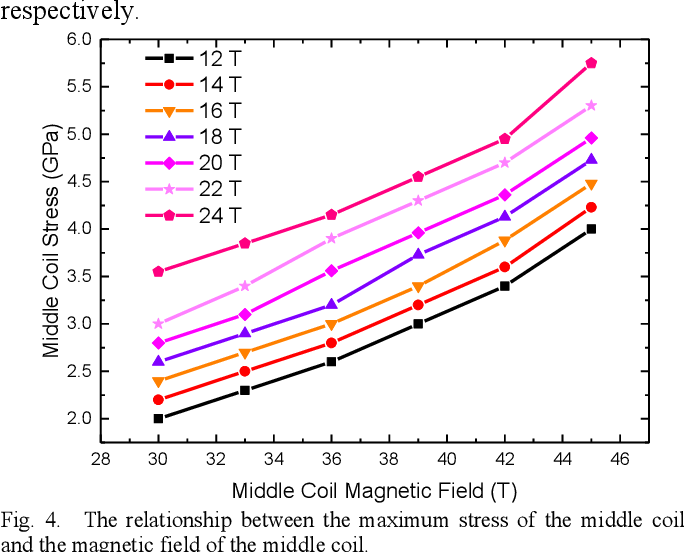
*This graph plots a key constraint function. The stress in a coil (y-axis) is a function of its magnetic field contribution (a result of the design variables). The horizontal line you might draw representing the material's yield strength defines the feasible operating region.*

*This image starkly connects simulation with reality. The FEM simulations (a, b, c) are used to predict stress concentrations, which, if they exceed the material's limit, can lead to the kind of catastrophic failure seen in the photograph (d). This is why the stress constraint is paramount.*
-
Thermal Constraint: The peak temperature reached anywhere in the coil must be below the limit where the conductor or insulating materials start to degrade or soften.
-
Geometric Constraints: The design must meet practical requirements.
- The inner bore must be large enough to accommodate the experiment: .
- The outer dimensions must fit within the cryostat or facility infrastructure: .
-
Power/Energy Constraints: The magnet's requirements cannot exceed the capacity of the power supply.
- For a pulsed magnet: .
- For a continuous magnet: .
2. Formalizing the Optimization Problem
With these three components, we can now write down a formal statement of the optimization problem.
Example 1: A "Classic" Pulsed Magnet
Let's formulate a common problem: Maximize the central field of a simple solenoid, subject to stress, thermal, and geometric constraints.
-
Design Variables:
(We fix the inner radius to provide a required bore size) -
Objective Function:
Maximize -
Constraints:
Here, functions like and are not simple analytical formulas. They are the outputs of the complex multi-physics FEM simulations we studied in the last lesson, run with the geometry defined by .
The following paper provides a real-world example of this kind of thinking for a very ambitious 60 T hybrid magnet.
Conceptual Design Optimization of a 60 T Hybrid Magnet
In this paper, 'Conceptual Design Optimization of a 60 T Hybrid Magnet', the authors explore the design space for a next-generation magnet. Their process is a perfect illustration of formulating a complex optimization problem.
Please read the Abstract and Section II, 'The Optimization Procedure'. Pay special attention to how they define their subsystems, the constraints they impose (total field, power, current densities, stress levels), and their objective (minimizing the cost of the HTS midsert, treated as a 'penalty function').
This paper shows how a seemingly intractable problem (design a 60T magnet) is broken down into a manageable optimization task by carefully defining the variables, constraints, and objectives for each part of the system.
Example 2: A Force-Reduced Solenoid
Drawing again from the dissertation by Szabolcs Rembeczki, we can formulate a more elegant, physics-driven optimization problem.
- Objective: Minimize the electromagnetic forces within the winding. As a proxy for this, we minimize the average angle, , between the current density vector and the magnetic field vector .
- Design Variables: The pitch angles of the layers: .
- Constraints: The design must still produce the required field, and not melt or break.
The formal problem statement is:
-
Objective Function:
Minimize across the coil volume. -
Design Variables:
-
Constraints:
- (Must achieve at least the target field)
- (Stress limit)
- And other relevant thermal or geometric constraints.
This is a beautiful example of using physical insight (, so force is zero if ) to formulate a clever objective function.
Test your understanding!
You are tasked with designing a lightweight pulsed coil for a space application. The goal is to produce a 20 T field in a 30 mm bore. The main limitation is the total mass of the coil. Formulate this as a design optimization problem. What are your objective function, primary design variables, and key constraints?
Show answer
- Objective Function: Minimize the total mass of the coil, . The mass is a function of the coil's geometry and material density.
- Design Variables: The primary geometric parameters of the coil: . The inner radius is fixed at 15 mm. You could also include conductor material choice if multiple options are available.
- Constraints:
- Field Constraint: The design must produce the target field: T.
- Stress Constraint: The peak stress must be within the material limits: .
- Thermal Constraint: The peak temperature rise must be acceptable: .
- Energy Constraint: The required energy must not exceed the available portable power supply: .
Conclusion
Today we have built the formal framework for magnet design optimization. You have learned to deconstruct this complex engineering task into a well-defined mathematical problem consisting of design variables, objectives, and constraints.
Key Takeaways:
- Design Optimization Framework: A problem is defined by its variables (knobs to turn), objective function (what to maximize/minimize), and constraints (rules to follow).
- Multi-Physics in Optimization: The results of the multi-physics FEM simulations from our last lesson serve as the basis for the constraint functions (e.g., calculating and ).
- Multi-Objective Trade-offs: Magnet design often involves conflicting goals. The Pareto front is the tool used to visualize and understand the set of optimal trade-off solutions.
- Problem Formulation is Key: A well-posed optimization problem is the first and most critical step towards finding a high-performance design. The choice of variables and objectives can range from simple (geometry, peak field) to more physically insightful (pitch angles, force minimization).
Next Lesson Preview:
Now that we know how to formulate a design optimization problem, the next logical question is: "How do we solve it?" In our next lesson, we will explore the algorithms that computational software uses to navigate the design space and find the optimal solution. We will discuss methods like gradient-based optimization and genetic algorithms, which are the engines that power automated design discovery.