In our previous lessons, we explored how variables act as placeholders in expressions and learned how to evaluate those expressions by substituting numbers for the variables. This was a "forward" process: you were given the input (x) and asked to find the output. Today, we're going to reverse our direction. You'll be given the final output and tasked with finding the original input. This "backward" process is called solving an equation, and it is one of the most fundamental and powerful skills in algebra.
This lesson will teach you how to solve a linear equation with one variable, such as . Mastering this will not only complete our foundational understanding of basic algebraic manipulation but also give us the tools to start exploring more complex relationships, which is essential for our journey toward understanding linear algebra and its role in AI.
The Equation as a Balanced Scale
At its heart, an equation is a statement of perfect balance. The equals sign (=) is the pivot point, and it insists that the value of the expression on the left is exactly the same as the value of the expression on the right. The most powerful intuition for this is a classic balance scale.
To get started, let's watch a video that introduces this core concept.
Algebra Basics: Solving Basic Equations Part 1 - Math Antics
This video from Math Antics provides a wonderfully clear and intuitive introduction to the idea of an equation as a balanced scale.
Watch the first part of the video, from the beginning to the main rule. Focus on the core principle: whatever you do to one side of an equation, you must do to the other to maintain the balance.
As the video explains, the golden rule of algebra is to always keep the equation balanced. If we add, subtract, multiply, or divide on one side, we must perform the exact same operation on the other side. This rule is what allows us to manipulate an equation without breaking it.
The goal when solving an equation is to figure out the unknown value, which we represent with a variable like . To do this, we need to get the variable all by itself on one side of the scale. This process is often called isolating the variable.
Finding x: The Art of Undoing
In the last lesson, we saw how an expression like is built. Starting with , you first multiply by 2 (giving ) and then add 3.
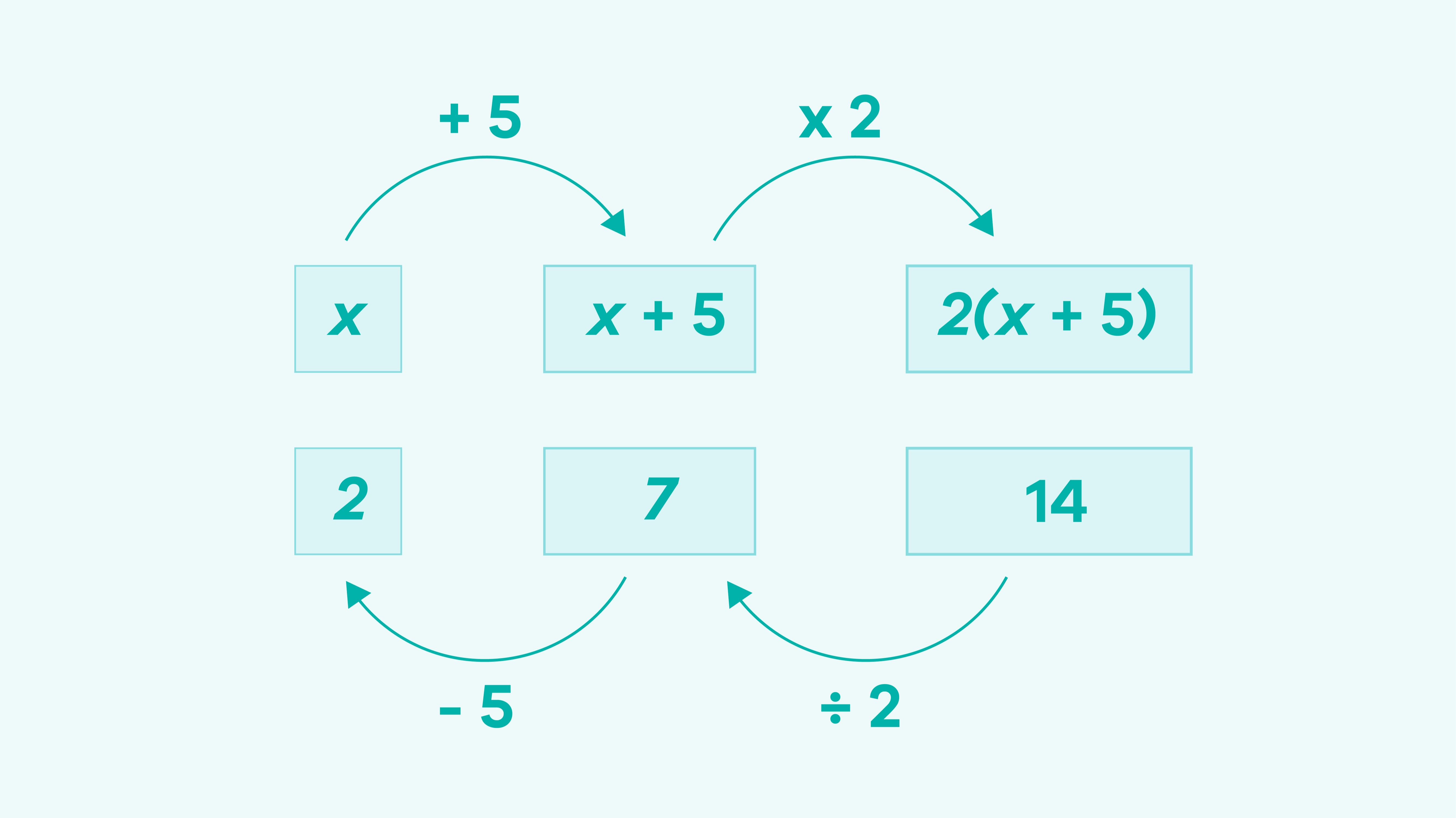
To solve the equation , we need to undo these steps in reverse order. This is where inverse operations come into play.
- The inverse of addition is subtraction.
- The inverse of subtraction is addition.
- The inverse of multiplication is division.
- The inverse of division is multiplication.
Looking at the diagram, to get back to from , we must first undo the +3 with a -3, and then undo the x2 with a ÷2.
Solving a Two-Step Equation: A Visual Walkthrough
Let's put this all together and solve our target equation, , using the balance scale analogy.
Using Models to Solve Equations | Texas Gateway
This article from the Texas Gateway provides an excellent visual demonstration of solving a two-step equation using the balance scale model.
First, read the Introduction to solidify the concept of an equation as a balance. Then, carefully study the section "Using Balances to Solve Equations". This section walks you through solving the equation 2x+3=7 step-by-step with visuals. Notice how removing blocks from one side requires removing the same number of blocks from the other to keep the scale balanced.
As the article demonstrates, solving involves two main steps:
-
Isolate the variable term (): We want to get the
xblocks by themselves. To do this, we remove the 3 unit blocks from the left side. To keep the scale balanced, we must also remove 3 unit blocks from the right side. This leaves us with 2xblocks on the left and 4 unit blocks on the right. Algebraically, this is subtracting 3 from both sides: -
Isolate the variable (): Now we have 2
xblocks balanced by 4 unit blocks. This means eachxblock must be worth 2 unit blocks. To find the value of a singlex, we divide the contents of both sides by 2.
We have found the solution! If we substitute back into our original equation, we get , which is a true statement. The scale balances.
Here is another visual summary of the process for a similar equation, .

The Algebraic Procedure
While visual models are fantastic for building intuition, you'll eventually perform these steps algebraically. The logic is exactly the same: use inverse operations to isolate the variable.
Let's watch a couple of short clips that demonstrate the algebra for each of the two steps we just performed.
Algebra Basics: Solving Basic Equations Part 1 - Math Antics
We return to the Math Antics video to see the algebraic procedure for the first step: undoing addition and subtraction.
Watch the segment from undoing addition to see how subtracting from both sides works. Then, watch from undoing subtraction to see how adding to both sides works.
Algebra Basics: Solving Basic Equations Part 2 - Math Antics
Now, let's watch the second part of the Math Antics series to see the second step: undoing multiplication and division.
Watch the segment from undoing multiplication. Notice how he uses the fraction bar to represent division, which is standard practice in algebra.
By combining these two one-step procedures, we can solve any two-step equation of the form .
Let's try one more example: Solve .
- Undo subtraction first. The expression is built by multiplying by 4, then subtracting 3. We undo this in reverse. The inverse of subtracting 3 is adding 3. We must do this to both sides to maintain balance.
- Undo multiplication. Now, is being multiplied by 4. The inverse is dividing by 4.
Our solution is .
Conclusion
In this lesson, we made a crucial leap from evaluating expressions to solving equations. This shift from a "forward" to a "backward" process is a cornerstone of algebra.
Here are the key takeaways:
- An equation is a statement that two expressions are equal, like a balanced scale.
- The golden rule is to keep the equation balanced: whatever operation you perform on one side, you must also perform on the other.
- To solve an equation, you isolate the variable by applying inverse operations in the reverse order of how the expression was built.
We've now covered the essential building blocks of algebra: variables, expressions, and equations. In our next lesson, we will introduce the concept of a function. This will formalize the "input-output machine" idea we've been using and provide a powerful framework for describing relationships between variables, which is central to all of linear algebra.