In our last lesson, we established that a variable is a placeholder for a number. This insight allows us to write general rules and relationships without knowing the specific numbers involved. Now, we'll take the next logical step: what happens when we do know the number?
Today's lesson is about evaluating simple algebraic expressions. This means we will take an expression containing a variable (like ), substitute a given numerical value for that variable (like setting ), and then calculate the final result. This is the fundamental process that turns an abstract algebraic rule into a concrete numerical answer. It's the bridge between having a formula and using it to get a result.
From Placeholder to Calculation
In the previous lesson, we saw how an expression like could represent a restaurant bill where is the placeholder for the tip. To "evaluate" this expression, you simply decide on the value of the tip and perform the calculation. If you decide to tip $3, you substitute 3 for and calculate .
This process of substituting a value and finding the result is a cornerstone of algebra. The following video provides a clear, step-by-step introduction to this concept.
Intro to Evaluating Algebraic Expressions | How to Evaluate Algebraic Expressions | Math with Mr. J
Watch this introductory video from "Math with Mr. J" to see how substitution works in practice.
Watch from the beginning to the end of the second example. Pay close attention to how he replaces the variable x with a specific number and then performs the calculation. Notice the important point he makes about notation for multiplication.
As the video demonstrates, the core idea is simple: replace the letter with the number you're given. The key is to then perform the arithmetic correctly.
The "Function Machine" Analogy
A powerful way to visualize this process is to think of an algebraic expression as a "function machine." The machine is programmed to perform a specific sequence of operations. The variable is the input slot where you feed in a number. The machine processes it and gives you a single output.
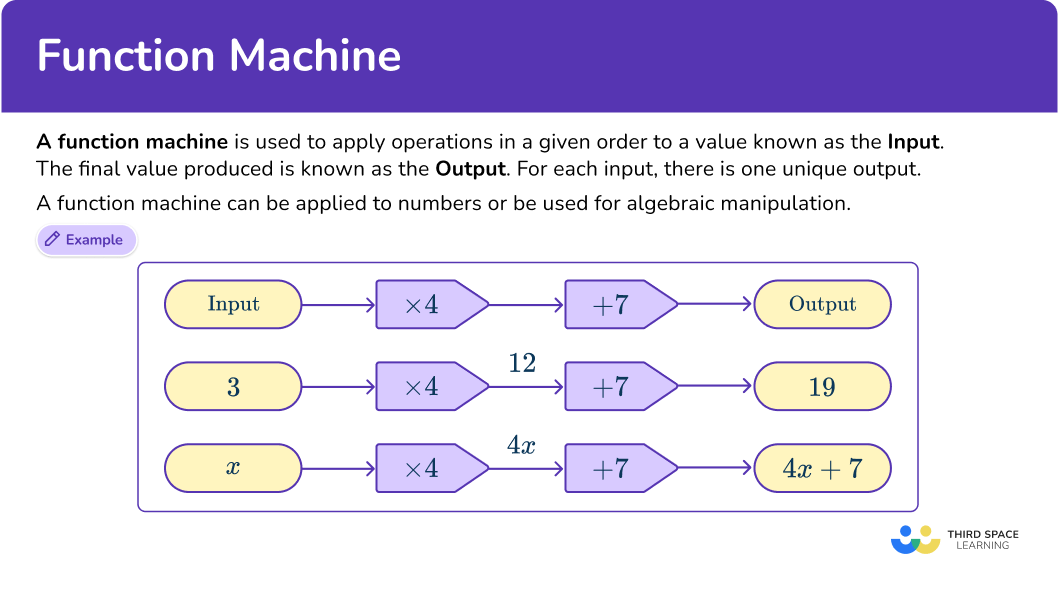
In this diagram, the expression is .
- If you put the number
3into the input slot for , the machine first calculates , then calculates , producing the output19. - If you put the number
10in, the output would be .
This input-process-output model is not just a helpful analogy; it's the conceptual foundation for how algorithms and computer programs work. They take inputs (data), apply rules (expressions and functions), and produce outputs (results).
The Two-Step Process: Substitute and Evaluate
No matter how complex the expression, the process of evaluating it always breaks down into two main steps. A great article from Third Space Learning outlines this clearly.
Evaluate The Expression - Steps, Examples & Questions
This article provides a concise definition and a clear, two-step guide for evaluating expressions.
First, read the section "What does it mean to evaluate the expression?" to see the formal definition. Then, read the two bullet points under the heading "How to evaluate the expression".
As the article states, the process is:
- Substitute each variable with its given value.
- Evaluate using the order of operations.
You might remember the order of operations by the acronym PEMDAS (Parentheses, Exponents, Multiplication and Division, Addition and Subtraction). This rule ensures that everyone evaluating the same expression gets the same answer.
Let's see this in action with expressions that have more than one variable.
Handling Multiple Inputs
What if our "machine" has more than one input slot? The principle is exactly the same: substitute each given value into its corresponding placeholder and then calculate the result.
Intro to Evaluating Algebraic Expressions | How to Evaluate Algebraic Expressions | Math with Mr. J
Let's return to the video from "Math with Mr. J" to see how this works with two variables.
Watch the remainder of the video, from the two-variable examples. Notice how he carefully substitutes the values for a and b before applying the order of operations.
The key is to be careful and methodical. Let's walk through an example from the "Evaluate The Expression" article we looked at earlier.
Consider the expression . We are asked to evaluate it when and .
- Substitute: Replace with 5 and with 6.
- Evaluate: Following the order of operations (PEMDAS), we do the multiplications first. Finally, we do the subtraction.
So, when and , the expression evaluates to 43.
Practice and Common Pitfalls
The best way to solidify this skill is to try it yourself. It's also helpful to be aware of common mistakes.
Evaluate The Expression - Steps, Examples & Questions
This resource provides practice questions and highlights common errors to avoid.
First, read the section "Easy mistakes to make". The most important point here is about the order of operations. Next, try to solve the first practice question on your own: "Evaluate 8x-10 when x=3." After you have an answer, read the provided solution to check your work.
Did you get 14? Let's break it down:
- Substitute:
- Evaluate: Multiply first: . Then subtract: .
A common mistake would be to subtract first () and then multiply (), which would be incorrect because it violates the order of operations.
Conclusion
In this lesson, we moved from understanding variables as abstract placeholders to using them in concrete calculations. This skill, evaluating expressions, is a fundamental action in mathematics and programming.
Here are the key takeaways:
- To evaluate an expression means to find its numerical value after substituting the variables with specific numbers.
- The process involves two steps: substitute the values, then calculate the result using the order of operations (PEMDAS).
- Thinking of an expression as an input-output machine is a powerful conceptual tool that connects algebra to the logic of computation.
We have now seen how to write an expression with a variable and how to get a value from it. In our next lesson, we will flip this around. We will start with the final value and work backward to figure out what the input must have been. This is called solving an equation, and it is one of the most powerful tools in algebra.