Welcome back. In the previous lesson, you converted a PM2.5 concentration into a PM2.5-specific AQI of 69. A report may also contain indices for ozone, PM10, and other pollutants. This lesson covers the final step for a U.S. daily report: selecting the overall AQI from those already-calculated indices.
The rule is short, but its limits matter. An overall AQI identifies the highest reported pollutant-specific index; it is not an average of pollutants or a measurement of everything in the air.
Select the highest index
For the U.S. daily AQI method, calculate an index for each pollutant with a usable measurement, then report the highest pollutant-specific index as the overall AQI. The pollutant producing it is called the responsible or critical pollutant.
The EPA’s technical guide states the calculation rule and gives a multi-pollutant example. Its breakpoint table dates from 2018, so use the guide here for aggregation, not to recalculate PM2.5 with outdated breakpoints.
aqi-technical-assistance-document-sept2018.pdf
Read the EPA guide to see where selecting the highest index fits into the daily reporting method.
In Section II, “Calculating the AQI,” on p. 9, read the calculation steps. Notice that concentrations are processed and converted to indices before an overall value is chosen. Then go to p. 11 and the question “What if I have values for more pollutants?” Read the example, focusing on why ozone supplies the final number.
Once the pollutant-specific indices have been calculated and rounded, the selection can be written as:
The maximum is taken over the available, applicable indices in that report. It is not a maximum of raw concentrations. For instance, a PM2.5 concentration expressed in micrograms per cubic meter and an ozone concentration expressed in parts per million cannot be ranked by their numerical size. Each must first be converted under its own pollutant-specific rules.
The indices also need to belong to the same report. Pollutants can have different prescribed averaging periods, as earlier lessons showed, but it would not make sense to combine yesterday’s completed PM2.5 index with an ozone index from a current report and label the result today’s overall AQI.
From several indices to one displayed number
Suppose a report supplies these completed pollutant-specific indices:
| Pollutant | Pollutant-specific AQI |
|---|---|
| PM2.5 | 69 |
| Ozone | 92 |
| PM10 | 57 |
The overall AQI is 92, and ozone is the responsible pollutant. The PM2.5 value of 69 from the previous lesson remains a valid PM2.5-specific result; it simply does not set the overall number in this report. Neither adding the three values nor averaging them is part of the rule.
The overall number takes its category from the same AQI bands used for pollutant-specific indices. In the EPA chart below, 92 falls in Moderate, the 51–100 band.
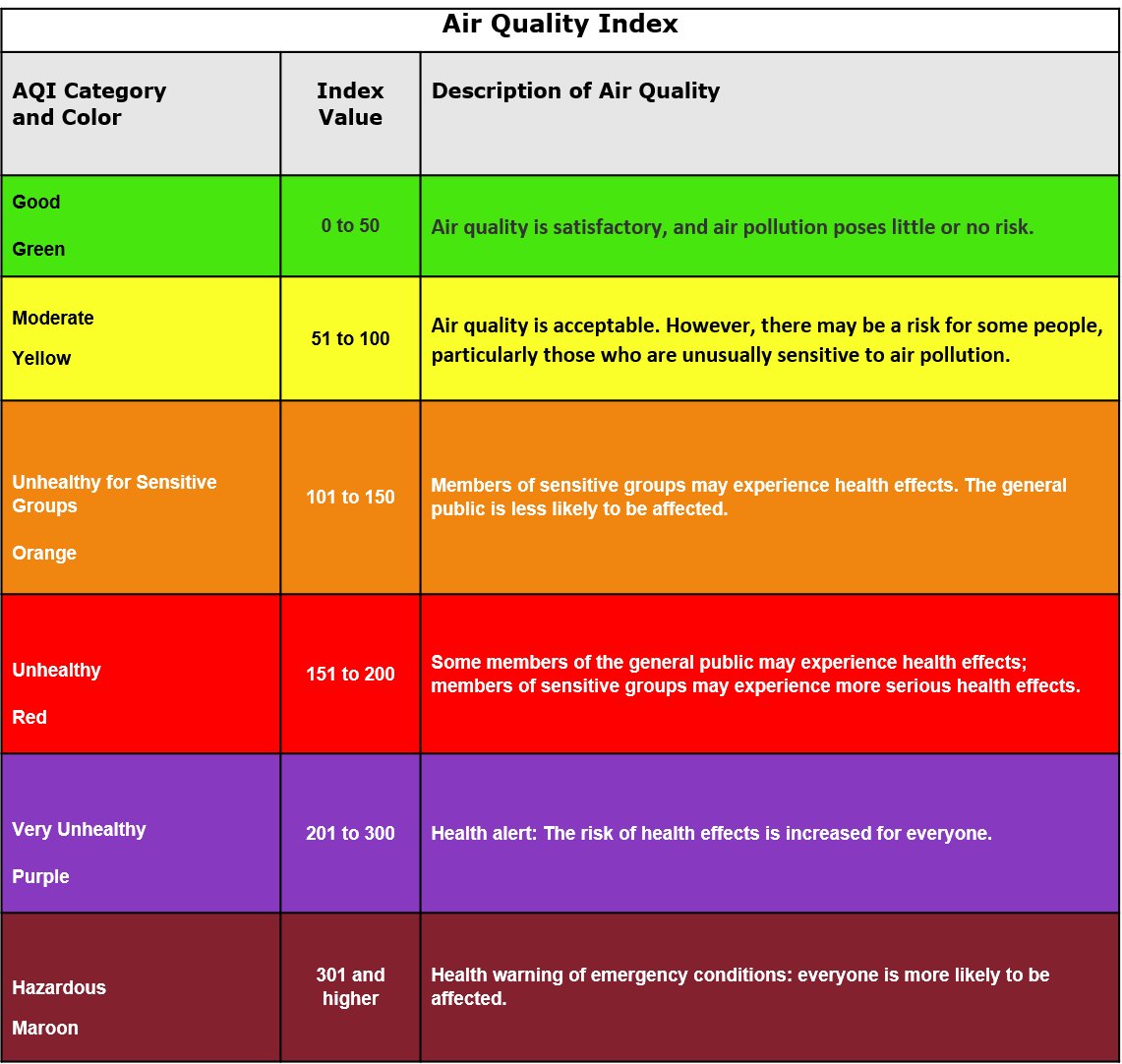
Selecting a maximum preserves the highest reported level of concern, but it does not erase the other indices. The EPA’s health guide illustrates this with an ozone index of 130 and a particle-pollution index of 101. The overall AQI is 130, with ozone responsible. Particle pollution is still above 100, so groups sensitive to particle pollution remain relevant to the accompanying health message.
A Guide to Air Quality and Your Health - AirNow.gov
Read the AirNow health guide’s reporting example to distinguish the headline number from the fuller pollutant-specific health information.
Find the subsection “How is a community’s AQI calculated and reported?” Start where it explains that raw measurements become separate pollutant indices. Read the reporting explanation through the example with ozone at 130 and particle pollution at 101. Focus on why the announced AQI is 130 and why the announcement still mentions particle pollution.
This distinction is useful when reading a news discussion. Two statements can both be accurate: “the overall AQI was 130, driven by ozone” and “particle pollution also reached an index of 101.” The second does not contradict the first.
What the maximum does—and does not—tell you
The maximum rule is a reporting rule, not a claim that the other pollutants are absent or harmless. It also does not mean that an AQI of 130 measures a person’s total dose from all pollutants. The overall number identifies the highest index among those reported; pollutant-specific details remain important when interpreting health guidance.
Its scope depends on what the report represents. In the EPA daily reporting method described in the technical guide, monitors within a reporting area contribute concentration data before pollutant indices are calculated. A reading for a particular monitor or a mapped estimate for a particular point has a different spatial scope. Taking the largest numbers from two unrelated locations would not produce a valid “overall AQI” for either location.
Coverage matters too. If a report supplies PM2.5 and ozone indices but has no usable PM10 value, the overall AQI is the maximum of the supplied indices. A missing PM10 value is not a PM10 index of zero. The headline alone cannot establish that every possible pollutant was measured.
For this lesson, the decision procedure is therefore:
- Identify the reporting system and the report whose overall AQI you want.
- Use its applicable, already-calculated pollutant-specific indices.
- Select the highest index and identify its responsible pollutant. If indices tie for highest, more than one pollutant shares that position.
- Read the category from the overall value, while checking other elevated pollutant indices for relevant health information.
Key takeaways
In a U.S. daily AQI report, the overall AQI is the highest applicable pollutant-specific index, not an average or sum. Its responsible pollutant explains the headline value, but other elevated indices can still matter to the health message. Before comparing two overall numbers, establish that they describe comparable reports, times, and places.
Next, you will see why the same PM2.5 concentration can receive different index values under different national scales or breakpoint versions—even before this maximum-selection step is applied.