Welcome to the second module of our course. Having established the core principles of the human body as a predictive, energy-regulating system, we now move into the specific chemical architecture that executes these predictions and manages the budget. This lesson begins our deep dive into the body's response to "load" by dissecting the neurochemical pathways of stress.
Your goal is to build a robust, first-principles model of human capacity and depletion. To do that, we must move beyond a monolithic concept of "stress" and see it as a precise, multi-part physiological process. Today, we will distinguish the two primary arms of this process: the fast-acting neural pathway and the slower, more sustained hormonal pathway. Understanding their distinct mechanisms, timescales, and functions is foundational to modeling how different types of stressors tax the system in different ways.
The Two Arms of the Stress Response
When the brain perceives a stressor—be it a physical threat or a demanding cognitive task—it initiates a response through two major, interconnected systems:
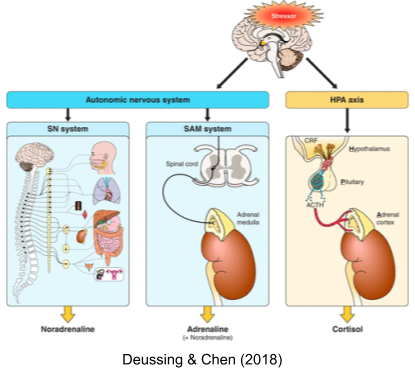
- The Sympatho-Adrenal-Medullary (SAM) Axis: The fast pathway. This is a neural system designed for immediate, rapid mobilization. Think of it as the body's "go" signal, providing a burst of resources for acute challenges.
- The Hypothalamic-Pituitary-Adrenal (HPA) Axis: The slow pathway. This is a hormonal cascade designed for slower, more sustained adaptation. It manages energy over longer timescales and plays a role in recovery and regulation.
These two systems are not redundant; they have different roles and operate on different clocks. The diagram below provides a high-level schematic of these two pathways.
To begin, let's ground this distinction in the formal literature.
A Comprehensive Overview on Stress Neurobiology
This review article provides a rigorous overview of the stress system's neuroanatomy. It immediately establishes the SAM and HPA axes as the two major components and differentiates their timing.
Please read the abstract, which introduces the two major components. Then, in the section "The Neuroanatomy of the Stress System," read the subsection on "Physical Stressors." Focus on the paragraph that describes the two phases of the response, noting the keywords used to describe the timing and duration of each.
The key takeaway is that the body deploys a two-speed response. The SAM axis provides the immediate "fight-or-flight" reaction, while the HPA axis orchestrates a more prolonged adaptation. Let's now examine the specific machinery of each.
The Fast Pathway: Sympatho-Adrenal-Medullary (SAM) Axis
The SAM axis is essentially an extension of the sympathetic nervous system, designed for speed.
Mechanism & Timescale:
The response begins when the hypothalamus activates sympathetic neurons in the spinal cord. These preganglionic neurons project directly to the adrenal medulla. This is a crucial anatomical point: the adrenal medulla is not just a gland; it's a modified sympathetic ganglion. Its cells, called chromaffin cells, are functionally postganglionic neurons that release their neurotransmitters directly into the bloodstream. This direct neural pathway makes the response incredibly fast, with effects felt across the body in seconds.
The following video provides an excellent visual and mechanistic walkthrough of this entire cascade, from the spinal cord to the target organs.
Endocrinology | Adrenal Medulla | Catecholamines
This Ninja Nerd lecture meticulously details the anatomy and biochemistry of the adrenal medulla's response. It is ideal for understanding the process at the circuit and cellular level you're interested in.
Watch the following segments: Pathway Activation: This covers the adrenal medulla's identity as neural tissue and how acute stress triggers the sympathetic pathway. Cellular Mechanism: Pay close attention to the explanation of the long preganglionic neuron, the role of acetylcholine, and the activation of chromaffin cells. This is the core neural circuit. Catecholamine Synthesis: This section details the biochemical conversion from tyrosine to epinephrine, including the enzymes involved and the 80/20 release ratio. This is the cellular machinery. Systemic Effects: This visually demonstrates how the released catecholamines affect the liver, fat tissue, heart, blood vessels, and lungs to mobilize the body for action.
Mediators & Function:
As the video detailed, the SAM axis releases two key catecholamines: epinephrine (adrenaline) and norepinephrine (noradrenaline). While norepinephrine also functions as a neurotransmitter in the brain and at sympathetic nerve endings, the defining output of the SAM axis is a flood of both hormones into the circulation.
These hormones act on adrenergic receptors throughout the body, orchestrating the classic "fight-or-flight" response. Their function is singular: prepare the body for immediate, intense physical exertion.
Here's a breakdown of the key effects:
- Cardiovascular: Increases heart rate and contractility, leading to higher cardiac output and blood pressure. Vasoconstriction in non-essential organs (like the gut) and vasodilation in skeletal muscles shunts blood to where it's needed most.
- Metabolic: Rapidly increases blood glucose by stimulating glycogenolysis (breakdown of glycogen) and gluconeogenesis (synthesis of new glucose) in the liver. It also promotes lipolysis (breakdown of fats) in adipose tissue to provide fatty acids as an additional fuel source.
- Respiratory: Induces bronchodilation (relaxation of airway smooth muscle), increasing airflow to the lungs to maximize oxygen uptake.
- Cognitive: In the brain, norepinephrine from the locus coeruleus enhances arousal, vigilance, and focused attention.
The Slow Pathway: Hypothalamic-Pituitary-Adrenal (HPA) Axis
While the SAM axis handles the immediate crisis, the HPA axis manages the aftermath and prepares the body for sustained periods of stress. It is a slower, more complex, and longer-lasting hormonal system.
Physiology, Stress Reaction - StatPearls - NCBI Bookshelf
This StatPearls article provides a concise, medically grounded summary of both axes. We'll use it to formally define the HPA cascade and its functions.
First, locate the heading "Cellular Level" and review the two components of the stress response: the HPA and SAM axes. Then, focus on the two main sections: Read the section Sympathetic-Adreno-Medullar System for a quick recap of what we just covered. Note the description of its effects as behavioral activation. Read the section Hypothalamic-Pituitary-Adrenal System in detail. Trace the cascade from CRH to ACTH to cortisol. Pay attention to the role of CRH receptors and binding proteins, as these add a layer of regulation. Finally, jump down to the Mechanism section and read the first two paragraphs, which summarize the functions of cortisol and the glucocorticoid receptors in the brain.
Mechanism & Timescale:
The HPA axis is a classic endocrine cascade. Its timescale is dictated by the speed of hormone synthesis, release, circulation, and action, making it significantly slower than the neural SAM axis (minutes to hours).
- Hypothalamus: The paraventricular nucleus (PVN) of the hypothalamus releases corticotropin-releasing hormone (CRH) into the portal system connecting it to the pituitary.
- Pituitary: CRH stimulates cells in the anterior pituitary to release adrenocorticotropic hormone (ACTH) into the general bloodstream.
- Adrenal Gland: ACTH travels to the adrenal glands and stimulates the adrenal cortex to synthesize and release glucocorticoids.
Mediator & Function:
The primary mediator of the HPA axis in humans is cortisol. Cortisol's overarching function is to manage energy resources during a prolonged stressor and to help the system return to baseline. It acts more like a systemic resource manager than an emergency responder.
Key effects include:
- Metabolic: Cortisol powerfully increases the availability of metabolic fuel. It stimulates gluconeogenesis in the liver, promotes the breakdown of fats and proteins into precursors for glucose, and crucially, suppresses insulin to prevent this newly liberated glucose from being stored away, keeping it available for the brain and muscles.
- Anti-inflammatory & Immunosuppressive: In the short term, cortisol has potent anti-inflammatory effects, preventing the immune system from overreacting during a crisis. (As we'll see in a later lesson, this becomes maladaptive when cortisol is chronically elevated).
- Permissive Effects: Cortisol also has a "permissive" role, meaning it enhances the effects of other hormones. For instance, it increases the sensitivity of blood vessels to epinephrine and norepinephrine, helping to maintain blood pressure.
- Feedback Regulation: Cortisol completes a negative feedback loop by acting on the hypothalamus and pituitary to inhibit the release of CRH and ACTH, which is critical for turning the stress response off.
Synthesis: Two Systems, One Response
It is crucial to see these as two distinct but complementary systems, not as redundant pathways.
| Feature | Fast Pathway (SAM Axis) | Slow Pathway (HPA Axis) |
|---|---|---|
| Pathway Type | Neural (Sympathetic Nervous System) | Hormonal (Endocrine Cascade) |
| Primary Mediators | Epinephrine, Norepinephrine | Cortisol (a glucocorticoid) |
| Onset Speed | Seconds | Minutes to Hours |
| Duration of Effect | Short-lived | Sustained, long-lasting |
| Primary Function | Immediate Mobilization ("Fight-or-Flight") | Sustained Energy Management, Adaptation, and Recovery |
| System Analogy | A fast-acting thruster for immediate acceleration. | The main engine and fuel management system for a long journey. |
The SAM axis gives you the immediate burst to deal with an acute threat. The HPA axis comes online to sustain that response, manage the body's energy economy through the crisis, and eventually help shut the system down. The interaction between them is complex; for example, cortisol can potentiate the effects of catecholamines, linking the slow system's output back to the fast one's effectors.
Conclusion
In this lesson, we have dissected the body's two-speed stress response. We distinguished the fast, neural SAM axis, which releases epinephrine and norepinephrine for immediate mobilization, from the slow, hormonal HPA axis, which releases cortisol for sustained energy management and adaptation.
This distinction is not merely academic. It is fundamental to your goal of modeling depletion. A task that triggers a sharp, brief SAM activation (like a near-miss in traffic) has a different energetic cost and recovery profile than a task that induces a prolonged, low-level HPA activation (like preparing for a difficult meeting). Understanding which system is being engaged by a given stressor is the first step in quantifying its load.
In our next lesson, we will focus exclusively on the HPA axis. We will trace its negative feedback loop in detail and, critically, explore how chronic stress leads to the breakdown of this regulatory mechanism—a state of allostatic overload that is central to understanding burnout and many psychiatric conditions.