Introduction
In our last lesson, we established a critical architectural distinction in the brain: the predictive modeling of the external world (exteroception) versus the internal body (interoception). We saw that due to differences in cortical structure—specifically the granular versus agranular nature of the processing areas—our internal, interoceptive world is fundamentally more dominated by the brain's top-down predictions.
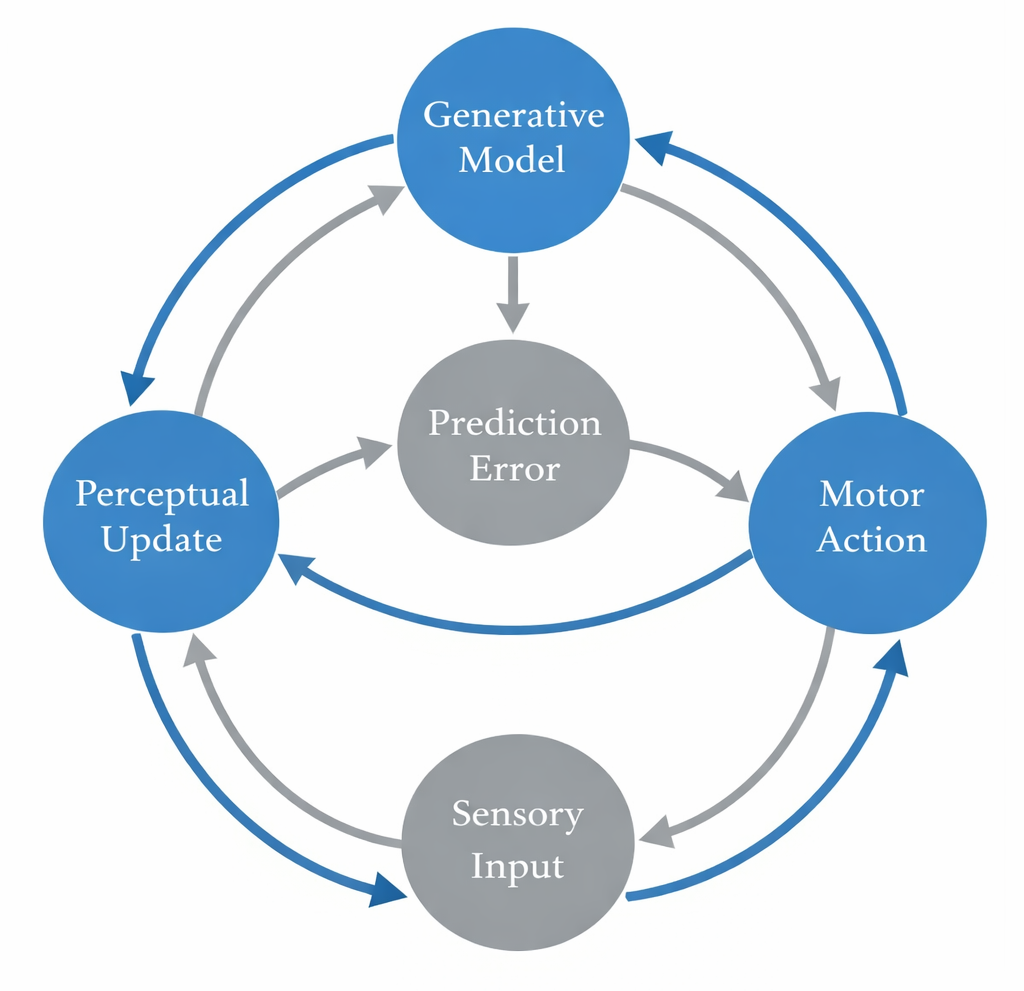
This brings us to a foundational question. The brain's core task, under the predictive processing framework, is to minimize prediction error. But what happens when there's a discrepancy between prediction and reality? There are two possible solutions: either the brain can change its internal model to better match the world, or it can act on the world to make it better match the model. Today, we will see how these two pathways are not separate but are two sides of the same coin, unified under the principle of active inference. You will learn to explain this unified loop of perception and action, using a concrete sensorimotor example to demonstrate how the brain accomplishes its goals not by issuing commands, but by making its own predictions come true.
Perception and Action: Two Paths to Minimize Error
At its core, predictive processing posits that the brain is an inference engine, constantly striving to minimize surprise, or its more tractable proxy, variational free energy. Under standard assumptions, this is equivalent to minimizing prediction error.
-
Perceptual Inference (Changing the Model): This is the classic "Bayesian brain" concept. When sensory input from the world violates the brain's predictions, the resulting prediction error signal propagates up the cortical hierarchy, compelling an update to the generative model. Your brain changes its "mind" to better fit the sensory evidence. This is what we conventionally call perception or learning.
-
Active Inference (Changing the World): This is the revolutionary extension. The brain can also minimize prediction error by acting on the world to make the sensory input conform to its predictions. Instead of changing the model to fit the world, you change the world to fit the model. Action becomes a form of self-fulfilling prophecy.
This unified process is the essence of active inference. The organism is not a passive recipient of sensory data but an active agent, constantly moving, probing, and sampling the environment to make its predictions come true.
Let's ground this in a formal explanation. The paper "Model-Based Approaches to Active Perception and Control" provides a clear, concise overview of active inference.
Model-Based Approaches to Active Perception and Control
This section explains how active inference unifies perception and action under a single prediction-error minimization scheme. It moves beyond just seeing action as a tool for perception (active perception) and recasts it as a fundamental part of inference itself.
Please read the subsection "Beyond Active Perception" within Section 3. Focus on the core idea that an agent can reduce prediction error in two ways: by revising its hypothesis (perception) or by changing the world to match the hypothesis (action). The "apple-in-my-hand" example is a particularly clear illustration of these two opposing "directions of fit."
As the paper explains, if an agent has a high-level prediction (or prior belief), such as "I want an apple," this belief generates a cascade of lower-level predictions: the visual expectation of seeing an apple, the proprioceptive expectation of feeling the apple's weight and shape in your hand, and even the interoceptive expectation of the metabolic resources needed to eat it. The discrepancy between these predictions and your current sensory reality (no apple) creates a potent prediction error. This error can then be resolved by acting—reaching, grasping—until the incoming sensations match the prediction and the error is minimized.

A Concrete Example: Motor Control as Proprioceptive Prediction
This unification of perception and action fundamentally reframes our understanding of the motor system. The traditional view holds that the motor cortex sends "commands" down to the spinal cord to execute movements. Active inference proposes a more elegant solution that resolves several anatomical paradoxes.
The central claim is this: the motor cortex does not send motor commands; it sends proprioceptive predictions.
Higher cortical levels predict the sensory consequences of a desired movement—the stream of proprioceptive signals from muscles, tendons, and joints that would occur if the movement were happening. The spinal cord's role is then to act as a simple reflex controller, minimizing the prediction error between this descending prediction and the actual, real-time feedback from the limb.
The foundational paper "Predictions not commands: active inference in the motor system" by Adams, Shipp, and Friston lays out this argument with anatomical and physiological evidence. It is a key text for understanding this concept at the level you require.
[PDF] Predictions not commands: active inference in the motor system
This review paper argues that the anatomy and physiology of descending motor pathways are consistent with them conveying proprioceptive predictions, not motor commands. It is a canonical paper for understanding motor control under active inference.
First, read the section "Active inference" (p. 3). This section formally introduces the idea that motor reflexes fulfill descending proprioceptive predictions. Then, study Figure 2 and its detailed caption, "This schematic". It illustrates the proposed spinal cord circuitry, showing how descending predictions and ascending sensory signals are placed in opposition to generate prediction errors that drive motor neurons.
Let's walk through the mechanics using a simple arm movement:
- A Goal is Formed: A high-level cortical area forms a goal, which translates into a prediction of a future state, e.g., "my hand is holding a cup."
- Proprioceptive Predictions are Generated: The motor cortex, receiving this high-level prior, generates a continuous stream of predictions about the proprioceptive sensations of the arm and hand as they move towards the cup. It predicts a trajectory of joint angles, muscle lengths, and tendon tensions.
- Prediction Error at the Spinal Level: In the spinal cord, these descending predictions are compared with the actual proprioceptive feedback coming from the arm in its current position. This creates a prediction error.
- Action Resolves the Error: This prediction error drives alpha motor neurons. The muscles contract in precisely the way needed to move the arm along the predicted trajectory, thereby "canceling out" the prediction error in real time. The movement stops when the final predicted state ("hand holding cup") matches the sensory reality, and the prediction error is resolved.
In this view, classical reflexes are not just simple reactions to stimuli; they are the fundamental machinery that our brain uses to make its predictions about movement come true.
To see this principle in action, watch the following segment from a lecture by Thomas Parr, another key researcher in the field. He provides clear simulations of this exact process.
Thomas Parr: The neurobiology of active inference
This lecture provides an excellent neurobiological account of active inference, with helpful simulations. We will focus on the parts that illustrate motor control.
First, watch the brief conceptual overview from the start to understand the two routes to maximizing model evidence. Then, jump to the section on motor control. Watch the simulation of the reflex arc, which shows how a tap on the tendon creates a proprioceptive prediction error that is corrected by movement. Finally, observe the simulation of goal-directed arm movement, which demonstrates how a high-level goal (a target location) is translated into a continuous motor trajectory that fulfills the underlying prediction.
Conclusion
Today we have unified perception and action under a single principle. Rather than seeing a serial process of perception → cognition → action, active inference posits a continuous, unified loop where the brain minimizes prediction error through two complementary strategies.
Key takeaways:
- A Unified Loop: Active inference frames perception and action as two sides of the same coin, both aimed at minimizing prediction error (or free energy).
- Two Directions of Fit: Perception updates the internal model to better fit the world (model → world). Action changes the world to better fit the model (world → model).
- Proprioceptive Prediction: In the motor system, this means higher cortical areas send descending proprioceptive predictions of desired movements, not explicit motor commands.
- Action as Reflex: Classical reflex arcs in the spinal cord are the mechanism that resolves the prediction error between predicted and actual bodily states, thereby "enslaving" the muscles to fulfill the brain's predictions.
This concept is a cornerstone of the predictive processing framework. It explains how a system with a generative model can move from simply modeling the world to acting within it purposefully.
In our next lesson, we will ascend the hierarchy. If active inference is about fulfilling predictions, we must ask: where do the highest-level predictions—our goals, intentions, and plans—come from? We will explore the hierarchical organization of the generative model and see how it enables predictions with temporal depth, moving from the immediate sensorimotor loop to long-term, abstract goals.