Hello! Welcome to the start of your journey into C programming. I'm excited to guide you through this, and over the next 30 days, we'll transform the way you think about computers, logic, and problem-solving.
This first lesson is all about the "why." Before we write a single line of code, we'll establish a solid foundation by exploring two fundamental questions: What exactly is a programming language? And in a world full of newer, trendier languages, why is C—a language born in the 1970s—still a powerhouse and the perfect starting point for your ambitious goals in embedded systems, competitive programming, and beyond? By the end of this session, you'll have a clear map of the landscape and a deep appreciation for the tool we're about to master.
What is a Programming Language?
At its heart, programming is about communication. But you're not talking to a person who can fill in gaps or understand context. You're communicating with a machine that is incredibly powerful but also incredibly literal. It does exactly what you tell it to do, nothing more, nothing less.
A fantastic way to grasp this is the "peanut butter and jelly sandwich" analogy. Imagine you have to write down instructions for a robot to make a sandwich.
What are your favorite analogies to explain programming?
This forum post contains several great analogies for programming. We'll start with one that perfectly illustrates the need for precision.
Please read the comment by user "dansherpa" that starts with this analogy. Notice how an instruction like "spread the peanut butter on the bread" fails because the robot hasn't been told to open the jar or take the bread out of the bag.
This is the fundamental challenge of programming: you must break down a complex goal into a series of brutally simple, unambiguous steps. A bug in a program isn't the computer making a mistake; it's the result of flawed or incomplete instructions. The computer is like the "literate baby" described in another comment on that same page: it follows your manual to the letter but has zero initiative.
So, if the computer is this literal, what language does it actually speak? To understand this, let's dive into the machine's perspective.
Introduction to programming and programming languages: C Programming Tutorial 01
The video "Introduction to programming and programming languages" by mycodeschool provides a clear, step-by-step explanation of how we get from human ideas to machine actions.
Please watch the following segments: First, watch the introduction to understand what a program is. Next, watch the segment explaining why computers use binary. This is the core "language" of all digital hardware—a system of 0s and 1s representing "off" and "on" electrical states. This is the deep-down "why" that everything else is built on. Finally, watch the crucial explanation of the layers of abstraction from machine language to high-level languages. Pay close attention to the progression: Machine Language: Raw binary codes the CPU understands directly. Assembly Language: A slightly more human-readable layer using mnemonics. High-Level Languages (like C): Abstract, human-friendly languages that a compiler translates into machine language.
In essence, a programming language like C is a powerful tool that bridges the vast gap between our human way of thinking and the computer's rigid binary world. We write our instructions in a structured, readable format, and a special program called a compiler does the heavy lifting of translating it into the machine language the processor can execute.
Why C is Your Foundational Language
You have diverse goals, from creating software for embedded devices to excelling in competitive programming and landing technical interviews. C is not just a good choice for this path; it is arguably the best choice because it sits at the crossroads of all these domains.
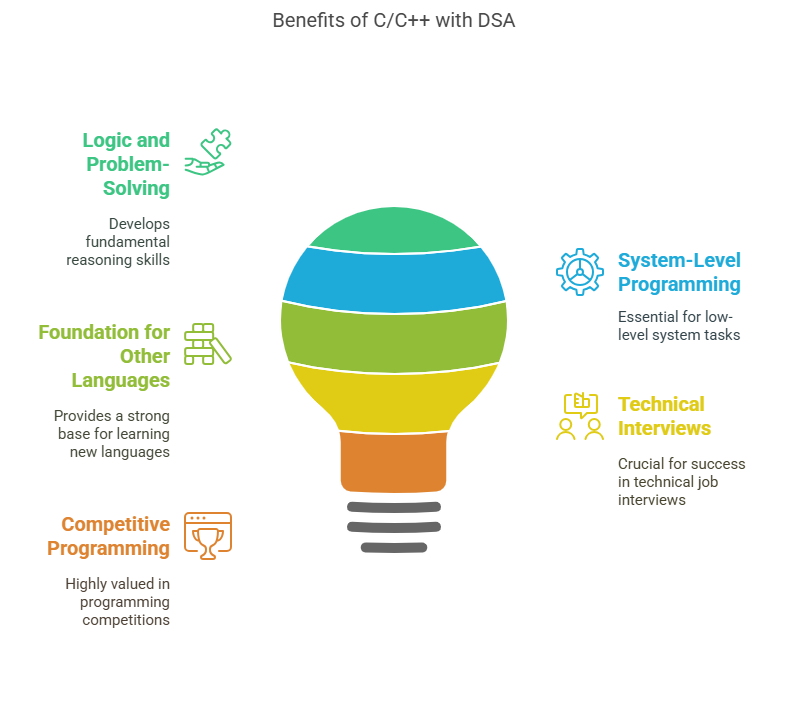
As the infographic suggests, learning C develops core problem-solving skills and provides a rock-solid foundation for almost everything else in computer science. Let's see why, connecting it to your specific interests.
1. For Systems and Embedded Programming: Unmatched Control
Your interest in embedded systems points directly to C's greatest strength: control. Embedded systems are computers inside other devices—cars, drones, medical equipment, home appliances. These devices have limited memory and processing power, and their software must be extremely efficient and reliable.
C allows programmers to get "close to the hardware." It gives you tools (which we'll explore in-depth later, like pointers) to manage memory directly and perform low-level operations that are impossible in many modern languages. This is why C is the language of choice for the software that runs our world.
Why Do We Still Use C in 2025 ?
The video "Why Do We Still Use C in 2026 ?" gives fantastic, concrete examples of where C is used.
Watch the section from the beginning to see how C is used in everything from election machines and medical devices to NASA's Mars rovers and advanced automotive systems.
These examples aren't just historical footnotes; they are active, modern systems that rely on C for its predictability and performance. When a software failure could have life-threatening consequences, engineers choose C.

2. For Competitive Programming: Raw Speed
In competitive programming, you solve complex algorithmic puzzles under tight time and memory constraints. The efficiency of your code is paramount.
C excels here because it's fast. A compiled C program is a lean set of machine instructions, with no extra baggage. Unlike interpreted languages (like Python) or languages that run on a "virtual machine" (like Java), C has virtually no runtime overhead. This means your code runs as fast as the hardware will allow—a critical advantage when milliseconds matter.
3. As the Bedrock of Modern Computing
Here's one of the biggest secrets in software development: even when you're using other languages, you're often indirectly using C.
Why C Language Is Still Used in Modern Software Dev
This article provides an excellent overview of C's enduring relevance. It connects many of the dots we've discussed.
Please read the following sections from the article: Section 2, "C Powers Operating Systems," to see how foundational C is to Windows, Linux, and macOS. Section 3, "C Is the Language of Embedded Systems," which reinforces what we've already discussed. Section 4, "Performance Matters," confirming its role in high-speed applications. And most importantly, Section 7, "Modern Languages Depend on C." This reveals that the interpreters and virtual machines for languages like Python, Java, and Ruby are themselves built in C.
By learning C, you're not just learning one language. You're learning the fundamental principles of how memory works, how data is represented, and how the processor actually executes code. This deep understanding will make you a better programmer, no matter which language you use in the future.
Conclusion
I hope you now have a clear picture of what we're about to do and why it matters. Let's summarize the key takeaways:
- Programming is about giving precise, unambiguous instructions to a computer. The machine is a literal-minded but powerful servant.
- We use high-level languages like C to write human-readable instructions, which a compiler translates into the binary machine language the CPU understands.
- C is a foundational language because it provides a unique combination of speed and low-level control.
- This combination makes it indispensable for systems programming (like operating systems), embedded systems (like in cars and medical devices), and performance-critical tasks (like competitive programming).
- By learning C, you gain a deep understanding of how computers work, which will serve as a powerful foundation for your entire career in technology.
You now understand the "why." You know the destination and have the map. In our next lesson, we'll start the engine.
Preview of the next lesson: We will roll up our sleeves and set up your digital workshop. You'll install a code editor and a C compiler, the two essential tools you'll need. By the end, you'll be ready to write and run your first piece of C code.