In our previous lessons, you've mastered several powerful techniques for finding the limit of a sequence, including algebraic manipulation, L'Hôpital's rule, and the Squeeze Theorem. These methods are excellent when our goal is to compute the exact value a sequence converges to. However, sometimes we are more interested in the behavior of a sequence's terms themselves. Do they march steadily in one direction? Do they stay confined within a certain range of values?
This lesson introduces two fundamental properties that describe this behavior: monotonicity (whether a sequence is consistently increasing or decreasing) and boundedness (whether a sequence is confined by upper and lower limits). You will learn the formal definitions for these properties and, more importantly, master the analytical techniques to determine if a given sequence has them. These concepts are not just descriptive; they are the building blocks for one of the most elegant theorems in sequence convergence, which we will explore in our next session.
What are Monotonic and Bounded Sequences?
Let's begin by establishing clear, formal definitions for these properties. While the intuitive ideas of "always increasing" or "staying within a range" are useful, mathematical precision is key.
Calculus II - More on Sequences
This reading from Paul's Online Math Notes provides concise, formal definitions for increasing, decreasing, monotonic, and bounded sequences.
Please read the first part of the page, from the beginning down to the start of the examples. Focus on mastering the precise meaning of each of the six numbered definitions.
To summarize the key definitions:
- A sequence is increasing if for all .
- A sequence is decreasing if for all .
- A sequence is monotonic if it is either increasing or decreasing.
- A sequence is bounded above if there is a number such that for all .
- A sequence is bounded below if there is a number such that for all .
- A sequence is bounded if it is bounded both above and below.
Note that some texts use "non-decreasing" () and "non-increasing" () to allow for terms to be equal. For our purposes, we will follow the convention in the reading, but it's good to be aware of this slight variation in terminology.
The image below gives a helpful visual summary of these concepts.

How to Determine if a Sequence is Monotonic
Simply looking at the first few terms can be misleading. To prove a sequence is monotonic, we need a rigorous method that holds for all . There are three primary techniques.
Method 1: Direct Comparison
This method involves setting up an inequality between a generic term and the next term . You then use algebra to prove whether the inequality (for increasing) or (for decreasing) is always true.
The following video provides an excellent walkthrough of this algebraic approach.
Monotonic Sequences and Bounded Sequences - Calculus 2
In this video from The Organic Chemistry Tutor, watch the first worked example, which demonstrates how to prove that the sequence a_n = \frac{3n}{n+2} is increasing.
Watch from the start of the example to its conclusion. Pay close attention to how the inequality a_n \le a_{n+1} is set up and algebraically simplified to reach a statement that is known to be true (in this case, 0 \le 6).
This method is powerful when the algebra is manageable.
Method 2: Using Derivatives
Since you have a strong background in calculus, you can leverage a powerful connection between sequences and functions. If we have a sequence , we can often define a corresponding real-valued function such that . If we can show that for greater than some value, then the function is increasing, which implies the sequence is also increasing. Likewise, if , the sequence is decreasing.
This is often the most efficient method for sequences that are expressed as rational functions or involve logarithms.
Calculus II - More on Sequences
This reading continues from where you left off, focusing on examples where using derivatives is the best approach. It also contains a critical warning about relying on intuition.
Please read through the section titled "Example 2". Focus on two key aspects: In part (a), see how the derivative of f(x) = \frac{x}{x+1} is used to prove that the sequence a_n = \frac{n}{n+1} is increasing. In part (b), study the example a_n = \frac{n^3}{n^4 + 10000}. This is a crucial example that shows how a sequence can increase for the first several terms and then start decreasing. This demonstrates why simply listing out terms is not a valid proof of monotonicity.
Method 3: Ratio of Consecutive Terms
For sequences involving factorials or in an exponent, both direct comparison and derivatives can be cumbersome. A more elegant approach is often to examine the ratio .
- If the terms are all positive and for all , then , so the sequence is increasing.
- If the terms are all positive and for all , then , so the sequence is decreasing.
Let's look at the sequence . Listing the first few terms gives us , , , . It seems to increase and then decrease. This property of being monotonic after a certain point is called being eventually monotonic. For the purpose of convergence, which depends on the long-term behavior, "eventually monotonic" is just as good as "monotonic".
Let's prove it is eventually decreasing using the ratio method:
The ratio will be less than 1 whenever , or . This proves that for , the sequence is decreasing. It is therefore eventually monotonic.
How to Determine if a Sequence is Bounded
Finding bounds can sometimes be an art, but there are standard strategies.
-
For monotonic sequences: The behavior is predictable.
- If a sequence is increasing, its first term is a lower bound. To find an upper bound, you can investigate the limit: . If this limit is a finite number , then is an upper bound. If the limit is , the sequence is not bounded above.
- If a sequence is decreasing, its first term is an upper bound. The limit (if finite) will be a lower bound.
-
For oscillating sequences: Use known properties of the functions involved. For example, we know and . These can be used to bound the entire sequence. For instance, the sequence is bounded. Since , we have . For , this means . Therefore, , so . The sequence is bounded.
The following video discusses how to find bounds in these different scenarios.
Monotonic and Bounded Sequences | Calculus 2 | Math with Professor V
This video from Math with Professor V walks through several examples of determining boundedness.
Please watch these three clips: First, an example of an unbounded sequence: the analysis of a_n = n^2, which is bounded below but not above. Next, see how boundedness is determined for a decreasing sequence: the analysis of a_n = 1/n. Notice how the first term provides the upper bound and the limit provides the lower bound. Finally, watch a more complex example that combines the derivative test for monotonicity with limits for boundedness: the analysis of a_n = \frac{1-n}{2+n}.
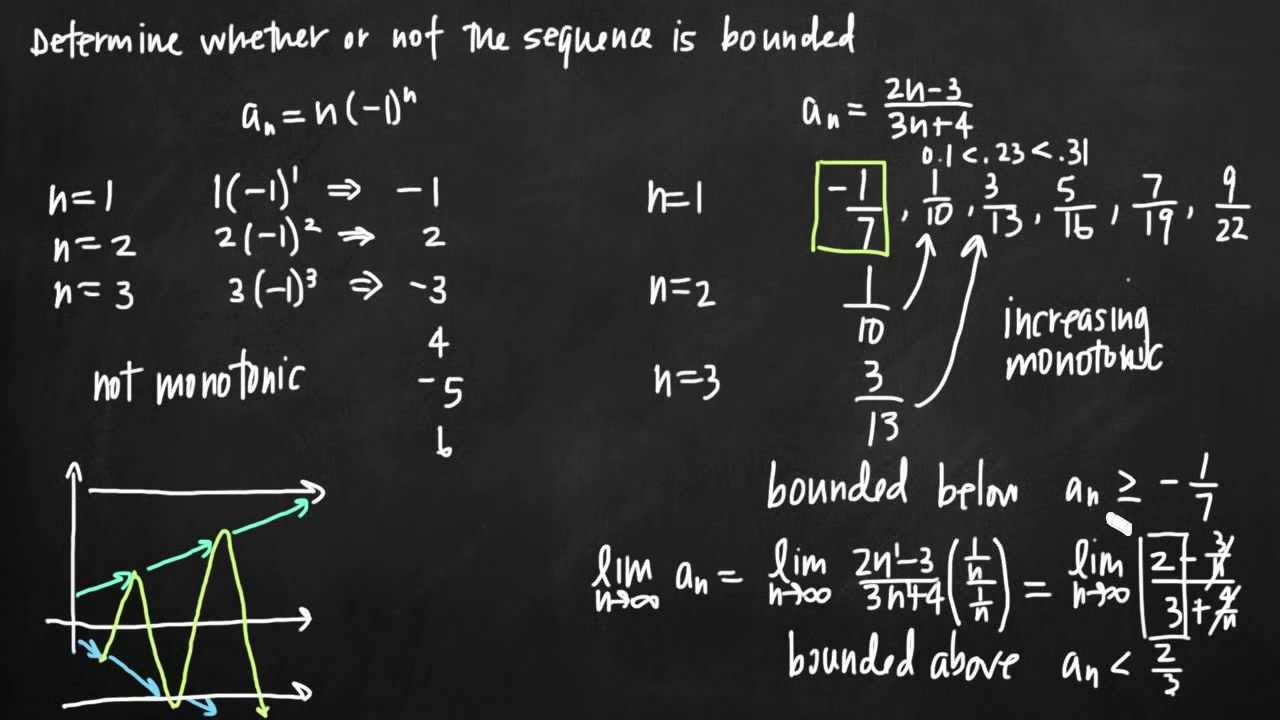
The image below shows two more worked examples. On the left, is neither monotonic nor bounded. On the right, is shown to be increasing (and thus monotonic) and bounded.
Practice Problems
Apply the techniques you've learned to determine if the following sequences are monotonic and/or bounded.
Take a few minutes to work through them before checking the solutions.
Solutions:
-
Sequence :
- Monotonicity: Let's use the derivative test. Consider .
Using the quotient rule:
The denominator is always positive. The numerator is negative for . Thus, for , the sequence is decreasing (it is eventually monotonic). - Boundedness: Since the sequence is decreasing for , it is bounded above. The maximum value will be either or . , . So an upper bound is . To find a lower bound, we take the limit:
Since all terms are positive, a lower bound is . Because it is bounded above and below, the sequence is bounded.
- Monotonicity: Let's use the derivative test. Consider .
-
Sequence :
- Monotonicity: Let's use the derivative test again. Consider .
For , both the numerator () and denominator are always positive. Thus , and the sequence is increasing (and therefore monotonic). - Boundedness: Since the sequence is increasing, its first term is a lower bound. To check for an upper bound, we take the limit:
Since the limit is infinite, the sequence is not bounded above. Therefore, the sequence is not bounded.
- Monotonicity: Let's use the derivative test again. Consider .
Conclusion
In this lesson, we shifted our focus from calculating the limits of sequences to analyzing their intrinsic properties. You learned the formal definitions of monotonic and bounded sequences and mastered several techniques to test for these properties.
The key takeaways are:
- A monotonic sequence is one that is always increasing or always decreasing (at least eventually).
- A bounded sequence is one whose terms are all contained between some upper and lower bound.
- To prove monotonicity, you can use direct comparison ( vs. ), the derivative of a corresponding function , or the ratio .
- To determine boundedness, you can find explicit bounds by analyzing the sequence's monotonicity, its limit, or the properties of its component functions.
You now have the tools to classify sequences based on their behavior. In our next lesson, we will connect these two properties in a powerful way with the Monotone Convergence Theorem. This theorem states that if a sequence is both bounded and monotonic, it is guaranteed to converge. This will give us a way to prove convergence even when we cannot easily calculate the limit itself.