Welcome back. In our previous lesson, you learned how to analyze a sequence's behavior by determining if it is monotonic (always heading in one direction) and bounded (confined within a certain range). These properties are more than just descriptive; they are the two essential ingredients for a powerful result that guarantees convergence.
This lesson introduces one of the cornerstone theorems of sequence analysis: the Monotone Convergence Theorem. You will learn how this elegant theorem connects boundedness and monotonicity to provide a definitive test for convergence. Our goal is to apply this theorem, which will allow you to prove that a sequence converges even when you can't compute its limit directly. This is a crucial tool that bridges the gap between the behavior of a sequence and its ultimate fate.
The Monotone Convergence Theorem
At its heart, the Monotone Convergence Theorem makes a simple, intuitive claim: if a sequence is always increasing but is prevented from going past a certain "ceiling" (an upper bound), it must eventually level off and approach a specific value. Similarly, a decreasing sequence that can't fall below a "floor" (a lower bound) must also settle at a specific value.
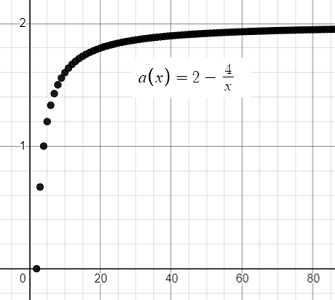
Let's formalize this intuition. The following reading from the OpenStax Calculus text provides a clear explanation and the formal statement of the theorem.
5.1 Sequences - Calculus Volume 2
This reading will first walk you through the logical reasoning behind the theorem and then provide its formal statement.
Start by reading the intuitive explanation under the "Bounded Sequences" heading. Then, review the formal definitions for monotone sequences, and finally, read the formal statement of the Monotone Convergence Theorem (Theorem 5.6).
To summarize the theorem:
If a sequence is bounded and is monotonic for all greater than some integer , then it converges.
More specifically:
- If the sequence is increasing and bounded above, it converges to its supremum (least upper bound).
- If the sequence is decreasing and bounded below, it converges to its infimum (greatest lower bound).
A Look at the Proof
The OpenStax text omits the proof, but since you have an interest in the rigorous underpinnings of these concepts, it's worth seeing why the theorem is true. The proof relies on a deep property of the real number system called the Completeness Axiom, which essentially states that there are no "gaps" in the real number line. This axiom guarantees that any non-empty set of real numbers with an upper bound must have a least upper bound (a supremum).
The following video provides an excellent, detailed proof. It is from a Real Analysis series, so the language is formal, but the logic is clear and builds on ideas you are familiar with.
Detailed Proof of the Monotone Convergence Theorem | Real Analysis
This video from the Wrath of Math channel provides a full proof, connecting the theorem to the fundamental properties of real numbers.
First, watch the visual intuition, which provides a clear graphical motivation for the theorem. Then, follow the core part of the proof for a bounded, increasing sequence from this segment. The key idea is that since the sequence is bounded, a least upper bound (supremum) must exist. The proof then uses the definition of a limit to show that the sequence's terms must get arbitrarily close to this supremum.
Applying the Monotone Convergence Theorem
The true power of this theorem lies in its application. It gives us a two-step method to prove convergence:
- Show the sequence is monotonic (or at least eventually monotonic). You can use any of the methods from our last lesson: direct comparison, derivatives, or the ratio of consecutive terms.
- Show the sequence is bounded. For an increasing sequence, you only need to find an upper bound. For a decreasing sequence, you only need a lower bound.
If you can establish both, the Monotone Convergence Theorem guarantees that the limit exists. Let's see this process in action.
Monotonic Sequences and Bounded Sequences - Calculus 2
This video segment demonstrates the standard two-step application of the theorem to a straightforward sequence.
Watch the example starting from this timestamp. The presenter shows that the sequence a_n = 1/n^2 is both decreasing and bounded, and therefore must converge. This is a perfect illustration of the methodology.
Finding the Limit
The theorem tells us that a limit exists, but it doesn't tell us what it is. However, once we know a sequence converges, we can often find its limit, especially for recursively defined sequences.
If we know , then it must also be true that , since the sequence is just the same sequence with the first term omitted, which doesn't affect the limit. This allows for a powerful algebraic trick.
The next reading demonstrates this technique on a classic example.
5.1 Sequences - Calculus Volume 2
This example is a classic application of the MCT to a recursively defined sequence, showcasing how to find the limit after proving its existence.
In Example 5.6, focus on part a. Follow the argument carefully. First, the author shows the sequence is decreasing and bounded below, concluding it converges via the MCT. Then, they set \lim a_{n+1} = \lim a_n = L in the recurrence relation and solve for L. This is a standard and very useful technique.
A Note on "Eventually Monotonic" Sequences
A sequence does not need to be monotonic from its very first term for the theorem to apply. As long as it becomes monotonic from some point onwards (i.e., it is eventually monotonic), its long-term behavior is stable. Since convergence is all about long-term behavior, the Monotone Convergence Theorem still holds.
The following example is a great illustration of this. The sequence increases for a few terms before settling into a decreasing pattern.
Monotonic Sequences and Bounded Sequences - Calculus 2
This final example demonstrates the flexibility of the MCT when dealing with sequences that are not strictly monotonic from the start.
Watch the segment from this example. The presenter analyzes the sequence a_n = 3^n/n!. Notice how it increases for the first few terms before becoming strictly decreasing for all n \ge 2. Since it is eventually decreasing and also bounded below by 0, the theorem still applies, and we can conclude it converges.
Conclusion
In this lesson, you've added a powerful and elegant tool to your mathematical arsenal. The Monotone Convergence Theorem provides a bridge between the descriptive properties of a sequence and the definitive conclusion of its convergence.
Here are the key takeaways:
- The Monotone Convergence Theorem states that if a sequence is both bounded and monotonic (or eventually monotonic), it is guaranteed to converge.
- Applying the theorem is a two-step process: first, prove monotonicity, then prove boundedness.
- This theorem is especially useful for proving that a sequence converges when its limit is not obvious. For recursively defined sequences, it allows you to first prove that a limit exists, and then solve for algebraically.
You have now completed your study of the foundations of sequences. You can define them, find their limits, and now, prove their convergence based on their internal properties.
In our next lesson, we will make the leap from sequences to infinite series. You will learn that an infinite series is defined as the limit of a very special type of sequence—the sequence of its partial sums. The concepts of convergence and limits that you have mastered here will be directly applicable as we begin to explore the fascinating world of infinite sums.