Welcome to your personalized course on Formal and Design Verification!
Given your strong foundation in FPV and your goal to be interview-ready for both FV and DV roles, we will start by solidifying and deepening your SystemVerilog Assertions (SVA) expertise. This first module, "SVA Foundations & Advanced Semantics," is designed to refine your understanding of the subtle details that distinguish a proficient engineer from an expert—details that are frequently targeted in technical interviews.
This first lesson focuses on the absolute cornerstone of SVA: implication operators. We will dissect the precise timing semantics of overlapped (|->) and non-overlapped (|=>) implication, analyze their trade-offs, and establish a clear framework for when to use each. Mastering this is non-negotiable for writing correct and efficient properties.
1. The Need for Implication: Why Not Just Sequences?
As you know, concurrent assertions are tied to a clock and are evaluated at every active clock edge. A naive approach might be to simply write a sequence and assert it directly. However, this leads to a significant problem.
Let's consider a simple property: "If req is asserted, then ack must be asserted two cycles later." One might try to write this as:
// Incorrect attempt
assert property (@(posedge clk) req ##2 ack);
This property will check for req at every positive clock edge. On cycles where req is not asserted, the assertion will fail immediately. This is not our intent. We only care about the behavior if and when req occurs.
To see a clear illustration of this issue, please review the following material.
[PDF] SystemVerilog Assertions (SVA) Training Workshop - Sutherland HDL
This section from a Sutherland HDL workshop presentation illustrates the problem of using raw sequences in assertions and sets the stage for why implication is necessary.
Please review slide 13, titled 'A Concurrent Assertion Gotcha'. Focus on the waveform and the explanation of why the assertion fails on cycles where req is false. This demonstrates why we need a way to conditionally evaluate a sequence.
This problem is precisely what implication operators are designed to solve. They provide a conditional structure: if a trigger condition occurs, then check the corresponding behavior.
2. The Language of Implication: Antecedent, Consequent, and Vacuity
An SVA property with implication is structured as:
antecedent operator consequent
To discuss these constructs professionally, it's vital to use the correct terminology.
Blog: An Introduction to Assertion-Based Verification - Part 2 - FirstEDA
Before we compare the two implication operators, let's solidify our vocabulary. This blog post from FirstEDA provides clear, standard definitions for the components of an implication.
Read the section 'The Use of Implication', up to (but not including) the paragraph that starts 'A vacuous pass is crucial...'. Pay close attention to the definitions of 'antecedent', 'consequent', and 'vacuous truth'.
As the reading highlights, here are the key takeaways:
- Antecedent (the "if" part): This is the trigger or a pre-condition. It can be a simple boolean expression or a complex sequence.
- Consequent (the "then" part): This is the expected behavior or sequence of events that must follow if the antecedent is true.
- Vacuous Success (or Vacuous Pass): If the antecedent is false at a given clock edge, the property is considered trivially true. The check is not relevant, so the property passes vacuously without evaluating the consequent. This is a crucial concept for both simulation efficiency and formal analysis. In an interview, using the term "vacuous" correctly demonstrates a deeper understanding.
3. Overlapped (|->) vs. Non-overlapped (|=>) Implication
The choice between |-> and |=> determines the precise starting time of the consequent's evaluation relative to the completion of the antecedent. This is a frequent source of off-by-one errors and a classic interview topic.
Overlapped Implication: |->
- Timing: The consequent starts evaluation on the same clock edge that the antecedent completes.
- Analogy: Think of it as a combinational or immediate consequence.
- Example:
req |-> gnt- At a
posedge clk, ifreqis true, the property requiresgntto also be true in that same cycle.
- At a
Non-overlapped Implication: |=>
- Timing: The consequent starts evaluation on the next clock edge after the antecedent completes.
- Analogy: Think of it as a registered or next-cycle consequence.
- Example:
req |=> gnt- At a
posedge clk, ifreqis true, the property requiresgntto be true on the followingposedge clk.
- At a
- Key Identity: A non-overlapped implication
a |=> bis semantically identical toa |-> ##1 b. Remembering this can simplify complex properties.
The following resource provides excellent diagrams to visualize this difference.
[PDF] SystemVerilog Assertions (SVA) Training Workshop - Sutherland HDL
Now let's examine the precise timing of the two implication operators. The Sutherland HDL presentation offers clear, concise diagrams for both.
Study slide 14, 'Conditioning Sequences Using Implication Operators'. Focus on the two diagrams that illustrate the difference between |-> (overlapped) and |=> (non-overlapped) implication. Contrast where the (req ##2 ack) sequence begins in each case.
To further solidify this, analyze the waveform below.
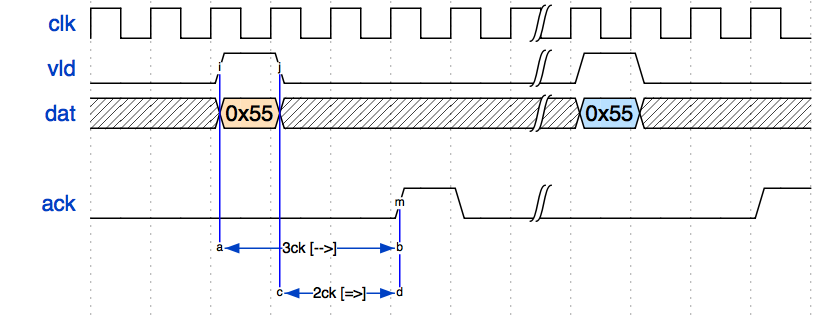
4. Strategic Selection and Trade-offs
Choosing the correct implication operator is not just about syntax; it's about correctly modeling the design's micro-architectural intent.
-
Use
|->(Overlapped) for properties describing behavior within the same clock cycle. This is common for:- Combinational logic relationships:
sel |-> (out == a) - Conditions on data buses when a valid signal is high:
vld |-> $stable(data) - Checking properties where the antecedent and consequent are causally linked in the same cycle.
- Combinational logic relationships:
-
Use
|=>(Non-overlapped) for properties describing behavior across consecutive clock cycles. This is far more common for verifying control logic and pipelines:- Standard request/grant protocols:
req |=> gnt(If you request this cycle, you are granted next cycle). - Pipeline behavior:
stage1_vld |=> stage2_vld - Checking the output of a register:
(d_in == 5) |=> (q_out == 5)
- Standard request/grant protocols:
An Important Performance Trade-off
What happens if your antecedent is true for multiple consecutive cycles? For example, req is held high for 4 cycles. A property like req |=> gnt will start four separate evaluation threads, one on each cycle req is high. This can be inefficient in simulation.
A more precise and efficient way to write this is to trigger the assertion only on the start of the event.
Blog: An Introduction to Assertion-Based Verification - Part 2 - FirstEDA
Knowing the syntax is one thing; using it efficiently is another. This is a key differentiator in interviews. The FirstEDA article discusses how to write more performant assertions by being more specific with your antecedent.
Read from the paragraph starting 'The assertion example we introduced above has one disadvantage...' through to the end of the 'general assertion ‘tips’'. Focus on how using $rose(REQ) makes the property more precise and efficient.
The key takeaway is that using edge-detection functions like $rose() or $fell() in the antecedent makes your property's intent clearer and reduces simulation overhead by preventing redundant threads.
Conclusion
In this lesson, we established the foundational role of SVA implication. You can now precisely explain the timing semantics of both |-> and |=>, articulate the key terminology (antecedent, consequent, vacuity), and make strategic choices based on design intent and performance considerations.
Key Takeaways:
- Implication
(antecedent |-> consequent)is used to conditionally check a property. |->(Overlapped): Consequent starts in the same cycle the antecedent ends. Best for same-cycle and combinational checks.|=>(Non-overlapped): Consequent starts in the next cycle after the antecedent ends. Best for registered and pipelined logic. It is equivalent to|-> ##1.- A property passes vacuously if its antecedent is false.
- For efficiency, use specific trigger conditions like
$rose()in the antecedent to avoid redundant evaluation threads.
In the next lesson, we will build upon this foundation to explore repetition operators (##, [*], [->], [=]), allowing you to write powerful sequences for complex multi-cycle timing patterns.
🧠 Interview & Practice Drill
Time to put this theory into practice. Answer these questions as you would in a high-pressure interview.
🎤 Interview Drill Section
-
Rapid Fire Theory:
- What is the fundamental difference between
|->and|=>? - What does it mean for a property to pass vacuously? Why is this concept important in formal verification?
- I have a property
a |=> b. Can I rewrite this using|->? If so, how? - An engineer on my team wrote
assert property (@(posedge clk) req ##1 gnt);. What's wrong with this, and how would you fix it?
- What is the fundamental difference between
-
Scenario-based Question:
- "I have a 3-stage pipeline. A valid transaction enters
stage0indicated bys0_vld. It is expected to appear instage1(indicated bys1_vld) one cycle later, and instage2(indicated bys2_vld) two cycles after that. However, the pipeline can be stalled at any stage. A stall is indicated bys1_stallors2_stall. Ifs1_stallis high, the data in stage0 does not move to stage1. - Forget the stall condition for a moment. Whiteboard the SVA property to check that if a transaction is valid in
stage0, it becomes valid instage1on the next cycle. Which implication operator will you use and why?"
- "I have a 3-stage pipeline. A valid transaction enters
🧩 Coding Exercises
Write the SVA properties for the following scenarios. Assume a default clocking block @(posedge clk).
- Combinational Mux Check: A 2-to-1 multiplexer has inputs
a,b, a selectorsel, and outputy. Write a property that asserts: wheneverselis high, the outputymust be equal to inputbin the same cycle. - Registered Assignment: A register
qis loaded with the value ofdwhenload_enis high. Write a property to verify that ifload_enis high on a given cycle, the value ofqin the next cycle will be equal to the value thatdhad. - Modified Handshake: A
reqsignal is sent to a module. The module is expected to respond withackexactly 3 clock cycles later. Write a property that verifies this relationship only for the first cycle thatreqgoes high (i.e., on its rising edge).