Welcome to the final lesson of our course on clinical laboratory interpretation. Over the past several modules, we have built a comprehensive framework for understanding and applying lab results, culminating in our last lesson on synthesizing data to see the complete clinical picture. You've learned to connect a patient's story and physical exam with complex lab patterns to refine your diagnosis.
Today, we address the final, and perhaps most important, aspect of true clinical mastery: humility. No tool is perfect, and laboratory tests are no exception. This lesson is dedicated to recognizing the limitations of our diagnostic tools. Our learning outcome is to recognize the limitations of lab testing and identify when clinical context overrides an abnormal result. This is the art of medicine—knowing when to trust the patient in front of you more than the number on the page.
1. The Pilot and the Instruments: A Guiding Analogy
In our previous lesson, we focused on putting pieces together. Now, we'll learn when to question if a piece even belongs in the puzzle. Let's start with a mental model to guide us through this lesson.
Lab Results, Values, and Interpretation (CBC, BMP, CMP, LFT)
The MedCram video 'Lab Results, Values, and Interpretation' provides a powerful analogy. It compares a clinician to a pilot flying a plane (the patient). Lab results are the instruments, essential for navigating when visibility (the clinical picture) is poor. But what if the instruments are faulty or misleading?
Please watch from 1:49 to 3:00 to understand the pilot analogy. Then, watch from 6:20 to 9:13, where the video explains why, unlike a pilot, a clinician cannot always 'trust their instruments.' Pay close attention to the discussion on lab errors and the importance of clinical verification.
As you just saw, while a pilot is often told to trust their instruments over their senses, a clinician must do the opposite: always filter lab data through the lens of clinical common sense. An unexpected or bizarre lab value should trigger skepticism, not blind action. Our job today is to build a systematic approach to that skepticism.
2. Laboratory Stewardship: The "Goldilocks Principle"
Before we even interpret a result, recognizing limitations begins with thoughtful ordering. Ordering too few tests can lead to missed diagnoses, but ordering too many invites confusion from false positives and adds unnecessary costs.
This philosophy is often called laboratory stewardship. The goal is to find the "just right" amount of testing.
The Society for Academic Emergency Medicine (SAEM) provides a guide for students that outlines this principle beautifully. It gives a framework for deciding when a test is truly necessary.
Please read the section titled 'Laboratory Stewardship.' Focus on the three general themes to consider when ordering studies. These principles are the foundation for avoiding the pitfalls of over-testing.
To summarize those key principles:
- Only order a test if the result will change your management.
- Always consider the pre-test probability of the disease.
- Have a lower threshold to test for "can't miss" diagnoses.
This mindset is your first line of defense against being misled by lab data.
3. Limitation 1: The Test Itself (Statistical Realities)
A lab test doesn't provide a "yes" or "no" answer; it provides a probability. The value of that probability is hugely dependent on the pre-test likelihood of disease.
Positive Predictive Value & Disease Prevalence
This excellent video from Medmastery demonstrates how a test's Positive Predictive Value (PPV)—the probability that a positive result is a true positive—is not a fixed property of the test. It changes dramatically based on the prevalence of the disease in the population you're testing.
Please watch from 1:47 to 4:55. The video first shows mathematically how the same test can be useful in a high-prevalence population but nearly useless in a low-prevalence one. Then, it tells a powerful true story about a pilot that perfectly illustrates this principle in action.
The story of the pilot with a left bundle branch block (LBBB) is a perfect example of this lesson's theme.
- The "Abnormal" Result: An LBBB on an ECG.
- The Context: The "patient" is a healthy, asymptomatic pilot. The prevalence of underlying cardiomyopathy in this population is extremely low.
- The Limitation: In this low-prevalence setting, the PPV of an LBBB for predicting future cardiomyopathy is poor. The finding is more likely to be a false positive (or a benign variant) than a sign of true disease.
- The Override: The expert clinician recognized that the clinical context (a healthy pilot) overrode the "abnormal" finding, arguing against the aviation authority's blanket directive.
This principle is vital for interpreting screening tests. For example, using the D-dimer to screen for pulmonary embolism is only recommended for patients with a low-to-intermediate pre-test probability. In a high-risk patient, the test is likely to be positive anyway and a negative result isn't reassuring enough to stop you from ordering a CT scan. In a very low-risk patient (e.g., meeting PERC criteria), the risk of a false positive outweighs the benefit of testing.
4. Limitation 2: The Process (Pre-Analytical Errors)
Often, an abnormal result has nothing to do with the patient's physiology and everything to do with what happened to the blood sample on its way to the lab. Up to two-thirds of lab errors are pre-analytical, meaning they occur during collection, handling, or transport.
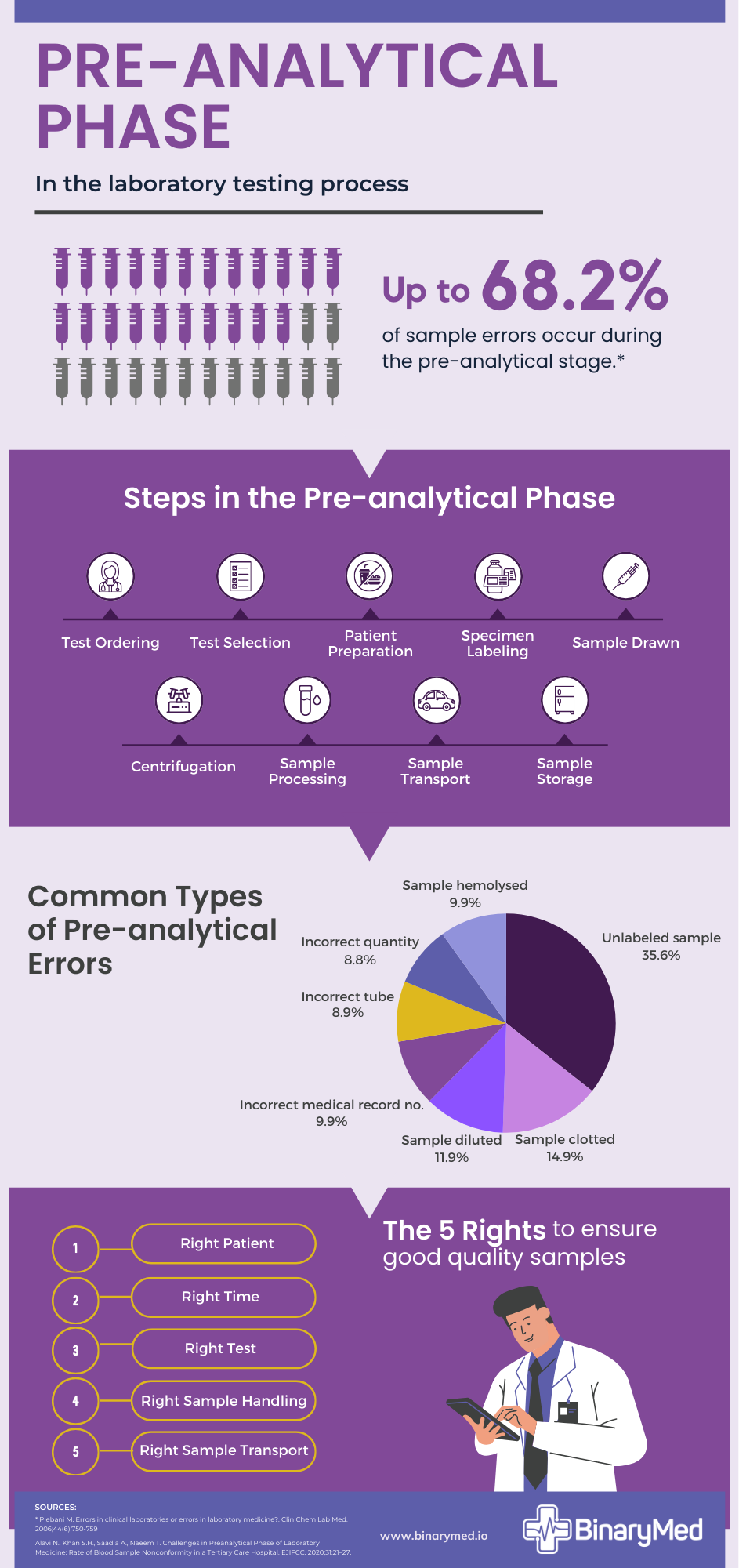
Here are some classic examples where context should make you suspect a pre-analytical error:
- Pseudohyperkalemia: A patient feels perfectly fine, their ECG is normal, but their potassium is 7.0 mEq/L. The most likely cause is hemolysis, where red blood cells broke open in the tube, releasing their intracellular potassium. This can happen from a difficult blood draw. The clinical context (asymptomatic, normal ECG) overrides the critical lab value. The correct action is to calmly repeat the test, not to start aggressive treatment for hyperkalemia.
- Contamination from an IV line: A patient's glucose is reported as 450 mg/dL, but they have no history of diabetes and no other signs of hyperglycemia. If the blood was drawn from an arm where a dextrose-containing IV fluid was infusing, the sample was likely contaminated.
- Incorrect tube: A sample for a coagulation study (PT/INR) is drawn in the wrong type of tube (one without citrate anticoagulant). The blood will clot in the tube, consuming the clotting factors, and the result will be a falsely, astronomically high INR.
Test your understanding!
A 72-year-old woman with a history of heart failure is admitted for pneumonia. She is clinically stable. Her routine morning labs show a potassium of 6.8 mEq/L (critical value). Her ECG shows no changes. What is the most likely cause of this lab finding, and what should be your immediate first step?
Show answer
The most likely cause is pseudohyperkalemia from hemolysis (a pre-analytical error). Given that the patient is clinically stable and her ECG is unchanged, a true life-threatening hyperkalemia is less likely. Your immediate first step should be to request a repeat blood draw to verify the result, perhaps asking the phlebotomist to use a larger gauge needle to minimize the risk of hemolysis. You should not immediately administer treatments like insulin, glucose, or kayexalate, which could cause dangerous hypokalemia if the initial result was an error.
5. Limitation 3: The Patient (Physiological Context)
Even with a perfect test and a perfect sample, the patient's own body can create misleading results. You must always interpret labs within the context of the individual's specific physiological state.
The article "Pitfalls & pearls for 8 common lab tests" provides several excellent examples. Let's explore a few.
Pitfalls & pearls for 8 common lab tests
This article from The Journal of Family Practice is a practical guide to common situations where lab results can be misleading without the proper context. It's filled with clinical pearls that directly address our learning outcome.
First, read the section 'Hemoglobin A1c: How does anemia affect it?' Then, read the section 'Urine drug screens: Which factors affect their accuracy?' including Table 3. These are two very different but common scenarios where context is everything.
Let's break down these examples:
-
Hemoglobin A1c: The HbA1c test measures the percentage of hemoglobin coated in glucose, acting as an estimate of average blood sugar over the lifespan of a red blood cell (~3 months). But what if the RBC lifespan is altered?
- In iron deficiency anemia, RBCs live longer, giving them more time to accumulate glucose. This can falsely elevate the HbA1c, making a patient look diabetic when they are not.
- In conditions with rapid RBC turnover (like hemolytic anemia or splenomegaly), the RBC lifespan is shorter. This can falsely lower the HbA1c, masking underlying hyperglycemia.
- The Override: In a patient with a known hemoglobinopathy or significant anemia, you cannot trust the HbA1c. You must rely on other methods like frequent fingerstick glucose monitoring or a fructosamine level.
-
Urine Drug Screens (UDS): As you saw in Table 3, these immunoassays are notoriously prone to cross-reactivity.
- Common over-the-counter medications like ibuprofen can cause a false positive for barbiturates, PCP, or cannabinoids.
- The popular antidepressant sertraline (Zoloft) can cause a false positive for benzodiazepines.
- The Override: Never make a definitive clinical or social judgment based on a screening UDS alone. If the result is unexpected and the patient denies use, the clinical context overrides the initial lab screen. The appropriate next step is to send the sample for confirmatory testing (gas chromatography-mass spectrometry), which is far more specific.
Conclusion: Becoming a Thoughtful Clinician
Congratulations on completing this course! You have journeyed from the basic definitions of sensitivity and specificity to the complex art of clinical synthesis. This final lesson was designed to instill a healthy skepticism and a deep respect for clinical context. A lab test is a powerful tool, but it is only a tool. It is not a substitute for your eyes, your ears, your hands, and your brain.
Key Takeaways from this Lesson:
- A lab result's value depends on the pre-test probability. A surprising result in a low-risk patient is often a false positive.
- Many "critical" values are due to pre-analytical errors. If a result is clinically discordant, your first thought should be to question the sample's integrity and repeat the test.
- The patient's physiology matters. Conditions like anemia, pregnancy, or kidney disease can fundamentally alter the meaning of many lab tests.
- Trust, but verify. Use the entire clinical picture—history, exam, vitals, and trends in other labs—to corroborate a result before you act.
Your goal as you continue your training is not to become a person who can recite normal lab values. It is to become a thoughtful physician who treats the person, not the paper. We hope this course has given you a solid foundation for that journey. Best of luck.