Hello! Welcome back to our module on Renal Function and Urinalysis.
In our last lesson, you learned how to analyze urine microscopy findings—specifically dysmorphic red cells and RBC casts—to pinpoint the source of bleeding in hematuria as either glomerular or non-glomerular. This is a great example of using lab results to identify a potential structural problem in the urinary tract.
Today, we'll shift our focus from structure to function. We'll explore two other key urinalysis parameters, urine specific gravity (USG) and urine osmolality (Uosm). Our goal is to interpret these values to assess the kidney's ability to concentrate urine, which is a vital tool for evaluating a patient's volume status and diagnosing important renal and endocrine disorders.
What Are We Measuring? Concentration, Density, and Particles
Both urine specific gravity and osmolality are measures of urine concentration. They tell us how much "stuff" (solutes like sodium, chloride, urea) is dissolved in the urine's water. However, they measure this in slightly different ways.
- Urine Specific Gravity (USG): This measures the density of urine relative to the density of pure water. It's influenced by both the number and the size/weight of the particles.
- Urine Osmolality (Uosm): This measures the number of solute particles per kilogram of water. It is not affected by the size or weight of the particles.
To understand these concepts from first principles and see why osmolality is generally a more accurate measure, please watch the following video.
Urine specific gravity - Density - Concentrated vs Diluted Urine - Urinalysis
This video from Medicosis Perfectionalis breaks down the concepts of density, specific gravity, and osmolality in a clear and memorable way. It establishes the foundation for everything we'll discuss today.
Watch from 0:44 to 5:31. Pay close attention to: The definition of specific gravity as a ratio of densities. The explanation of why osmolality is considered a 'colligative property' (depending only on the number of particles). The three reasons why urine osmolality is a more accurate measure of concentration than specific gravity.
The Master Regulator: Antidiuretic Hormone (ADH)
The kidney doesn't concentrate or dilute urine randomly. This process is tightly controlled by Antidiuretic Hormone (ADH), also known as vasopressin. ADH is released from the posterior pituitary in response to changes in your body's hydration status (specifically, plasma osmolality).
- When you are dehydrated, plasma osmolality rises. This triggers ADH release.
- ADH travels to the kidney and acts on the collecting ducts, causing them to reabsorb free water back into the blood.
- The result: less water is excreted, and the urine becomes concentrated (high Uosm, high USG).
Conversely, when you are well-hydrated, plasma osmolality falls, ADH is suppressed, less water is reabsorbed, and the urine becomes dilute (low Uosm, low USG).
This powerful feedback loop is the key to interpreting urine concentration tests. The same video you just watched provides a great summary of this process.
Urine specific gravity - Density - Concentrated vs Diluted Urine - Urinalysis
Let's continue with the same Medicosis Perfectionalis video to see how ADH directly controls urine concentration.
Watch from 5:31 to 6:52. Focus on the simple relationship: More ADH = More Concentrated Urine; Less ADH = More Dilute Urine.
Interpreting the Numbers in Clinical Context
Now, let's apply this physiology. When you see a USG or Uosm value, you must interpret it in the context of the patient's likely volume status.
Normal Ranges:
- Urine Specific Gravity: Can range widely from ~1.005 (very dilute) to ~1.030 (very concentrated). A value of 1.010 is isosthenuric, meaning it has the same density as the plasma filtrate before the kidney has acted on it.
- Urine Osmolality: Has an even wider range, from ~50 mOsm/kg (maximally dilute) to over 1200 mOsm/kg (maximally concentrated). A random sample in a person with normal fluid intake is typically 500-850 mOsm/kg.
A healthy kidney should produce urine with a concentration that is appropriate for the patient's hydration level.
- In a dehydrated patient (e.g., from vomiting): You expect a high USG (>1.020) and high Uosm (>800 mOsm/kg). This shows the kidneys are responding correctly to conserve water.
- In a patient with excessive fluid intake: You expect a low USG (<1.010) and low Uosm (<100 mOsm/kg). This shows the kidneys are correctly excreting the excess water.
The following resource provides an excellent overview of the causes of high and low urine osmolality.
This article from Medscape, 'Urine Osmolality,' is a standard clinical reference. It provides the normal ranges and lists the key conditions associated with increased or decreased urine concentration.
Please read the short 'Reference Range' and 'Interpretation' sections. Focus on the lists of conditions that cause increased and decreased urine osmolality. You'll see patterns emerging that link back to ADH and volume status.
Pathological Patterns: When the Kidney's Response is Inappropriate
The real diagnostic power of Uosm and USG comes from identifying when the urine concentration is inappropriate for the clinical situation. This points to a breakdown in the normal regulatory system.
For an excellent overview of these pathological states, please watch the next video.
Urinalysis | Clinical Medicine
This clip from Ninja Nerd Medicine provides a fantastic clinical framework for interpreting high and low specific gravity.
Watch from 0:45 to 4:15. Dr. Zach Murphy links urine concentration directly to clinical syndromes like dehydration, heart failure, diabetes insipidus (DI), and acute tubular necrosis (ATN). This is a very high-yield summary.
Let's break down the key inappropriate patterns:
-
Inappropriately Dilute Urine (Low Uosm/USG in a Dehydrated Patient)
- Clinical Picture: The patient is dehydrated (e.g., has high serum sodium, is clinically volume-depleted), but their urine is dilute.
- Mechanism: The kidneys are failing to conserve water. This is the hallmark of Diabetes Insipidus (DI).
- Central DI: The brain isn't making ADH.
- Nephrogenic DI: The kidneys can't respond to ADH.
- Lab Pattern: Uosm < 300 mOsm/kg, often < 100 mOsm/kg, despite signs of dehydration.
-
Inappropriately Concentrated Urine (High Uosm/USG in a Euvolemic/Hyponatremic Patient)
- Clinical Picture: The patient has low serum sodium (hyponatremia) and appears to have normal or slightly increased body water (euvolemic), but their urine is concentrated.
- Mechanism: The body is releasing ADH when it shouldn't be, causing excessive water retention that dilutes the blood's sodium. This is the Syndrome of Inappropriate ADH Secretion (SIADH).
- Lab Pattern: Uosm > 100 mOsm/kg (and often much higher), despite low serum osmolality.
-
Fixed Urine Concentration (Isosthenuria)
- Clinical Picture: The patient has acute or chronic kidney disease.
- Mechanism: The damaged renal tubules lose their ability to either concentrate or dilute the urine. The urine osmolality becomes "fixed" at a value similar to that of plasma.
- Lab Pattern: USG is fixed around 1.010 and Uosm is fixed around 300 mOsm/kg, regardless of the patient's hydration status. This is a crucial sign of significant intrinsic renal damage (e.g., Acute Tubular Necrosis, End-Stage Renal Disease).
To see how experts use osmolality to work through these exact problems, let's return to the Medscape article.
These sections of the 'Urine Osmolality' article detail how Uosm is used to diagnose the causes of sodium disorders and acute kidney injury.
Please read the subsections titled 'Urine osmolality and hyponatremia,' 'Urine osmolality and hypernatremia,' and 'Urine osmolality and acute tubular necrosis.' This reading directly connects the lab patterns to the clinical syndromes we just discussed.
Test your understanding!
A 75-year-old man is admitted to the hospital with a severe pneumonia. His serum sodium is 125 mEq/L (low). He appears euvolemic (not dehydrated or fluid overloaded). A spot urine sample shows a urine osmolality of 650 mOsm/kg.
Is the kidney's response appropriate or inappropriate? What condition does this pattern suggest?
Show answer
The response is inappropriate. In a patient with low serum sodium (hyponatremia), a healthy kidney should try to excrete free water to correct the imbalance. This would mean producing very dilute urine (Uosm < 100 mOsm/kg).
Instead, the urine is highly concentrated (650 mOsm/kg). This pattern of inappropriate urine concentration in a euvolemic, hyponatremic patient is classic for SIADH. Many conditions, including pneumonia, can trigger SIADH.
Putting It All Together: Specific Gravity vs. Osmolality in Practice
While USG is quick and easy (it's part of a standard dipstick urinalysis), you've seen that Uosm is more accurate. It's important to know when USG can be misleading. Because USG is a measure of density, large, heavy molecules can artificially increase it, making the urine seem more concentrated than it actually is.
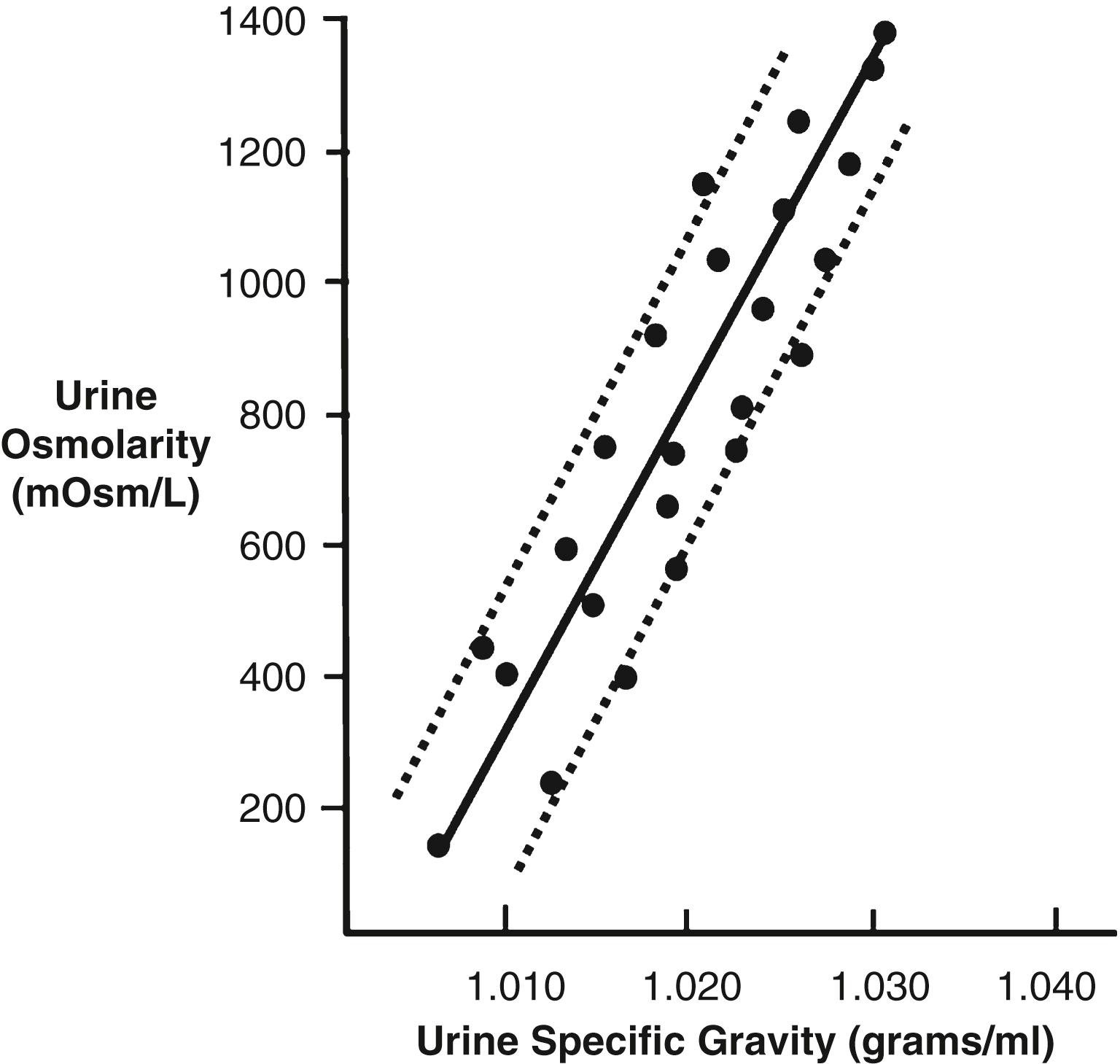
Key situations where USG is unreliable:
- Glycosuria: Large amounts of glucose in the urine (as in uncontrolled diabetes) increase its density and USG.
- Proteinuria: Significant protein in the urine also increases its density.
- Recent IV Contrast: Radiocontrast agents are large, dense molecules that are excreted in the urine and will dramatically elevate the USG.
In these situations, the USG will overestimate the true renal concentrating ability, and a directly measured Uosm is necessary for an accurate assessment.
Are urine sodium and osmolarity the same as specific ...
This article from Dr.Oracle.ai provides clear, guideline-based advice on using these tests in clinical practice.
Please read the sections titled: 'Critical Clinical Situations Where Specific Gravity Misleads' 'What Should Be Used Instead' 'Practical Clinical Approach' This will solidify your understanding of when to trust specific gravity and when to rely on osmolality.
Conclusion
You have now learned to interpret two powerful tests of renal function. By understanding how the kidney uses ADH to manage water balance, you can look at a urine specific gravity or osmolality result and determine if the kidney is functioning properly.
Key Takeaways:
- Urine Specific Gravity (USG) and Urine Osmolality (Uosm) both measure urine concentration, but Uosm is more accurate because it depends only on the number of particles, not their size.
- A healthy kidney produces concentrated urine (high Uosm/USG) in response to dehydration and dilute urine (low Uosm/USG) in response to overhydration.
- An inappropriate urine concentration is a major diagnostic clue.
- Dilute urine in a dehydrated patient suggests Diabetes Insipidus.
- Concentrated urine in a euvolemic, hyponatremic patient suggests SIADH.
- A fixed specific gravity (~1.010) or osmolality (~300 mOsm/kg) that doesn't change with hydration status is a hallmark of severe intrinsic kidney damage (e.g., ATN, CKD).
This lesson is a critical bridge to our next topic. You've now seen how a high Uosm can suggest a "prerenal" state (dehydration) and a low, fixed Uosm can suggest an "intrinsic" state (ATN). In our next lesson, we will formalize this by learning how to synthesize serum and urine markers to differentiate between prerenal, intrinsic, and postrenal acute kidney injury (AKI).