Hello! Welcome back to our module on interpreting liver lab results.
In our last lesson, we focused on bilirubin. We saw how fractionating it into conjugated and unconjugated forms helps localize the cause of jaundice to problems before, within, or after the liver. This builds on our earlier discussions of ALT/AST (markers of hepatocellular injury) and ALP/GGT (markers of cholestasis).
So far, these tests primarily tell us when liver cells are injured or when bile flow is blocked. They don't, however, tell us about the liver's actual performance or capacity. Today, we shift our focus from injury to function. Our goal is to assess hepatic synthetic function using albumin and the International Normalized Ratio (INR). These two tests are true "liver function tests" because they measure how well the liver is doing its essential job of producing vital proteins.
The Liver as a Protein Factory
The American Association for the Study of Liver Diseases (AASLD) categorizes liver tests into markers of injury (like AST/ALT) and markers of function. The two most important functional markers, which we'll cover today, are albumin and the clotting factors measured by PT/INR.
Let's start with albumin, the most abundant protein in your blood.
Albumin: A Marker of Chronic Synthetic Function
Albumin is a protein synthesized exclusively by the liver. Its main role is to maintain the oncotic pressure in your blood vessels, which keeps fluid from leaking into the surrounding tissues.
To understand its clinical utility, let's watch a brief segment from the Strong Medicine video series.
Interpretation of LFTs (Liver Function Tests)
This video explains the basics of albumin, including its function in maintaining oncotic pressure and the main reasons its levels might be low.
Watch the clip from 12:52 to 14:35. Pay attention to the three major categories of causes for low albumin (hypoalbuminemia) and its clinical consequences.
As the video explains, low albumin can be caused by:
- Decreased Synthesis: The liver isn't making enough. This is what we see in chronic liver disease (cirrhosis).
- Increased Loss: The body is losing albumin, typically through the kidneys (nephrotic syndrome) or gut.
- Redistribution/Dilution: Albumin moves out of the bloodstream in states of severe inflammation (like sepsis) or is diluted in fluid overload.
The clinical consequences of low albumin are directly related to the loss of oncotic pressure, leading to fluid shifts and swelling, such as:
- Pitting edema in the legs
- Ascites (fluid in the abdomen)
- Pleural effusions (fluid around the lungs)
The Importance of Half-Life
A crucial point for interpretation is albumin's half-life.
Interpretation of Liver Function Tests (LFTs)
This section from Geeky Medics highlights a key feature of albumin that determines its use as a diagnostic marker. This is a critical concept for distinguishing acute from chronic liver problems.
Read the short section under the heading 'Albumin'. Focus on the specific half-life mentioned and what this implies about its utility in severe liver disease.
Albumin has a long half-life of about 20 days. This means it is a poor marker of acute liver failure. A patient can have sudden, catastrophic liver failure, but their albumin level will remain normal for weeks.
Therefore, a low albumin level strongly suggests a chronic problem, such as cirrhosis, that has been developing over many weeks or months. It tells you the liver has had impaired synthetic function for a significant amount of time.
Prothrombin Time (PT) and INR: A Marker of Acute and Chronic Function
Since albumin is slow to change, how do we assess the liver's synthetic function in real-time? For that, we turn to the coagulation system. The liver produces most of the body's clotting factors.
The Prothrombin Time (PT) measures the integrity of the extrinsic coagulation pathway, which relies on several liver-produced factors. To standardize results between labs, the PT is converted into the International Normalized Ratio (INR). A higher INR means the blood takes longer to clot.
Interpretation of LFTs (Liver Function Tests)
Let's return to the Strong Medicine video to understand how INR reflects liver function.
Watch the segment from 14:35 to 16:44. Note which clotting factors are involved and the non-liver causes of an elevated INR.
An elevated INR can be caused by:
- Decreased Synthesis of Clotting Factors: This is the key link to liver function. It's seen in both acute and chronic liver disease.
- Vitamin K Deficiency: The synthesis of factors II, VII, IX, and X is dependent on vitamin K. Deficiency can occur from malnutrition, malabsorption, or antibiotic use.
- Anticoagulants: Medications like warfarin (Coumadin) are designed to elevate the INR.
- Increased Consumption: Conditions like Disseminated Intravascular Coagulation (DIC) use up clotting factors, raising the INR.
The Power of a Short Half-Life
Unlike albumin, some clotting factors have very short half-lives. Factor VII, for example, has a half-life of only 4-6 hours. This makes the INR an exceptionally sensitive marker of acute changes in liver synthesis.
This flowchart of Acute Liver Failure (ALF) demonstrates this point visually.

In a patient with a sudden, severe liver injury (like an acetaminophen overdose), the INR will be one of the first and most dramatic lab values to become abnormal. In fact, an INR ≥ 1.5 is part of the definition of acute liver failure.
Putting It All Together: Albumin vs. INR
You can use the differing half-lives of albumin and clotting factors to determine the acuity of liver disease.
- Low Albumin + High INR: This pattern indicates a chronic process, like end-stage cirrhosis. The liver's synthetic capacity has been failing for a long time, leading to both low albumin and an inability to produce clotting factors.
- Normal Albumin + High INR: This pattern points to an acute process, like acute viral hepatitis or a drug-induced liver injury. The clotting factors have been rapidly depleted, but not enough time has passed for the albumin level to fall.
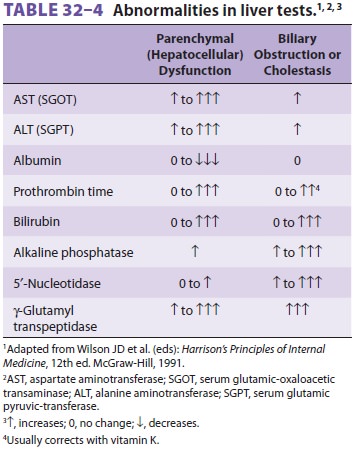
The table below summarizes the typical LFT patterns. Notice how in "Parenchymal (hepatocellular) dysfunction," both albumin and prothrombin time are affected.
Test your understanding!
A 55-year-old man with a long history of heavy alcohol use is admitted for confusion. His labs show:
- ALT: 45 IU/L (Normal: 10-40)
- AST: 80 IU/L (Normal: 10-30)
- Albumin: 2.2 g/dL (Normal: 3.5-5.5)
- INR: 1.8 (Normal: ~1.0)
- Total Bilirubin: 3.5 mg/dL
What do the albumin and INR tell you about the state of his liver?
Show answer
The combination of a very low albumin and a high INR points to severe, chronic synthetic dysfunction. This is the classic pattern of end-stage liver disease (cirrhosis). The aminotransferases (AST/ALT) are only mildly elevated; in advanced cirrhosis, there may be few healthy hepatocytes left to injure, so the enzyme levels can be deceptively low. The true severity of the disease is revealed by the failure of synthetic function.
Conclusion
You have now completed the core components of the liver function test panel. You can assess injury, cholestasis, and now, true synthetic function.
Key Takeaways:
- Albumin and INR are markers of the liver's synthetic function.
- Albumin has a long half-life (~20 days) and a low level indicates chronic liver disease (e.g., cirrhosis). Remember to rule out other causes like nephrotic syndrome or malnutrition.
- INR reflects clotting factors with short half-lives, making it a sensitive marker for both acute and chronic liver dysfunction. An INR ≥ 1.5 is a key criterion for acute liver failure.
- Interpreting albumin and INR together helps you determine the acuity and severity of liver disease.
In our next lesson, we will synthesize everything we've learned. We will move from interpreting individual labs to recognizing the complete laboratory patterns that suggest specific conditions like acute viral hepatitis, chronic liver disease, and biliary obstruction.