Hello! Welcome to the third lesson in our module on "Inflammatory and Cardiac Markers."
In our last lesson, we mastered the interpretation of troponins for diagnosing and risk-stratifying acute coronary syndrome. We established the critical concept that a biomarker's value must be interpreted in its full clinical context. Today, we shift from a marker of myocyte death (troponin) to a marker of myocyte stretch: B-type Natriuretic Peptide (BNP).
Your learning outcome for this lesson is to use B-type natriuretic peptide (BNP) or NT-proBNP in the evaluation of suspected heart failure. This is a scenario you will encounter constantly, especially in the emergency department or on the medical wards when a patient presents with shortness of breath (dyspnea). We will cover what BNP is, the key values that help you rule in or rule out heart failure, and how to use it as a powerful diagnostic tool.
1. What are BNP and NT-proBNP?
B-type natriuretic peptide (BNP) and its precursor fragment, N-terminal pro-B-type natriuretic peptide (NT-proBNP), are hormones released by the heart muscle cells (myocytes) of the ventricles.
The primary trigger for their release is myocardial stretch. When the ventricles are overfilled with blood or are pumping against high pressure—hallmarks of heart failure—they stretch, and in response, release these peptides into the bloodstream.
Diagnostic Criteria of Heart Failure BNP and NT-proBNP
This video from Demystifying Medicine provides a clear, concise explanation of the basic physiology of natriuretic peptides.
Watch from 03:53 to 04:58. Focus on understanding that BNP is a hormone released by stretched ventricles to help the body reduce fluid volume and blood pressure.
From proBNP to BNP and NT-proBNP
The ventricles actually synthesize a precursor molecule called proBNP. When released, an enzyme cleaves proBNP into two parts in a 1:1 ratio:
- BNP: The biologically active hormone. It promotes salt and water excretion by the kidneys (natriuresis and diuresis) and causes vasodilation to lower blood pressure. It has a short half-life of about 20 minutes.
- NT-proBNP: A biologically inactive fragment. Because it's not actively cleared by receptors, it has a much longer half-life of about 120 minutes.
This difference in half-life is important. It explains why the absolute blood levels of NT-proBNP are much higher than BNP, and why their reference ranges and cutoffs are different. Your hospital lab will typically offer a test for one or the other, but not both. For clinical purposes, they provide similar diagnostic information.
2. Diagnosing Heart Failure with Natriuretic Peptides
The single most important clinical use of BNP and NT-proBNP is to help differentiate between cardiac and non-cardiac causes of acute dyspnea.
The key strength of these markers is their exceptionally high negative predictive value (NPV). This means that a normal level in a patient with acute dyspnea makes acute heart failure very unlikely, prompting you to search for other causes like pneumonia, COPD, or pulmonary embolism.
Key Diagnostic Cutoffs
While values can vary slightly by assay, the following are widely accepted cutoffs for interpreting these tests in a patient presenting with acute dyspnea.
| Marker | Level (pg/mL) | Interpretation |
|---|---|---|
| BNP | < 100 | Heart Failure Unlikely (High NPV) |
| 100 - 400 | "Gray Zone" - Indeterminate | |
| > 400 | Heart Failure Likely | |
| NT-proBNP | < 300 | Heart Failure Unlikely (High NPV) |
| Age-adjusted "Rule-in" | See below |
This image provides a helpful algorithm for using these markers in the acute setting.
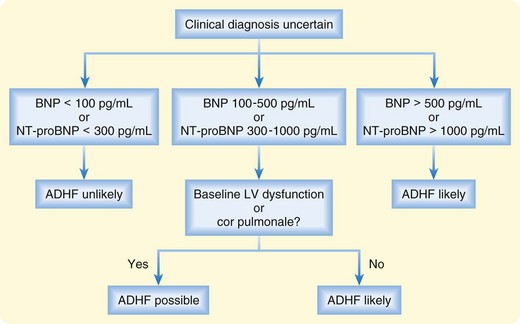
For NT-proBNP, a single "rule-in" value is less accurate because levels rise significantly with age. Therefore, age-adjusted cutoffs are often used for ruling in heart failure:
- < 50 years: > 450 pg/mL
- 50-75 years: > 900 pg/mL
- > 75 years: > 1800 pg/mL
A value below 300 pg/mL, however, remains a powerful rule-out tool at any age.
This second flowchart illustrates the diagnostic approach in the outpatient setting for a patient with suspected new-onset heart failure, highlighting the importance of age-adjusted thresholds for NT-proBNP.

Test your understanding!
An 82-year-old woman presents to the emergency department with three days of increasing shortness of breath and swollen legs. Her past medical history is significant for hypertension. You are trying to determine if this is an acute heart failure exacerbation. Which of the following lab results would most confidently allow you to rule out acute heart failure?
A) BNP of 350 pg/mL
B) NT-proBNP of 1200 pg/mL
C) NT-proBNP of 250 pg/mL
D) BNP of 150 pg/mL
Show answer
C) NT-proBNP of 250 pg/mL
A value of NT-proBNP < 300 pg/mL has a very high negative predictive value, making acute heart failure highly unlikely. The other values fall into the "gray zone" (A and D) or a likely positive range for her age (B), which would increase suspicion for heart failure.
3. Context is Everything: Factors that Influence BNP Levels
Just like with troponin, an abnormal BNP level is not a diagnosis in itself. It is a piece of data that must be integrated with the patient's history, exam, and other findings. Numerous conditions can affect BNP and NT-proBNP levels, and being aware of these is essential for accurate interpretation.
Diagnostic Criteria of Heart Failure BNP and NT-proBNP
Let's listen to a practicing cardiologist, Dr. Gregory Curnew, describe how he integrates BNP/NT-proBNP into his clinical practice. He provides invaluable pearls about interpreting the test in the real world.
Watch the segment from 06:36 to 09:06. Pay close attention to the factors he mentions that can raise or lower BNP levels, such as age, kidney function, atrial fibrillation, and obesity.
As Dr. Curnew highlighted, several factors can lead to misleading results. It is critical to know these confounders.
Brain-Type Natriuretic Peptide (BNP) Reference Range - Medscape
This reference article from Medscape provides a detailed look at factors that can cause falsely high or low natriuretic peptide levels. Understanding these is key to avoiding diagnostic errors.
Please read the section titled 'Considerations'. Focus on the two sub-sections: 'Falsely low levels of natriuretic peptides' and 'Falsely high levels of BNP and NT-proBNP'. This will give you a systematic list of the most common pitfalls.
To summarize the key confounders:
Conditions that can Falsely ELEVATE BNP/NT-proBNP:
- Renal Failure: Both are cleared by the kidneys, especially NT-proBNP. Poor kidney function leads to higher baseline levels.
- Older Age: Levels gradually increase with age.
- Female Sex: Women tend to have slightly higher levels than men.
- Atrial Fibrillation: The rapid, irregular atrial contraction increases ventricular filling pressures and wall stress.
- Pulmonary Disease: Conditions that strain the right side of the heart, like pulmonary embolism (PE), severe COPD, or pulmonary hypertension, will also raise BNP.
- Sepsis and Critical Illness: Systemic inflammation and hemodynamic stress can cause an elevation.
Conditions that can Falsely LOWER BNP/NT-proBNP:
- Obesity: This is a major clinical pitfall. Adipose tissue increases the clearance of natriuretic peptides. An obese patient can be in florid heart failure with only a modestly elevated or "gray zone" BNP. You must have a higher index of suspicion in these patients.
Conclusion
You have now learned how to wield another powerful cardiac biomarker. By understanding what BNP represents and its diagnostic cutoffs, you can rapidly and effectively assess the likelihood of heart failure in a patient with dyspnea.
Key Takeaways:
- BNP and NT-proBNP are hormones released by the heart in response to myocardial stretch, serving as a proxy for volume and pressure overload.
- Their primary clinical use is in the evaluation of acute dyspnea, where a normal level (BNP < 100, NT-proBNP < 300) has a high negative predictive value, making acute heart failure unlikely.
- "Rule-in" thresholds are higher (e.g., BNP > 400) and for NT-proBNP, they should be adjusted for age.
- Crucially, you must interpret the value in context. Be aware of conditions that can falsely elevate levels (renal failure, AFib, PE, age) or falsely lower them (obesity).
In our next and final lesson for this module, we will synthesize what we've learned about troponins and BNP by focusing specifically on the challenge we've touched on in both lessons: recognizing common clinical situations where cardiac biomarkers can be falsely elevated or misleading.