Hello! Welcome to the next lesson in your scheduling course.
In our last lesson, we explored how to apply list scheduling heuristics to hybrid flow shop (HFS) problems. We saw how simple priority rules can create good schedules quickly, providing a practical alternative to exact methods like MILP, especially as problems grow in size. You learned that in an HFS, jobs follow a common sequence of stages, but have flexibility in choosing among parallel machines within each stage.
Today, we will increase the complexity and flexibility one step further. We are moving from the structured world of flow shops to the more general and intricate Job Shop Scheduling Problem (JSSP). Understanding the JSSP is a critical milestone, as it forms the direct foundation for the Flexible Job Shop Problem (FJSP), the core topic of your thesis.
This lesson directly addresses the learning outcome: Define the job shop scheduling problem and contrast it with flow shop and hybrid flow shop. By the end, you will have a clear mental model of these three fundamental manufacturing environments, understanding their defining characteristics and the implications for scheduling complexity.
From Structured Flow to Flexible Routes
The primary difference between the scheduling environments we've studied lies in the constraints placed on job routing. To formalize these distinctions, let's turn to a comprehensive academic review paper.
Fifty Years of Research in Scheduling – Theory and Applications
The paper 'Fifty Years of Research in Scheduling – Theory and Applications' provides clear, standard definitions for various machine environments. Reading this section will ground your understanding in the formal notation used in the field.
Please read the two paragraphs describing shop scheduling environments. This content starts right after the description of parallel machines with '(i) the flow shop (α = Fm)'. Focus on how the definitions for flow shop, job shop, and their flexible/hybrid variants differ based on job flow and machine setups.
As you read, you'll see the key distinctions boil down to this:
-
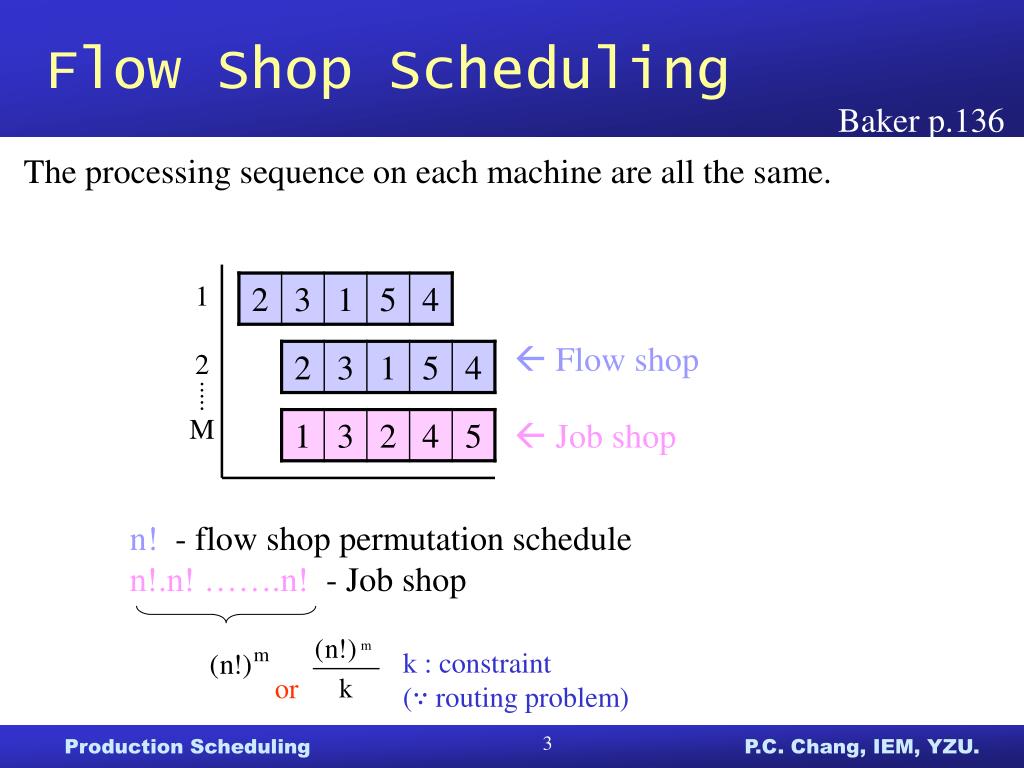
Flow Shop (FS): All jobs follow the exact same, unidirectional path through the machines. For example, every job must be processed on Machine 1, then Machine 2, then Machine 3, and so on. This is a highly constrained, linear flow.
-
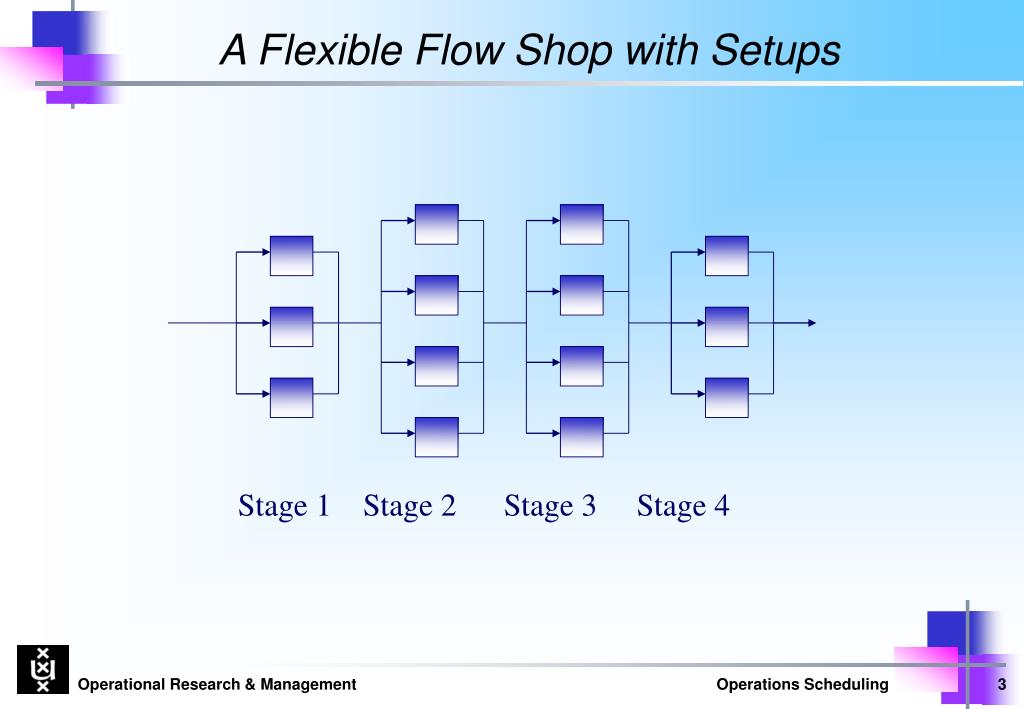
Hybrid Flow Shop (HFS): The overall path is still linear and the same for all jobs (Stage 1 -> Stage 2 -> ...), but each stage consists of a set of parallel machines. This introduces flexibility in machine assignment at each stage, but the route of stages is fixed.
-
Job Shop (JS): This is the most general of the three. Each job has its own unique, predetermined processing route. Job 1 might go M1 -> M3 -> M2, while Job 2 goes M2 -> M1 -> M3. There is no longer a common flow pattern.
The following image provides a great visual summary of the core difference between a flow shop and a job shop.
To complete the visual comparison, recall the structure of a Hybrid (or Flexible) Flow Shop, which sits between the pure flow shop and the job shop in terms of flexibility.
Comparing the Environments
Given your background in industrial engineering, you can think of these environments as different production layouts:
- Flow Shop: An assembly line.
- Job Shop: A custom fabrication workshop.
- Hybrid Flow Shop: A cellular manufacturing system where each cell (stage) has multiple identical machines.
Let's summarize the contrasts in a table.
| Feature | Flow Shop (FS) | Hybrid Flow Shop (HFS) | Job Shop (JS) |
|---|---|---|---|
| Job Routing | Identical, fixed sequence of machines for all jobs. | Identical, fixed sequence of stages for all jobs. | Unique, predetermined sequence of machines for each job. |
| Flexibility | Low (only job sequencing). | Medium (job sequencing and machine choice within stages). | High (job sequencing is constrained by unique routes). |
| Example Route | All jobs: M1 → M2 → M3 | All jobs: Stage1(M1a/M1b) → Stage2(M2a/M2b) | Job 1: M1→M3, Job 2: M2→M1 |
| Complexity | NP-hard for . | NP-hard. More complex than FS. | NP-hard. Generally considered the hardest of the three. |
This increase in routing freedom makes the job shop problem significantly more challenging. In a flow shop, the main decision is the initial job sequence. In a job shop, you must resolve potential conflicts on every machine, as jobs arrive from different predecessors at unpredictable times.
Formal Definition of the Job Shop Problem
The classical Job Shop Scheduling Problem (JSSP) can be formally stated with a set of common assumptions. Understanding these assumptions is vital for building mathematical models later.
A Novel Hybrid Algorithm for Permutation Flow Shop ...
The paper 'A Novel Hybrid Algorithm...' provides a concise list of the standard assumptions for the Job Shop Problem.
First, read the bulleted list of assumptions under the heading 'There are some assumptions considering the JSP problem' in section 2. Then, read the similar list under the heading 'III. JOB SHOP SCHEDULING PROBLEM' in section 4. These lists overlap but reinforce the core constraints of the classic model.
Based on the reading, the key characteristics and assumptions of the JSSP are:
- A set of jobs must be processed on a set of machines.
- Each job consists of a sequence of operations, .
- Each operation has a specific machine it must be processed on and a known, deterministic processing time.
- The sequence of operations for each job (the "technological route") is fixed and can be different for each job.
- An operation cannot start until its predecessor (for the same job) is complete.
- A machine can only process one operation at a time.
- Operations are non-preemptive, meaning once started, an operation cannot be interrupted.
The most commonly studied objective, similar to our flow shop discussions, is the minimization of makespan (). In the standard three-field notation, this problem is denoted as .
Test your understanding!
Consider a scheduling problem with three jobs (J1, J2, J3) and three machines (M1, M2, M3). The processing routes for the jobs are as follows:
- J1 Route: M1 → M2 → M3
- J2 Route: M1 → M2 → M3
- J3 Route: M2 → M1 → M3
How would you classify this scheduling environment (Flow Shop, Hybrid Flow Shop, or Job Shop)? Justify your answer.
Show answer
This is a Job Shop.
Justification: Although J1 and J2 have the same route, J3 has a different route (M2 → M1 → M3). In a pure Flow Shop, all jobs must follow the exact same route. Since there is at least one job with a unique route, the environment is classified as a Job Shop. It is not a Hybrid Flow Shop because there is no mention of parallel machines at any stage.
Conclusion
In this lesson, you've formally defined the job shop environment and, more importantly, learned to distinguish it from flow shops and hybrid flow shops based on the structure of job routings.
Key Takeaways:
- Flow Shop: All jobs follow a single, identical machine sequence.
- Hybrid Flow Shop: All jobs follow a single sequence of stages, with machine flexibility within each stage.
- Job Shop: Each job has its own unique, predetermined route through the machines.
- This progression from flow shop to job shop represents a significant increase in flexibility and, consequently, scheduling complexity. The JSSP is a direct, non-flexible version of the FJSP you will study for your thesis.
Preview of the Next Lesson:
The complex, crisscrossing routes in a job shop make simple Gantt chart construction and list-based heuristics difficult to apply effectively. To manage this complexity, we need a more powerful representation of the problem. In the next lesson, we will learn to construct and interpret a disjunctive graph representation of a job shop problem. This graph-based model is a cornerstone of modern scheduling theory and is fundamental to developing the advanced algorithms needed to solve both JSSP and FJSP.