Hello! Welcome back to our module on metaheuristics.
In our last lesson, we focused on the "what" of local search: what a neighborhood is and how to construct one for scheduling problems using operators like swap and insertion. We established that these neighborhood structures provide the pathways for our search algorithm to move from one solution to another.
Today, we address the "how" and "why": how do we strategically choose our path, and why does that choice matter? This leads us directly to the core strategic dilemma in metaheuristic design. Our learning outcome for this lesson is to evaluate the trade-off between exploration and exploitation in metaheuristic design. Understanding this balance is arguably the most critical skill in designing or selecting an effective optimization algorithm for your thesis research on the Flexible Job Shop Problem (FJSP).
1. The Fundamental Trade-Off: Intensification vs. Diversification
Every effective search strategy must balance two competing objectives:
- Intensification (Exploitation): The strategy of focusing on a specific, promising region of the search space to find the best possible solution within that region. This is about refining good solutions. A simple hill-climbing search is pure exploitation.
- Diversification (Exploration): The strategy of visiting new, previously unexplored regions of the search space. This is about finding new, potentially better areas to search and avoiding getting trapped in a local optimum. A purely random search is pure exploration.
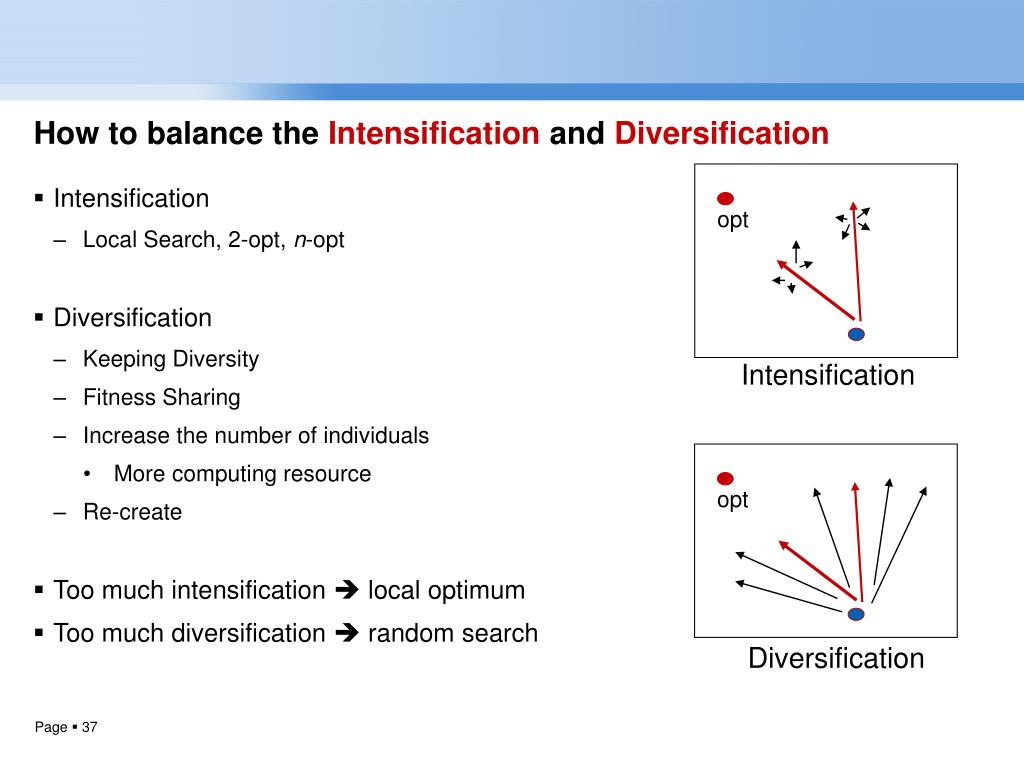
To build a solid theoretical foundation for this concept, we'll turn to a foundational paper in the field.
Metaheuristics in Combinatorial Optimization
The paper 'Metaheuristics in Combinatorial Optimization' by Christian Blum and Andrea Roli provides a clear and rigorous definition of these core concepts. We'll use it to establish our terminology.
Please read the introduction, starting from the beginning up to the end of Section 1 (pages 268-271). Focus on the definitions of metaheuristics and, in particular, the final paragraphs that introduce and define intensification and diversification (and their synonyms, exploitation and exploration).
The key insight from this reading is that successful metaheuristics don't just choose one strategy; they create a dynamic balance between them. They need to exploit good solutions to make progress but also explore new areas to ensure they don't miss the global optimum.
2. A Framework for Evaluating the Trade-Off
To "evaluate" this trade-off in a structured way, we can use an analytical framework. The same paper by Blum and Roli introduces a useful model called the I&D (Intensification & Diversification) Frame.
Metaheuristics in Combinatorial Optimization
Let's continue with the Blum and Roli paper to understand the I&D Frame. This framework will give us a powerful tool for analyzing how different algorithmic components contribute to exploration and exploitation.
Please read Section 5.1, 'Intensification and Diversification' (pages 292-295). Pay close attention to Figure 18 and the explanation of the three corners of the I&D Frame.
Let's break down the I&D Frame:
- It visualizes the space of all possible search mechanisms (which they call "I&D components").
- The three corners represent pure, extreme strategies:
- OG (Objective Function Guided): Pure intensification. A component here is driven solely by finding a better objective value (e.g., always moving to the best neighbor).
- R (Random): Pure, unguided diversification. A component here acts randomly, without regard for the objective function or search history (e.g., a random restart).
- NOG (Non-Objective Guided): Guided diversification. A component here is deterministic but not based on the objective function. It's typically driven by memory of the search history (e.g., forbidding recently used moves, as in Tabu Search).
- The Trade-off: Any real metaheuristic component lies somewhere within this triangle. Its position reveals its balance: the closer it is to the OG corner, the more it intensifies; the closer it is to the R-NOG edge, the more it diversifies.
This framework moves us beyond a simple "either/or" view and allows us to see exploration and exploitation as a spectrum.
3. The Trade-Off in Action: Concrete Examples
Let's see how this theoretical framework applies to real algorithms. We'll analyze how different metaheuristics implement and control this trade-off.
a) Simulated Annealing: Probabilistic Control
Simulated Annealing (SA) provides a classic and mathematically elegant example of controlling the trade-off with a single parameter.
Optimization - I (Simulated Annealing)
This video on Simulated Annealing from NPTEL provides an excellent, step-by-step explanation of how the 'temperature' parameter acts as a control knob for the exploration-exploitation balance.
Please watch the following segments: Exploration vs. Exploitation (01:51 - 02:48): This part frames the problem by contrasting hill climbing (pure exploitation) with a random walk (pure exploration). The Role of Temperature (22:34 - 30:32): This is the most critical part. Pay close attention to how the probability of accepting a move changes with the temperature T. Notice the shape of the sigmoid function at high vs. low temperatures. The Cooling Schedule (30:32 - 34:14): Understand how the algorithm dynamically changes the balance over time by gradually reducing T.
From the video, we can summarize SA's strategy:
- Acceptance Criterion: A move that improves the solution is always accepted (intensification). A move that worsens the solution is accepted with a probability .
- The 'Temperature' (
T) Knob:- High
T: The probability of accepting a worsening move is high. The search is nearly random and can easily escape local optima. This is strong exploration. - Low
T: The probability of accepting a worsening move is very low. The search behaves like hill climbing, only accepting improvements. This is strong exploitation.
- High
- Cooling Schedule: SA doesn't use a fixed temperature. It starts high (exploring broadly) and gradually decreases
T(shifting towards exploitation to fine-tune a solution). This is a dynamic strategy for managing the trade-off.
In the I&D Frame, the SA acceptance criterion sits in the middle of the triangle, as it's guided by the objective function (), randomness, and a non-objective function (the cooling schedule).
Test your understanding!
Imagine you are using Simulated Annealing to solve a scheduling problem. Your initial runs show that the algorithm almost always gets stuck in the very first local optimum it finds. Based on SA's mechanism for balancing exploration and exploitation, what two parameters of the algorithm would you adjust to encourage more exploration?
Show answer
You would adjust:
- The Initial Temperature (
T_initial): You should increase it. A higher starting temperature makes the algorithm more likely to accept worsening moves at the beginning of the search, allowing it to "jump out" of early local optima and explore the search space more broadly. - The Cooling Rate: You should make the cooling slower (e.g., if
T_new = α * T_old, you would use a value ofαcloser to 1, like 0.99 instead of 0.95). A slower cooling rate means the algorithm spends more time at higher temperatures, giving it more opportunity to explore before it settles into an exploitation phase.
b) Tabu Search: Memory-Based Control
Tabu Search (TS) manages the trade-off using a different mechanism: memory.
TutORial: Tabu and Scatter Search: Principles and Practice
This tutorial on Tabu Search by INFORMS explains how short-term and long-term memory structures are used to guide the search, preventing it from getting stuck.
Please watch the video from 07:04 to 22:32 to understand short-term memory (the tabu list). Then, watch from 43:40 to 47:31 to understand how long-term memory is used for diversification.
Here's how Tabu Search balances the forces:
- Intensification: At each step, TS chooses the best move from the available neighborhood, which is a strong intensification strategy.
- Diversification: This is where memory comes in. The tabu list (short-term memory) forbids moves that would reverse recent changes for a certain number of iterations (the "tabu tenure"). This has two effects:
- It prevents the search from immediately cycling between two solutions.
- It forces the search to explore other, non-tabu moves, even if they are worse than the current solution, pushing it out of local optima.
- Long-Term Memory: More advanced TS strategies use frequency-based memory to penalize moves or solution components that have been visited too often, providing a powerful push for diversification into entirely new regions of the search space.
In the I&D Frame, the TS move selection mechanism lies on the line between the OG corner (choosing the best move) and the NOG corner (using memory to restrict choices). The length of the tabu list tunes this balance: a longer list increases diversification.
4. Connection to Modern FJSP Research
This trade-off isn't just a theoretical concept; it's at the heart of modern scheduling research, including work on your thesis topic, FJSP. State-of-the-art algorithms often use sophisticated techniques to manage this balance dynamically. One prominent approach involves Reinforcement Learning (RL).
Metaheuristics for multi-objective scheduling problems in ...
This recent review paper connects our discussion directly to your field. It highlights how Reinforcement Learning, specifically Q-learning, is being integrated with metaheuristics to manage the exploration-exploitation balance in complex scheduling problems.
Please read Section 6, 'Combining metaheuristic algorithm and reinforcement learning for shop scheduling optimization', focusing on the introduction and Section 6.1 (up to the paragraph on energy-efficient scheduling). Note the explicit mention of Q-learning's 'efficient exploration exploitation balance through ε-greedy strategy'.
The key takeaway for your thesis work is that you can design a metaheuristic where the choice between exploration and exploitation is learned rather than pre-programmed. For example, an RL agent could learn:
- When to explore vs. exploit: Based on the current state of the search (e.g., if no improvement has been found for many iterations, increase exploration).
- Which move to use: It could learn to choose an intensifying move (like a small swap on a critical machine) or a diversifying move (like moving a job to an entirely different machine) based on what has worked well in the past.
The ε-greedy strategy mentioned in the paper is a perfect, simple example: with probability 1-ε, exploit the best action learned so far; with probability ε, explore a random action.
Conclusion
Today we have moved from the mechanics of neighborhood generation to the strategy of search guidance. The balance between exploring new possibilities and exploiting known good solutions is the central challenge you will face when designing or implementing a metaheuristic for your thesis.
Key Takeaways:
- Metaheuristic performance hinges on balancing intensification (exploitation) and diversification (exploration).
- The I&D Frame provides a conceptual model to analyze and compare how different algorithmic components contribute to this balance.
- Simulated Annealing controls the trade-off probabilistically using the
temperatureparameter and acooling schedule. - Tabu Search controls the trade-off deterministically using
memory(the tabu list) to forbid recent moves. - Modern hybrid algorithms, often used for FJSP, can use Reinforcement Learning to dynamically learn an effective exploration-exploitation strategy during the search.
Preview of the Next Lesson:
We've now seen how single-solution metaheuristics like SA and TS manage this trade-off. In our next lesson, we will begin our deep dive into Genetic Algorithms (GA). GAs are population-based, and as we will see, they manage the exploration-exploitation balance in a very different way: through the interplay of selection (exploitation) and the genetic operators of crossover and mutation (exploration).