Welcome back. In our first lesson, we established the fundamental difference between financial accounting, which reports to external stakeholders, and management accounting, which provides information for internal decision-making. Your work in data entry puts you at the very start of this information pipeline, recording the transactions that get used in both disciplines.
Today, we move from the 'why' of management accounting to the 'how'. To provide managers with useful information for planning and control, the raw data you're familiar with must be organized. This lesson is all about that organizational process: cost classification. You will learn to classify costs in three primary ways that are essential for the ACCA MA exam: by their nature, their function, and their behavior. Mastering this is a non-negotiable first step for almost every topic that follows, from product costing to budgeting and performance evaluation.
The Different Lenses of Cost Classification
Imagine you're looking at a single business expense, like the electricity bill for a factory. How you classify this cost depends entirely on the question you're trying to answer.
- If you're asking, "Can we trace this cost to a single product?" you're classifying by nature.
- If you're asking, "Does this cost relate to making the product or running the office?" you're classifying by function.
- If you're asking, "How will this cost change if we double our production?" you're classifying by behavior.
It's crucial to understand that these are just different 'lenses' to view the same cost. A single cost can, and often does, fit into multiple categories simultaneously. A video from Commerce Specialist explains this point brilliantly.
Classification of Costs | Types of Cost | Elements of Cost | Cost Concepts | ACCA F2 | CMA | CIA |
Please watch this short concluding segment from the "Classification of Costs" video. The presenter uses a simple analogy to explain how one cost can have multiple classifications at the same time. This is a vital concept to grasp.
Watch the final section, where the presenter discusses how a cost can be, for example, direct, variable, and a product cost all at once. This clip runs from the start of the explanation.
With this framing in mind, let's explore each of the main classification systems you need to know for your exam.
1. Classification by Nature: Direct vs. Indirect Costs
The first way we classify costs is by their relationship to a cost object—which is just an accounting term for anything we want to find the cost of (e.g., a product, a service, a department).
- Direct Costs can be specifically and fully traced to a single cost object. If you're making a wooden table, the cost of the wood is a direct cost.
- Indirect Costs (also known as overheads) are costs that are not directly traceable to a single cost object. The factory supervisor's salary or the rent on the factory are incurred for production as a whole, not for one specific table.
The video below provides excellent, practical examples to help distinguish between direct and indirect materials, labour, and expenses.
This video, "ACCA F2 Cost Classification" by AC Training, gives a concise, exam-focused overview of the different classifications. We'll start with the section on classifying by nature.
Please watch the segment from the discussion of 'Nature'. Pay close attention to the examples given for direct and indirect materials, labour, and expenses.
As the video mentions, the sum of all direct costs (Direct Materials + Direct Labour + Direct Expenses) is known as the Prime Cost. This is a key term in the ACCA syllabus.
The following diagram illustrates this breakdown clearly.

2. Classification by Function: Production vs. Non-Production Costs
The next classification system categorizes costs based on the business function they serve. The primary split here is between costs related to making the product and all other costs.
- Production Costs: All costs incurred within the factory or production environment. These include direct materials, direct labour, and all production overheads (like factory rent and electricity).
- Non-Production Costs: Costs incurred outside of the factory. These are typically grouped into:
- Administrative costs: General management, finance department salaries, office rent.
- Selling costs: Marketing, sales commissions, advertising.
- Distribution costs: Warehousing finished goods, delivery to customers.
Understanding this distinction is vital for inventory valuation, a topic we'll touch on later in the course. For now, let's solidify the definitions.
F2 – Chapter 1- The Nature, Source, and Purpose of Management Information - Serrari Ed
This article from Serrari Ed provides clear, ACCA-aligned definitions for these functional costs.
Please read the sections titled Production vs. Non-Production Costs and Unveiling the Non-Production Cost Elements. This will detail the main functional groupings.
3. Classification by Behavior: How Costs Change
This is arguably the most important classification for management decision-making. It focuses on how costs react to changes in the level of activity (e.g., the number of units produced).
There are four main cost behaviors you must know:
- Fixed Costs: These costs remain the same in total, regardless of the level of activity, within a certain range (the "relevant range"). A classic example is factory rent.
- Variable Costs: These costs change in total directly in proportion to the level of activity. The cost of raw materials is a perfect example—if you make twice as many units, you use twice the materials.
- Semi-Variable Costs (or Mixed Costs): These costs have both a fixed and a variable component. A telephone bill with a fixed monthly line rental plus a charge for each call made is a common example.
- Stepped-Fixed Costs: These costs are fixed only within a certain range of activity. If that range is exceeded, the cost "steps up" to a new, higher fixed level. For example, you might need one supervisor for 0-20 workers, but a second supervisor (and their salary) once you hire the 21st worker.
The following resource is an excellent guide that walks through each of these cost behaviors with clear definitions, examples, and graphs—all of which are common formats in the ACCA exam.
This guide from PastPaperHero is laser-focused on cost behavior, which is a critical area for your exam.
Please read the sections defining and explaining each cost type: Fixed Costs, Variable Costs, Semi-Variable Costs, and Stepped Fixed Costs. Also, review the Cost Graphs section and the excellent Comparison Summary Table at the end.
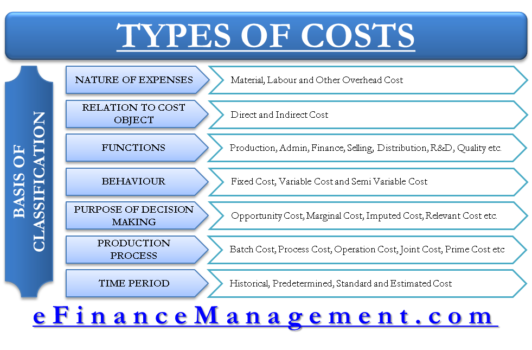
The image below gives a useful overview of the different ways costs can be classified, summarizing much of what we've discussed.
Conclusion
In this lesson, we've broken down the fundamental ways management accountants organize costs to make them useful for decision-making. You now have a framework for analyzing any cost a business incurs.
Key Takeaways:
- Costs can be classified in multiple ways simultaneously, depending on the question being asked.
- By Nature: Direct costs are traceable to a single product (forming the Prime Cost), while Indirect costs (overheads) are not.
- By Function: Production costs relate to the factory, while Non-Production costs cover administration, selling, and distribution.
- By Behavior: Fixed costs are static in total, Variable costs change with activity, Semi-Variable costs have both elements, and Stepped-Fixed costs jump at certain activity levels.
In the reading on cost behavior, you saw a brief mention of the "high-low method" for splitting semi-variable costs. This is a crucial practical skill. In our next lesson, we will focus exclusively on how to apply the high-low method to separate a semi-variable cost into its fixed and variable components—a technique that is frequently tested in the ACCA MA exam.