Welcome to the first lesson of your fast-paced course on Management Accounting. Given your goal of passing the ACCA Management Accounting (MA) exam in a tight timeframe, we will focus sharply on the core concepts you need to succeed. This initial lesson lays the essential groundwork by tackling the first learning outcome: identifying the key differences between financial and management accounting.
You've mentioned your work experience involves data entry accounting. This means you've likely been at the very source of where financial data is born—processing the transactions that eventually get summarized. Today, we'll explore the two distinct paths that data can take: one path leads to formal, external financial reports, and the other leads to internal, strategic insights for managers. Understanding this distinction is the first and most crucial step in mastering management accounting.
1. Defining the Two Fields of Accounting
Before we can compare financial and managerial accounting, we need a clear definition of each. Both are branches of the same "language of business," but they speak to different audiences and for different reasons.
The following video provides a concise and clear introduction to both fields. It's a great starting point to build a mental picture of their respective roles.
FINANCIAL vs MANAGERIAL Accounting
Please watch this brief segment from the "FINANCIAL vs MANAGERIAL Accounting" video by Accounting Stuff. It offers clear, textbook-style definitions for both financial and managerial accounting.
Watch from the beginning up to the point where the host starts talking about similarities. Focus on the definitions provided for each type of accounting. This segment is from the definitions until the lead-in to the next section.
To summarize what you just watched:
- Financial Accounting is about recording, summarizing, and reporting a company's financial transactions to the outside world. Think of it as creating a historical report card for external stakeholders.
- Managerial (or Management) Accounting is about identifying, measuring, and communicating information to management to help them with planning, decision-making, and control. It's the internal toolkit for steering the company into the future.
2. The Five Key Differences
Now that we have the basic definitions, let's dissect the differences. The same video you just started continues by breaking down the comparison into five distinct areas. This structure is extremely helpful for organizing your thoughts for the exam.
FINANCIAL vs MANAGERIAL Accounting
Continue watching the "FINANCIAL vs MANAGERIAL Accounting" video. The presenter walks through five critical differences that distinguish the two disciplines.
Please watch the main section of the video covering the five key differences, from the target audience to the level of regulation. The segment begins at difference number one.
Let's recap and solidify those five points, as they are fundamental to the ACCA syllabus.
-
Users: Financial accounting reports are for external users—investors, creditors, government bodies (like tax authorities), and the public. These users need standardized information to make investment, lending, or regulatory decisions. In contrast, management accounting reports are exclusively for internal users—the managers and executives who run the business day-to-day.
-
Time Focus (Outlook): Financial accounting is historical. It reports on what has already happened (e.g., the profit for the last year). Management accounting is forward-looking. It focuses on the future to help managers make decisions about what to do next (e.g., preparing a budget for the next year).
-
Scope: Financial accounting has a broad scope. It consolidates data to present a big-picture view of the entire organization. A published income statement shows the total profit, not the profit of each individual product line. Management accounting has a narrow scope, often breaking the organization down into segments like products, departments, or geographical regions to provide detailed, specific insights.
-
Priority: The priority for financial accounting is objectivity and precision. The information must be verifiable and presented in a true and fair manner. For management accounting, the priority is relevance and timeliness. Managers need information that is useful for the decision at hand, and they need it quickly. This means estimates and approximations are often acceptable if they help in making a timely decision.
-
Rules & Regulation: Financial accounting is heavily regulated. Companies must follow specific rules and standards, such as International Financial Reporting Standards (IFRS) or Generally Accepted Accounting Principles (GAAP). This ensures consistency and comparability. Management accounting, being internal, has no fixed rules. The format and content of a report are flexible and tailored to what management finds most useful.
This last point is particularly important. While financial accounting is about compliance, management accounting is about utility. As you've seen in your data entry role, every transaction is recorded according to strict rules. Management accounting takes that raw data and reshapes it in whatever way is most helpful for a specific decision, free from the constraints of IFRS.
3. Visualizing the Differences
Tables are an excellent way to summarize comparisons for exam revision. The image below provides a clear, at-a-glance overview of the key distinctions we've just discussed.
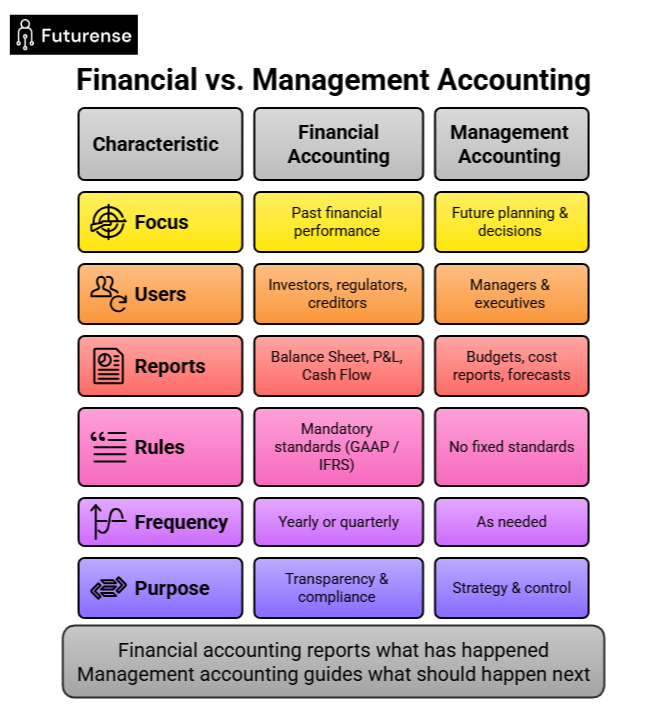
To connect this directly to your ACCA studies, let's look at the summary provided in a dedicated study guide. This resource presents the information in a way that closely mirrors what you can expect in your exam materials.
[PDF] CHAPTER 1: FUNDAMENTALS OF MANAGEMENT ACCOUNTING
This PDF is a chapter from an ACCA MA study guide. The table within it provides a definitive comparison that aligns perfectly with the ACCA syllabus.
Please read the section titled the comparison, paying close attention to "Diagram 1.2". This table effectively summarizes everything we have covered.
4. Where They Overlap
While we've focused on the differences, it's worth noting that these two fields are not entirely separate. They share common ground. Both draw from the same fundamental accounting system that records a company's transactions. The key is what they do with that data.
Financial Accounting vs Management: Differences and ...
This short article section briefly explains the similarities between the two accounting disciplines.
Read the short section titled Similarities to understand their shared foundations.
In essence, both disciplines aim to provide valuable information for decision-making. The crucial difference, as we've established, is the audience for those decisions—external stakeholders versus internal managers.
Conclusion
In this introductory lesson, we have established the essential distinction between financial and management accounting. This is the conceptual foundation upon which the entire MA syllabus is built.
Key Takeaways:
- Financial Accounting is for external users, is historical, follows strict rules (IFRS/GAAP), and reports on the company as a whole. Its main purpose is compliance and external reporting.
- Management Accounting is for internal users, is forward-looking, has no fixed rules, and focuses on specific segments of the business. Its main purpose is to aid internal planning, control, and decision-making.
In our next lesson, we will dive into the core building block of management accounting: costs. You will learn how to classify costs by their nature and behavior (fixed, variable, etc.). This skill is the first practical step in analyzing business operations and providing managers with the insights they need to make informed decisions.