Introduction
In our last lesson, we mastered the calculation of the Overhead Absorption Rate (OAR), a crucial tool for assigning a fair share of factory overheads to products based on budgeted figures. This allowed us to determine a product's cost before the accounting period even ends. However, the real world rarely aligns perfectly with budgets.
This lesson addresses the inevitable question: what happens when our actual costs and activity levels differ from our initial estimates? This discrepancy results in either under-absorption or over-absorption of overheads. Your ability to calculate this amount and explain its causes is a frequent and important topic in the ACCA MA exam. We will cover the mechanics of the calculation, explore the two primary reasons these discrepancies occur, and solidify your understanding with exam-style questions.
The Concept of Under and Over-Absorption
At the start of the year, we calculate our OAR to charge overheads to production. At the end of the year, we add up the actual overhead bills. If the total amount we've charged to production doesn't match the actual bills, we have a shortfall or a surplus.
- Under-absorption: The overheads charged to production are less than the overheads actually incurred. This is an unfavorable outcome, as it means not enough cost was included in our products, potentially understating the cost of goods sold and overstating profit during the period.
- Over-absorption: The overheads charged to production are more than the overheads actually incurred. This is a favorable outcome, meaning we've accounted for more than enough cost.
The following video provides a clear conceptual explanation of why this happens and frames it in terms of a profit or loss for the firm.
Over and Under Absorption of Overheads | Absorption Costing | A level Accounting 9706
This video from Alt Academy clearly defines under- and over-absorption and explains the core reasons why they occur.
Watch the section from this segment. Focus on understanding why under-absorption is effectively a loss (we didn't recover enough cost) and over-absorption is a profit (we recovered more than we spent). Note the two main drivers discussed: actual activity being different from budget, and actual spending being different from budget.
The Calculation: A Simple Template
Calculating under- or over-absorption is a standard exam task. There's a simple two-step process that you can rely on every time. An excellent, memorable template for this is OHA - OHI.
For an exam-focused approach, this next video is invaluable. The presenter provides a pro-forma that will help you solve these questions quickly and accurately under time pressure.
How to pass the ACCA MA Exam | 7 templates (pro-formas) to help you save time pass your exam
In this video, Steve Willis ACCA offers a brilliant, time-saving template for tackling over- and under-absorption questions in your exam.
Watch the segment from this point. Memorise the OHA - OHI template. OHA (Overheads Absorbed): Actual Activity Level × Predetermined OAR OHI (Overheads Incurred): The actual overhead cost for the period. Difference (OHA - OHI): A negative result is under-absorption. A positive result is over-absorption.
Let's break down the logic:
- Calculate Absorbed Overhead (OHA): First, we determine how much overhead we did charge to production during the period. This is based on the actual level of activity (e.g., actual hours worked) multiplied by the rate we set at the start of the period (the OAR).
- Compare with Incurred Overhead (OHI): We then compare this absorbed amount to the actual overhead costs incurred.
- Find the Difference: The difference is our under- or over-absorption.
Let's apply this with the core formulas and examples from a written resource.
PastPaperHero | Overheads and absorption - Overhead absorption rates and absorption
This PastPaperHero article provides the definitions and two clear worked examples that demonstrate the calculation.
First, read the definitions under the heading Absorbed, Under- and Over-Absorbed Overheads. Then, work through Worked Example 1.3 and Worked Example 1.4. Apply the "OHA - OHI" template to both examples to see how it works in practice. In Example 1.3: OHA = 22,000 hrs * $4 = $88,000. OHI = $90,000. The result is -$2,000 (under-absorbed). In Example 1.4: OHA = 7,500 hrs * $3 = $22,500. OHI = $22,000. The result is +$500 (over-absorbed).
Explaining the Causes
You don't just need to calculate the number; you need to explain why it happened. As the videos and readings have hinted, there are two distinct reasons for under- or over-absorption, and they can occur independently or together.
-
Expenditure Cause: The actual overhead spend was different from the budgeted overhead spend.
- If
Actual Spend > Budgeted Spend, it pushes towards under-absorption. We spent more than planned. - If
Actual Spend < Budgeted Spend, it pushes towards over-absorption. We were thriftier than planned.
- If
-
Volume Cause: The actual activity level (e.g., machine hours) was different from the budgeted activity level.
- If
Actual Activity < Budgeted Activity, it pushes towards under-absorption. We produced less than planned, so we didn't absorb enough overheads to cover the budgeted fixed costs. - If
Actual Activity > Budgeted Activity, it pushes towards over-absorption. We were busier than planned, so each extra unit absorbed more overhead, covering more than the budgeted fixed costs.
- If
This graph provides an excellent visual summary of these two causes.
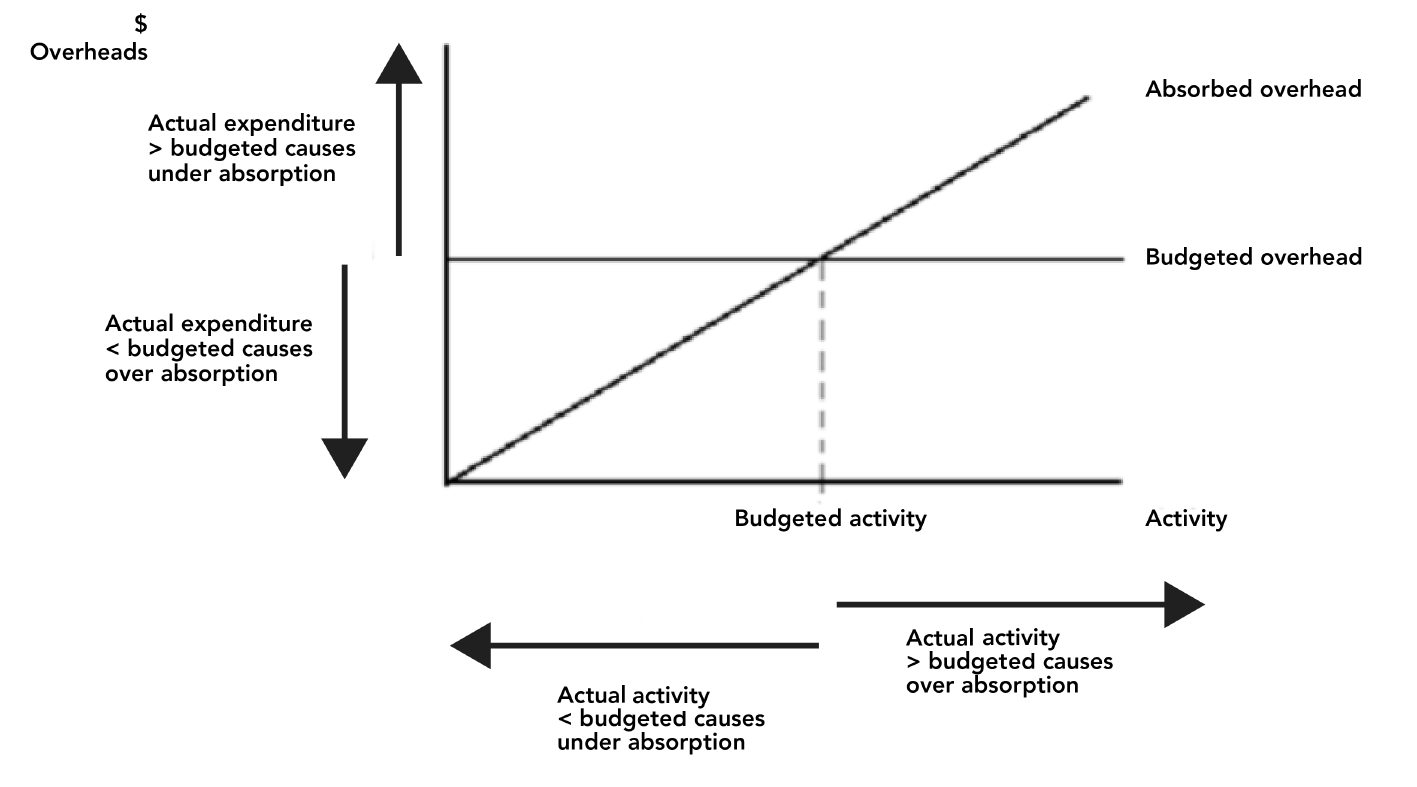
Notice how the final result depends on the combination of these two effects. For example, you could spend more than budget (causing under-absorption) but also work many more hours than budget (causing over-absorption). The final net effect will depend on which of these two factors is larger.
For a concise, list-based summary of these causes, refer back to the PastPaperHero article.
PastPaperHero | Overheads and absorption - Overhead absorption rates and absorption
This section of the article provides a quick checklist of the causes.
Read the four bullet points under the heading Main Causes. This is a perfect summary for revision.
An Exam-Style Question
Understanding the two causes separately is critical for theory-based questions in the exam. Let's tackle a question that the ACCA examining team identified as being poorly answered by students.
This ACCA article provides an exam-style multiple-choice question and a detailed breakdown of the correct and incorrect answers.
Read and attempt the question provided. Before looking at the answer, use the graph above (from resource 05bf2) to help you reason through it: Situation (1): Actual overhead expenditure was less than budgeted. Look at the vertical axis. Does moving down (less expenditure) cause over- or under-absorption? It causes over-absorption. Situation (2): Actual hours worked were less than budgeted. Look at the horizontal axis. Does moving left (less activity) cause over- or under-absorption? It causes under-absorption. Therefore, the correct statement is that (1) causes over-absorption and (2) causes under-absorption. Now, read the explanation in the article to confirm your understanding.
Application: WRAPWELL LTD
Let's conclude by applying this to our WRAPWELL LTD example. In the last lesson, we calculated the following OARs:
- Plastics Moulding OAR: £4.91 per machine hour (based on £157,036 budget overhead and 32,000 budget hours)
- Plastics Extrusion OAR: £9.81 per machine hour (based on £117,764 budget overhead and 12,000 budget hours)
Now, assume the following actual results for the period have come in:
| Department | Actual Machine Hours | Actual Overheads Incurred |
|---|---|---|
| Plastics Moulding | 33,000 | £160,000 |
| Plastics Extrusion | 11,500 | £116,000 |
Let's calculate the under- or over-absorption for each department using the OHA - OHI template.
Plastics Moulding:
- OHA: 33,000 actual hours × £4.91/hr = £162,030
- OHI: £160,000
- Difference: £162,030 - £160,000 = +£2,030 (Over-absorbed)
Why? The department was busier than planned (33k vs 32k hours), which drove over-absorption. This effect was larger than the impact of slightly overspending (£160k vs £157k budget).
Plastics Extrusion:
- OHA: 11,500 actual hours × £9.81/hr = £112,815
- OHI: £116,000
- Difference: £112,815 - £116,000 = -£3,185 (Under-absorbed)
Why? The department was less active than planned (11.5k vs 12k hours), causing under-absorption. It also helped that they spent less than budgeted (£116k vs £117.7k budget), but the volume effect was stronger.
Conclusion
Today we have closed the loop on absorption costing. By moving from budgets to actuals, you are now able to calculate and, crucially, explain the causes of under- and over-absorption of overheads. This completes the foundational topic of overhead costing.
Key Takeaways:
- Under/over-absorption occurs when absorbed overheads (based on actual activity) do not equal actual overheads incurred.
- The calculation is: Overhead Absorbed (Actual Activity × OAR) - Actual Overhead Incurred.
- A negative result is under-absorption (unfavorable), and a positive result is over-absorption (favorable).
- The two causes are an expenditure difference (spending vs. budget) and a volume difference (activity vs. budget).
With this module complete, we have built a solid foundation in costing. In our next lesson, we will shift focus to a new area: managing and accounting for the specific costs of materials and labor, starting with how to determine the most efficient quantity of materials to order.