Welcome back. In our last session, we systematically channeled all factory-wide overheads into the specific production and service departments. We finished by re-apportioning the service department costs, leaving us with a total overhead cost for each production department. We have successfully gathered the costs, but they are still in large "pots" at the departmental level.
The goal of this lesson is to complete the final, critical step in this process: assigning these departmental overheads to the individual products or jobs that are made. We will achieve this by calculating and applying an Overhead Absorption Rate (OAR). This is a concept you will use repeatedly throughout your Management Accounting studies, as it is fundamental to product costing, inventory valuation, and ultimately, profitability analysis. By the end of this 60-minute lesson, you will be able to calculate OARs using different activity bases and understand why choosing the correct one is crucial for accuracy.
Why Do We Need a Predetermined Rate?
In the previous lesson, we worked with total overhead costs for a period. However, managers need to know the cost of a product now—to quote a price for a customer or to value inventory. They can't wait until the end of the year to find out what the actual total electricity bill was.
This need for timely information requires us to use a predetermined overhead rate, calculated at the start of a period using budgeted figures. This approach also helps to smooth out fluctuations in costs and production volume over the year.
The following video provides an excellent explanation of why this forward-looking approach is essential in practice.
Predetermined Overhead Rate (what it is and how to calculate it)
This video from Edspira clarifies the practical reasons for using a predetermined overhead rate, focusing on the need for timely cost information and the concept of a cost driver.
Please watch the first part of the video, focusing on two key ideas: The explanation of why we can't wait for actual figures, from the beginning until this point. Note the example of quoting a price for a customer. The introduction to the idea of a cost driver, from this segment. This is the activity that is assumed to cause the overhead cost to be incurred.
Calculating the Overhead Absorption Rate (OAR)
As the video explained, we need a systematic way to charge, or "absorb," overheads into the cost of products. The tool we use is the Overhead Absorption Rate (OAR). The formula is straightforward and is always based on budgeted figures.
PastPaperHero | Overheads and absorption - Overhead absorption rates and absorption
This article from PastPaperHero provides the core definitions and the fundamental formula for calculating the OAR.
First, review the key term definitions. Then, focus on the section calculating the OAR. Memorise this formula, as it is one of the most important in management accounting.
The formula is:
The "Activity Level" in this formula is the cost driver or absorption base we select. The choice of this base is critical, as it determines how much overhead each product absorbs. The three most common bases you will be tested on are:
- Per Unit: Used only when a company produces identical, or highly similar, products.
- Per Labour Hour: Used in labour-intensive environments, where overheads (like supervision) are driven by the amount of time people are working.
- Per Machine Hour: Used in automated, machine-intensive environments, where overheads (like electricity, maintenance, depreciation) are driven by the time machines are running.
Choosing the Right Absorption Base
Using the wrong absorption base can lead to significant distortions in product costs. A product might appear artificially cheap or expensive, leading to poor decisions on pricing and production. The following video walks through this exact problem, showing why a simple "per unit" rate is often inadequate.
Accounting for overheads part 1 - ACCA Management Accounting (MA)
This OpenTuition video is one of the clearest explanations available. It starts with a simple case and builds up to the more complex and realistic scenarios you'll face in the exam.
First, watch how a simple OAR is calculated on a per unit basis for a single-product company. This section shows the basic logic of absorption. Next, watch carefully as the video explains the problem that arises when you have multiple products that consume different amounts of factory resources. It demonstrates how to calculate a more appropriate factory-wide OAR based on labour hours. This is a crucial concept. Watch from this segment.
Departmental vs. Blanket OARs
The video you just watched calculated a single "blanket" or factory-wide rate. However, a factory often contains multiple departments with very different characteristics. For example, one department might be machine-intensive (e.g., cutting), while another is labour-intensive (e.g., assembly).
In such cases, a single blanket rate for the whole factory would be inaccurate. It would over-charge the products that spend more time in the labour-intensive department and under-charge those that use the expensive machinery. To achieve greater accuracy, we calculate separate departmental OARs. This is the standard method and the one you should expect to use in your exam.
The next part of the OpenTuition video demonstrates this perfectly.
Accounting for overheads part 1 - ACCA Management Accounting (MA)
This part of the video builds directly on the previous section and our last lesson, showing you how to calculate separate OARs for different departments.
Watch from this concluding section. Notice how the total overheads are first split between the two departments (Assembly and Finishing), just as we did in our previous lesson. Then, a separate OAR (cost per hour) is calculated for each department based on the hours worked in that department.
Worked Example: WRAPWELL LTD
Let's apply this to our ongoing WRAPWELL LTD example. In the previous lesson, we calculated the total production overheads for the two production departments after re-apportionment:
- Plastics Moulding: £157,036
- Plastics Extrusion: £117,764
The exam question also provided the following budgeted activity levels:
| Department | Budgeted Direct Labour Hours | Budgeted Machine Hours |
|---|---|---|
| Plastics Moulding | 5,000 | 32,000 |
| Plastics Extrusion | 8,000 | 12,000 |
Our task is to calculate a suitable OAR for each department.
1. Choose the Absorption Base:
- Plastics Moulding: This department has far more machine hours (32,000) than labour hours (5,000). This indicates it is a machine-intensive department. The appropriate base is machine hours.
- Plastics Extrusion: This department is also machine-intensive, with 12,000 machine hours compared to 8,000 labour hours. We will use machine hours here as well.
2. Calculate the Departmental OARs:
-
Plastics Moulding OAR:
-
Plastics Extrusion OAR:
Now, if a specific job required 2 machine hours in the Moulding department and 0.5 machine hours in the Extrusion department, the total overhead absorbed by that job would be:
(2 hours * £4.91) + (0.5 hours * £9.81) = £9.82 + £4.91 = £14.73.
Visualizing Overhead Absorption
Conceptually, absorption costing takes a fixed cost and treats it as if it were a variable cost for the purpose of costing a product. The ACCA provides some excellent graphs to help visualize this.
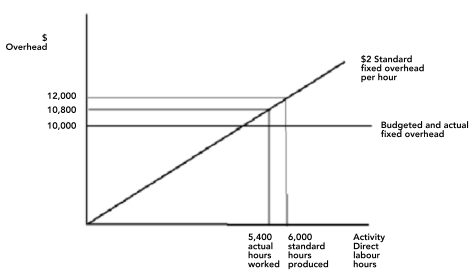
In the graph, the budgeted fixed overhead is a flat line at $10,000. However, by using an OAR of $2 per hour, we absorb overhead along the diagonal line. For example, at the budgeted activity of 6,000 hours, we would absorb 6,000 * $2 = $12,000. This process allows us to build an 'appropriate share' of fixed overhead into every unit we produce based on how much work it required.
This article from ACCA Global explains the concept of absorption using clear graphs.
Read the first section of the article, up to the heading FOAR based upon labour hours. Pay attention to how the graphs illustrate the process of converting a fixed cost into a variable charge per unit.
Conclusion
In this lesson, we have bridged the gap between departmental costs and individual product costs. You have learned how to calculate and apply the Overhead Absorption Rate, a cornerstone of management accounting.
Key Takeaways:
- Overheads are 'absorbed' into product costs using a predetermined overhead absorption rate (OAR) calculated from budgeted data.
- The formula is Budgeted Overheads / Budgeted Activity Level.
- The choice of activity level (the absorption base) is critical. Common bases are units, labour hours, and machine hours.
- The base should reflect the main cost driver for that department (e.g., machine hours for an automated department).
- Using separate departmental OARs is more accurate than a single factory-wide (blanket) rate when departments are different.
We calculated our OARs using budgets. But what happens when reality strikes and our actual spending and actual activity levels are different from what we planned? This discrepancy leads to either under- or over-absorption of overheads, which is a common exam topic and the focus of our next lesson.