Hello. This module examines two exceptions to the Senate’s ordinary legislative procedures: budget reconciliation and nominations. This lesson focuses on reconciliation. The central distinction remains between having the votes to pass a bill and having a way to reach that vote. Reconciliation can remove the need for legislative cloture, but it places limits on what the bill may contain.
By the end, you should be able to read a simplified reconciliation proposal and decide whether a provision can remain in the bill for a majority-vote passage, or whether a successful objection under the Byrd rule would remove it. Allow about 40 minutes for the video, readings, and lesson.
Why reconciliation changes the route to a vote
An ordinary Senate bill can face extended debate, making cloture important even when a majority supports final passage. Reconciliation works differently: it is a procedure for legislation that changes spending, revenues, or the statutory debt limit in pursuit of goals set by a congressional budget resolution. Its Senate debate is limited by law, so supporters do not need a three-fifths cloture vote merely to reach final passage.
The short video gives the overall route before we examine its restrictions.
How does budget reconciliation work?
Watch “How does budget reconciliation work?” from Roll Call for an overview of why a fiscal bill may reach a majority-vote passage without legislative cloture.
Watch the budget route for the relationship between the budget resolution, committee instructions, and a reconciliation bill. Then watch limits and votes for the Byrd rule and debate limit. Treat its description of the budget resolution as a “joint resolution” as imprecise: the relevant budget resolution is a concurrent resolution.
That distinction matters. The House and Senate adopt the budget resolution without sending it to the president; it sets congressional budgetary goals but does not itself change the law. A later reconciliation bill can change the law if both chambers pass the same text and it is enacted.
The budget resolution’s reconciliation instructions identify which committees are to contribute legislation, the type of budgetary change sought, a fiscal target, and a time period. Instructions provide a route into the expedited process, not permission to insert any provision that happens to be popular with a majority. Nor do they dictate every policy choice a committee must make.
The Reconciliation Process: Frequently Asked Questions
Read the Congressional Research Service’s “The Reconciliation Process: Frequently Asked Questions” to connect the expedited procedure to the instructions that authorize it.
On p. 1, in Question 1, “What is reconciliation?”, read the overview. On p. 2, in Question 3, “What are reconciliation directives?”, read the instructions. Focus on committee jurisdiction, fiscal target, and time period; the reporting date is less important for the decision method in this lesson.
A debate limit is not an unrestricted fast pass
Once a reconciliation bill reaches the Senate, the motion to proceed to it is not debatable. Debate on the bill is generally limited to 20 hours, divided equally between the majority and minority. This is why supporters need not file cloture to end debate on the bill and reach a final-passage vote.
Twenty hours does not mean the Senate must complete every vote within 20 hours. Voting time does not count against the debate limit. After debate time expires, senators may still vote on amendments before final passage, often in a lengthy series called a vote-a-rama. Amendments must also satisfy restrictions, including a germaneness requirement. Reconciliation prevents an ordinary debate filibuster of the bill; it does not eliminate procedural disputes or guarantee quick enactment.
The Reconciliation Process: Frequently Asked Questions
Return to the Congressional Research Service FAQ for the precise Senate debate rules behind the majority-vote route.
On p. 8, find the “In the Senate” subsection, after “In the House” and before Question 11, “What is a ‘vote-arama’?” Read the Senate rules. Distinguish the nondebatable motion to proceed, the 20-hour limit, and time spent voting.
If the bill reaches final passage with 50 senators voting yes and 50 voting no, the vice president can break the tie in favor of passage. That is a final-passage calculation, however. It does not answer whether a particular provision survives the special content rules.
The Byrd rule tests what belongs in the bill
The Byrd rule guards the boundary between a budget measure and an ordinary policy bill. It defines several forms of extraneous matter that may be removed from Senate reconciliation legislation. A provision is vulnerable if it meets any one of these tests:
- It makes no change in federal outlays or revenues. Changes to the terms determining who receives spending or pays a tax can count as budgetary changes.
- It increases outlays or reduces revenues when its committee’s title fails to comply with that committee’s reconciliation instructions.
- It lies outside the jurisdiction of the committee that submitted it.
- Its budgetary effects are merely incidental to its nonbudgetary policy effects.
- It contributes to a deficit increase in a year beyond the period covered by the reconciliation measure, without sufficient offset within the relevant committee title.
- It makes recommendations concerning the Social Security old-age, survivors, or disability insurance program under Title II. This restriction is not a blanket ban on every program established by the Social Security Act.
Notice two subtleties. A provision need not individually reduce the deficit merely because its committee has a deficit-reduction target; the committee’s compliance matters to the second test. Conversely, a measurable budget effect is not sufficient by itself: the jurisdictional, merely-incidental, and later-year tests may still apply.
The Reconciliation Process: Frequently Asked Questions
Use the FAQ’s compact account of all six tests and of what happens when a senator challenges a provision.
At the end of Question 5, “Are there restrictions on the content of a reconciliation bill?” (p. 5), read the waiver threshold. Then, in Question 6, “What is the Byrd rule?” (pp. 5–6), read the tests and enforcement. Focus on why a sustained objection normally strikes the challenged matter rather than defeating the entire bill.
A Byrd-rule violation does not automatically disappear from a draft. A senator must raise a point of order while the matter is pending. The presiding officer rules, advised by the Senate Parliamentarian. If the point of order is sustained, the offending matter is normally struck while the rest of the bill remains under consideration. Staff often review and revise language beforehand in an informal process called a Byrd bath, but that advance advice is not itself a floor ruling.
Supporters can seek to waive the Byrd-rule point of order. That requires three-fifths of senators duly chosen and sworn—normally 60 votes. These are not cloture votes. Thus, a coalition can have enough votes to pass a reconciliation bill but not enough to keep a provision that faces a sustained Byrd-rule objection.
Why the wording of a provision matters
The “merely incidental” test is particularly important because it asks about the relationship between a provision’s fiscal effects and its broader policy effects. A large dollar figure does not automatically settle that comparison.
A Congressional Research Service account of 2015 health-insurance legislation illustrates the distinction. The House’s proposed text would have ended an insurance-coverage requirement and its penalties. The Senate’s revised text instead set the tax penalty at zero while leaving the requirement in place. Although both approaches could substantially affect behavior, the Senate Parliamentarian advised that the broad repeal was extraneous and the change to the penalty was not. This was a judgment about the particular legislative language, not a general rule that setting any penalty to zero is always permissible.
The Senate's Byrd Rule: Frequently Asked Questions - Congress.gov
Read the Congressional Research Service’s more detailed explanation of the “merely incidental” test to see why a budget estimate alone may not resolve it.
In Question 3, “How does the Byrd rule define extraneous matter?”, find subsection (D), “Its budgetary effects are ‘merely incidental’ to its non-budgetary components,” on pp. 9–11. Read the comparison and example. Begin with the explanation of how budgetary and nonbudgetary components are compared; stop after the quoted explanation of why the Senate’s penalty adjustment differed from repeal. Figure 6 on p. 9 shows the contrasting language.
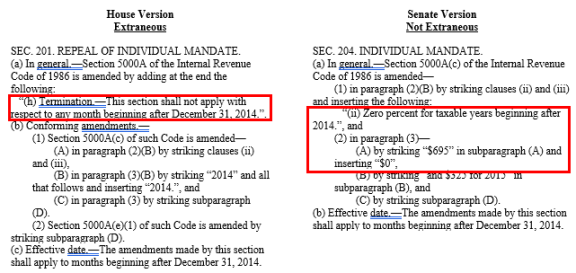
This example also explains why a prediction about reconciliation sometimes must be qualified. Straightforward cases—such as a provision with no spending or revenue effect—may be easy to classify. Whether a consequential policy change has budget effects that are merely incidental can require a case-specific judgment.
A decision method for a simplified scenario
Consider a budget resolution instructing a committee to reduce the deficit by at least $10 billion over its specified period. Its proposed reconciliation title would save $18 billion before adding a $3 billion spending provision within that committee’s jurisdiction. The title would still save $15 billion, meeting the instruction.
The spending provision is not extraneous merely because it spends money: the committee’s title still complies with its target. It must nevertheless survive the other relevant tests, including whether its fiscal effect is more than incidental and whether the title creates an unoffset deficit increase beyond the covered years. If the title instead saved only $8 billion after including that spending provision, the provision’s increase in outlays would be vulnerable under the committee-compliance test.
For an unfamiliar provision, work through the determination in this order:
- Establish the route. Confirm that both chambers adopted a budget resolution with reconciliation instructions for the relevant committee and type of budgetary change.
- Check the provision’s fit. Identify its effect on outlays or revenues, the submitting committee’s jurisdiction and compliance with its instructions, the scale of its nonbudgetary policy effects, any later-year deficit increase, and any Title II Social Security issue. A single extraneous-matter ground is enough to make it vulnerable.
- Check enforcement. A Byrd-rule point of order must be raised and sustained to strike the matter. If supporters obtain the three-fifths waiver, the challenged matter may remain despite the objection.
- Count passage votes separately. If the provision remains and the bill reaches final passage, a Senate majority—including a vice-presidential tie-break where applicable—can pass the bill without a legislative cloture vote.
The resulting conclusion should be precise. Majority support makes reconciliation passage possible; it does not guarantee that every provision supported by that majority can stay in the bill.
Key takeaways
Reconciliation replaces the ordinary need to end Senate debate by cloture with a nondebatable motion to proceed and limited debate on the bill. Its starting point is a budget resolution’s committee instructions, and its principal content safeguard in the Senate is the Byrd rule. A successful Byrd-rule objection normally removes the offending matter; keeping it over that objection generally requires three-fifths support, even though the remaining bill can pass by majority vote.
The next lesson turns to nominations, where the Senate also uses different cloture rules—but without reconciliation’s budget instructions or Byrd-rule tests.