Introduction
In our previous lessons, we built a strong foundation in application-level defenses against SQL injection, focusing on prepared statements and robust input validation. These techniques require direct modifications to the application's source code to ensure that user input is handled securely. Now, we'll shift our focus from internal to external defenses by examining a critical component of a modern security architecture: the Web Application Firewall (WAF).
This lesson will explore how a WAF acts as a protective shield, sitting between the user and your web application to inspect and filter incoming traffic. You will learn the mechanisms a WAF uses to identify the tell-tale signs of an SQL injection attack and how it acts to block these malicious requests before they can ever reach your application or database. This is a key element of the "defense-in-depth" strategy that is fundamental to your work as a security analyst.
What is a Web Application Firewall (WAF)?
A Web Application Firewall is a specialized type of firewall that operates at Layer 7 (the application layer) of the OSI model. Unlike a traditional network firewall that inspects traffic based on IP addresses and ports, a WAF understands the HTTP protocol and is designed to protect web applications from a wide range of common attacks, including Cross-Site Scripting (XSS), file inclusion, and, most importantly for us, SQL injection.
The following video provides a concise overview of what a WAF is and how it functions as a real-time gatekeeper for your web server.
Apache2 ModSecurity Tutorial | Apache2 WAF
This clip from HackerSploit's "Apache2 ModSecurity Tutorial" introduces the concept of a WAF and its role in real-time request inspection.
Please watch the section from the introduction to ModSecurity. Pay close attention to how it describes the WAF's process of inspecting requests and using predefined rules to distinguish between legitimate and malicious traffic.
As you just saw, the power of a WAF lies in its ability to analyze the content of incoming requests and apply a set of rules to block attacks. Let's dive into how exactly it does this for SQL injection.
How WAFs Detect SQL Injection Patterns
At its core, a WAF works by performing pattern matching on various parts of an HTTP request, such as the URL, headers, and request body (e.g., POST data). It searches for "signatures" of known attacks. For SQL injection, this means looking for specific keywords, special characters, and structures that are characteristic of malicious payloads.
Given your coding background, you'll find that these patterns are often defined using regular expressions (regex). A WAF's rule set contains a vast library of regex patterns designed to catch common attack techniques.
The following resource breaks down how you would construct these patterns to identify risky SQL syntax.
How to use regular expressions to match risky SQL patterns?
This article from Tencent Cloud provides excellent, practical examples of using regular expressions to detect SQL injection attempts. This is precisely the logic that powers a WAF's detection engine.
Please read the sections titled Common Risky SQL Patterns and Example Regex Patterns and Code. As you read, focus on the types of patterns being targeted (keywords, comments, tautologies) and examine the Python code snippet to see how these regex rules are applied to an input string. This directly mirrors how a WAF rule would be evaluated.
While you could write these rules yourself, most WAFs rely on professionally maintained, comprehensive rule sets. The most widely adopted is the OWASP ModSecurity Core Rule Set (CRS). This open-source set of rules provides protection against a wide array of attacks, including the OWASP Top 10 vulnerabilities, and is the foundation for many commercial and open-source WAF products.
Blocking and Logging: The WAF in Action
When a WAF rule is triggered by a malicious pattern, its default action is to block the request. It stops the request from ever reaching the application server and typically returns an HTTP 403 Forbidden error to the attacker.

Seeing this in a real-world context is key. The next video demonstrates setting up a WAF on Amazon Web Services (AWS) and shows it blocking an SQL injection attack in real time. It also highlights a critical task for a security analyst: reviewing the WAF logs to understand what attacks are being attempted against your applications.
Stop SQL Injection with AWS WAF - Basic AWS Tutorial
This tutorial from Loi Liang Yang demonstrates configuring AWS WAF to stop SQL injection. It provides a practical look at a major cloud provider's WAF service.
First, watch the segment on creating a rule. Notice how the user selects a pre-built, AWS-managed rule group specifically for "SQL database" attacks. This is an example of leveraging a managed rule set like the OWASP CRS. Next, see the WAF in action from the attack demonstration, where a simple ' OR 1=1 payload is sent and immediately blocked with a 403 Forbidden error. Finally, watch the part on reviewing blocked requests. This is a crucial part of your job as an analyst, as these logs provide threat intelligence about who is attacking you and what methods they are using.
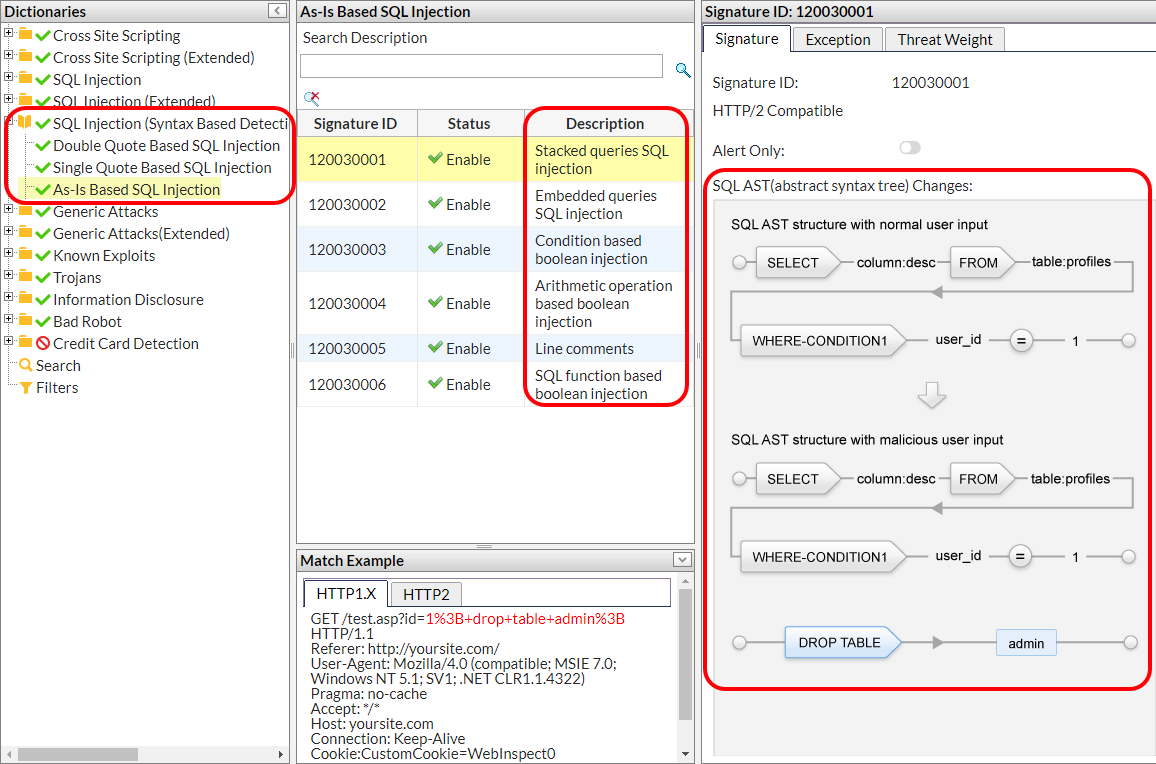
The image below shows another example, this time from a Fortinet WAF configuration screen. It illustrates how a specific signature (ID 120030001 for "Stacked queries SQL Injection") is designed to detect attempts to append malicious commands like DROP TABLE. It even visualizes how the malicious input alters the expected structure of the SQL query.
A Deeper Dive: WAF Processing and the "Fail Fast" Principle
To truly understand WAFs, it helps to know how they process requests. The ModSecurity engine, which underpins the OWASP CRS, uses a phased processing model.
- Phase 1: Request Headers. The WAF analyzes the request line, URI, and headers as soon as they are received.
- Phase 2: Request Body. After the entire request body (e.g., from a POST form) has been received, the WAF analyzes its contents.
Historically, many SQL injection rules were executed in Phase 2, even if the attack was clearly visible in the URL (Phase 1). For a high-performance system, this is suboptimal. If an attack is detectable in the URL, why wait for the entire request body to be buffered and processed before blocking it?
This leads to a crucial security design principle: Fail Fast. A system should identify and reject an invalid or malicious request at the earliest possible moment. The following article provides an excellent deep dive into this concept, which is highly relevant for security architecture and optimization.
OWASP CRS and Fail Fast: Improving Attack Detection in ...
This article from SKUDONET offers an expert-level analysis of WAF processing pipelines and the importance of early detection.
This reading is more in-depth, but the concepts are key to a professional understanding of WAFs. Start by reading the sections on OWASP CRS and the ModSecurity phase model to understand the foundation. Next, read about the subtle issue of delayed detection. Now, grasp the core concept in the section on the Fail Fast principle. Finally, read the sections on technical examples and early evaluation to see how applying the "Fail Fast" principle works in practice by moving rule evaluation to an earlier phase.
By understanding concepts like the Fail Fast principle, you move from simply knowing what a WAF does to understanding how it can be optimized for better security and performance—a critical skill for a security analyst.
Conclusion
In this lesson, we've explored the role of the Web Application Firewall as a powerful external defense. While application-level controls like prepared statements and input validation are your primary defenses, a WAF provides a vital, broad layer of protection that can block a wide range of attacks with minimal to no changes in application code.
Key Takeaways:
- A WAF is a Layer 7 firewall that inspects HTTP/S traffic to identify and block web-based attacks.
- It detects SQL injection by using signature-based detection, matching request contents against a library of patterns (often regular expressions) that signify malicious intent.
- WAFs rely on comprehensive rule sets, like the industry-standard OWASP Core Rule Set (CRS), to provide out-of-the-box protection.
- Upon detection, a WAF blocks the malicious request, typically returning a 403 Forbidden status code, and logs the event for analysis.
- Advanced WAF implementations follow the "Fail Fast" principle, aiming to detect and block attacks at the earliest possible stage in the request processing pipeline to enhance security and efficiency.
In our next lesson, we will return to application-level defenses and explore another powerful technique: parameterized stored procedures. You'll learn how they can be used to securely encapsulate database operations, providing yet another robust barrier against SQL injection.