Introduction
Welcome to the final lesson of your course! In our last session, we established a crucial foundation for LLM Operations by setting up comprehensive monitoring. You learned how to track vital metrics for cost, performance, and quality, using tools like LangSmith to gain deep observability into your production applications.
Today, we take the ultimate step in professionalizing our LLM development lifecycle. We will move from reacting to issues in production to proactively preventing them from ever being deployed. This lesson is designed to help you design an automated evaluation gate within a CI/CD pipeline to prevent LLM quality regressions.
By the end of this lesson, you will understand how to build a safety net that automatically tests every change—whether it's a new prompt, a different model, or updated agent logic—and blocks deployments that degrade your application's quality. This practice is a hallmark of elite AI engineering teams and a powerful way to ensure your applications remain reliable and trustworthy at scale.
Why Evals Belong in CI/CD: The AI Quality Gate
In your experience with traditional software engineering, you're well-versed in using Continuous Integration/Continuous Deployment (CI/CD) pipelines with unit and integration tests to catch functional bugs. However, LLM applications present a new challenge.

A change to a prompt might not cause a 500 error, but it could silently increase hallucinations, reduce factual accuracy, or introduce a new bias. Traditional tests are blind to these qualitative regressions. This is why we need to integrate AI-specific evaluations directly into the CI/CD pipeline, creating what is known as an "AI quality gate."
Trust at Scale: Regression Testing Multi-Agent Systems in ...
To understand the rationale and core principles behind this, let's read a section from the excellent article 'Trust at Scale: Regression Testing Multi-Agent Systems in Continuous Deployment Environments'.
Please read the introduction ('What is Regression Testing?') and the section 'The New Frontier of Quality Assurance: Challenges in Multi-Agent Systems'. Focus on why the non-deterministic nature of LLMs makes traditional regression testing insufficient and necessitates a new approach focused on 'consistent quality' rather than 'identical outputs'.
As the article explains, the goal is not to force an LLM to produce the exact same text every time. Instead, it's to ensure that its output consistently meets a predefined standard of quality and aligns with desired behaviors.
Anatomy of an LLM Regression Test Suite
To build an effective AI quality gate, you need a robust regression test suite specifically designed for LLMs. This suite has two main components: a curated dataset and a sophisticated set of evaluation techniques.
1. The "Golden Dataset"
This is a curated set of test cases that represents the most important scenarios your application will face. It's called a "golden dataset" because it serves as the standard against which all changes are measured. A strong golden dataset should include:
- Common Use Cases: Representative examples of typical user inputs.
- Edge Cases: Tricky, ambiguous, or unusual inputs that have historically caused problems.
- Past Failures: Any time a failure is identified in production, a corresponding test case should be added to the golden dataset to prevent that specific regression from happening again.
2. Advanced Evaluation Techniques
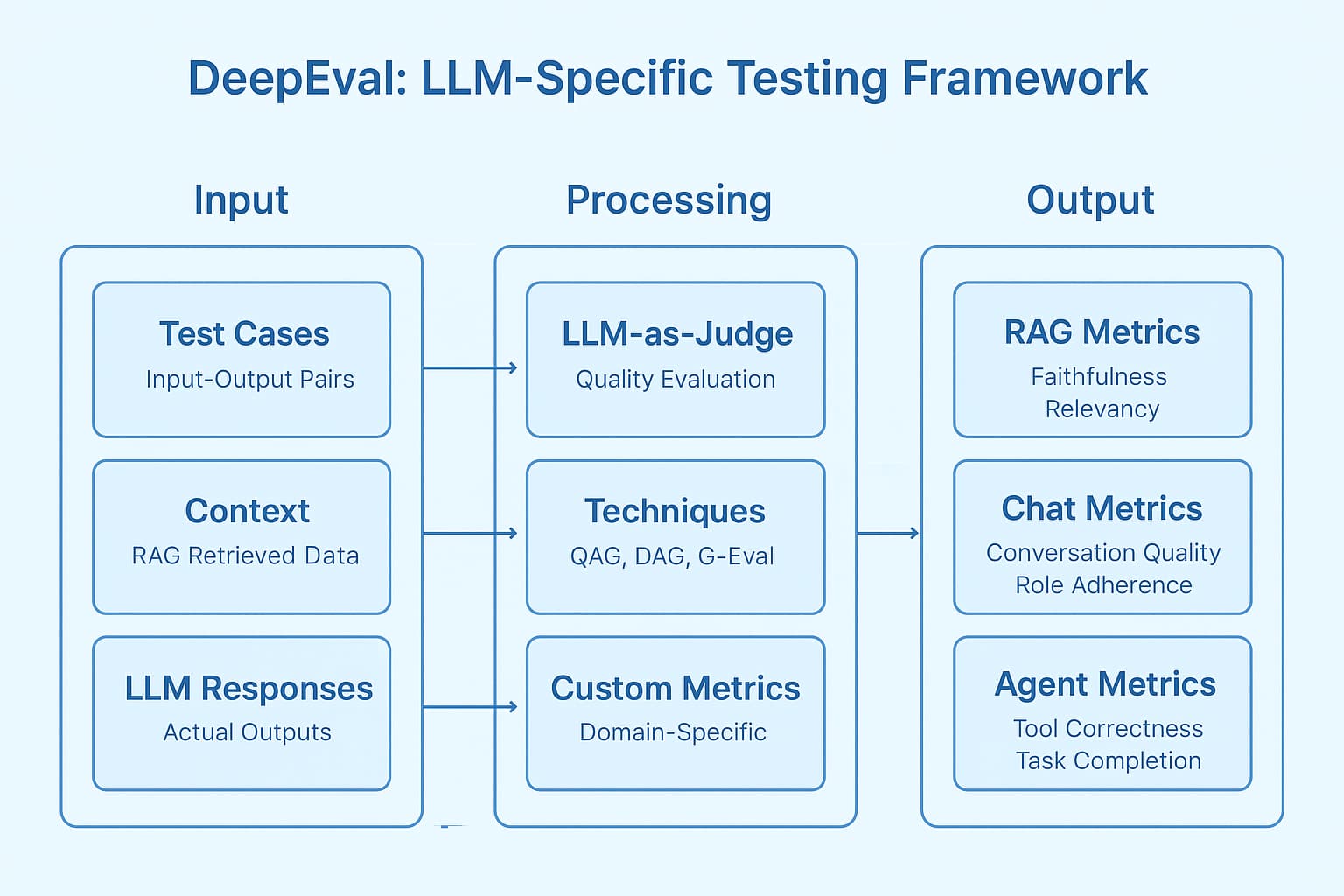
Once you run your application on the golden dataset, you can't simply check for string equality. You must use a combination of evaluation techniques to score the quality of the outputs.
Trust at Scale: Regression Testing Multi-Agent Systems in ...
The 'Trust at Scale' article provides an excellent overview of the advanced techniques required to evaluate these non-deterministic outputs. These methods form the core of your automated quality checks.
Read the section titled 'Advanced Evaluation for Non-Deterministic Outputs'. Pay close attention to the three techniques presented: Property-Based Testing: Verifying structural rules (e.g., 'the output must be valid markdown'). Semantic and Structural Validation: Checking for meaning similarity (using embeddings) and correct data formats (like JSON). LLM-as-a-Judge: Using a powerful LLM with a clear rubric to score subjective qualities like coherence or factual accuracy.
By combining these techniques, you can build a comprehensive scoring system that quantifies your application's performance on the golden dataset.
Designing the CI/CD Workflow with GitHub Actions
Now, let's operationalize this. We'll design a workflow using GitHub Actions that automatically runs our regression suite on every pull request.
The core logic of the workflow is:
- Trigger: The workflow runs when a pull request targeting the
mainbranch modifies key files (e.g., prompts, agent logic, model configurations). - Setup: The job checks out the code, sets up the Python environment, and installs dependencies.
- Evaluate: It runs the test suite (e.g., using
pytest), which executes the application on the golden dataset and computes quality scores using the techniques we just discussed. - Decide & Report: It compares the scores against a baseline and predefined thresholds to make a pass/fail decision, then posts a summary back to the pull request.
Trust at Scale: Regression Testing Multi-Agent Systems in ...
Let's turn to our main resource one last time for a complete, practical implementation.
Please read the section 'Automating Regression Testing with GitHub Actions'. Study the example YAML file. You don't need to memorize the syntax, but understand the purpose of each step: the on: pull_request trigger, dependency caching, managing secrets for API keys, and the final pytest execution step.
Implementing Quality Gates: Baselines and Thresholds
The most critical part of the CI/CD job is the decision-making step. How do you decide if a change is a regression? This involves two concepts: a baseline and thresholds.
- Baseline: To detect a regression, you must compare the performance of your new code (the pull request branch) against the performance of the current production code (the
mainbranch). The baseline is the set of scores generated by running themainbranch code on the golden dataset. - Thresholds: You then define rules for failure.
- Absolute Thresholds: "The
Factual_Accuracyscore must never be below 0.8." - Relative Thresholds: "The
Coherencescore must not drop by more than 5% compared to the baseline score from themainbranch."
- Absolute Thresholds: "The
If any of these thresholds are breached, the CI job fails, blocking the pull request from being merged and alerting the developer that their change introduced a quality regression.
Test your understanding!
You are working on a RAG-based chatbot. You've submitted a pull request with a new prompt designed to make the chatbot's responses more concise. Your CI/CD pipeline runs and fails. The report shows:
Concisenessscore: +15% (Improvement)Factual_Accuracyscore: -8% (Regression)Answer_Relevancyscore: -6% (Regression)
Your quality gate has a relative threshold that fails the build if any score degrades by more than 5%.
- Why did the build fail?
- What does this result tell you about the impact of your prompt change?
- What is your next step as a developer?
Show answer
- The build failed because the
Factual_AccuracyandAnswer_Relevancyscores both dropped by more than the 5% regression threshold, even though theConcisenessscore improved. - This result indicates that while your new prompt succeeded in making responses shorter, it did so at the cost of accuracy and relevance. The model is likely over-summarizing or omitting critical details and sources from the retrieved context to achieve conciseness.
- Your next step is to iterate on the prompt. You should try to refine the instructions to encourage conciseness without sacrificing factual grounding. For example, you could modify the prompt to say, "Summarize the key findings from the provided sources in no more than three sentences, making sure to include the most important facts." After refining the prompt, you would push the change and let the CI/CD pipeline re-evaluate it.
Practical Example: Regression Testing with LangSmith
Frameworks like LangChain's LangSmith provide built-in features that make setting up these regression tests much more manageable. You can define a golden dataset, run multiple versions of your application against it (e.g., old prompt vs. new prompt), and get a visual comparison of the results.
Regression Testing | LangSmith Evaluations - Part 15
Let's watch a practical demonstration of regression testing using LangSmith. This will make the concepts of baselines and regression detection very clear.
Please watch the video, focusing on these parts: 00:06 - 01:30: Understand the core idea of regression testing in this context: comparing a baseline model (e.g., GPT-4) against a new one (e.g., Llama 3) to see where performance improves or gets worse. 03:30 - 05:27: Observe how the LangSmith comparison view uses a baseline and color-codes improvements (green) and regressions (red). This is the visual output of an automated quality gate. 05:27 - 07:55: See how you can filter to isolate only the regressions and then drill down into the traces to understand why a specific case failed. This is the debugging loop enabled by the CI gate.
This workflow—automating evaluation, getting a clear red/green signal, and drilling down into failures—is the essence of what you are designing. The CI/CD pipeline provides the automation, and tools like LangSmith provide the evaluation and debugging interface.
Conclusion
Congratulations on completing the final lesson and the entire course! You have journeyed from the fundamentals of sequence modeling and the inner workings of the Transformer architecture to the cutting edge of LLM Operations.
Key Takeaways from this Lesson:
- AI Quality Gates are Essential: Traditional CI/CD tests are insufficient for LLMs; you must integrate automated AI evaluations to prevent qualitative regressions.
- Regression Suites Need a Golden Dataset: A curated set of common use cases, edge cases, and past failures is the foundation for reliable regression testing.
- Compare Against a Baseline: The core of regression testing is comparing the performance of a proposed change against the established performance of your production system.
- Use Thresholds to Automate Decisions: Define clear pass/fail rules (both absolute and relative) to create an automated gate that blocks harmful changes.
- Leverage Modern Tooling: Platforms like LangSmith, Langfuse, and others are purpose-built to streamline this process of evaluation, comparison, and debugging.
Over the past 12 modules, you have built a formidable skill set. You can now trace the evolution of sequence models, implement a Transformer from scratch, and navigate the complex landscape of modern LLM architectures like MoE and RoPE. You have mastered prompt engineering, fine-tuning with PEFT, and building complex RAG and agentic systems. Finally, you have closed the loop by learning to deploy, monitor, and create automated quality gates for these systems in production.
You have acquired the deep, principled, and practical knowledge required to bridge the gap between business needs and state-of-the-art AI implementation. This comprehensive understanding of the full LLM lifecycle is precisely what distinguishes an elite AI Engineer. The foundation is now set for you to build, innovate, and lead in this transformative field. Well done.