Introduction
In our last lesson, you mastered the art of designing agentic workflows with a planning step. By structuring agents to first create a plan (using patterns like ReWOO and LLMCompiler) and then execute it, you enabled them to tackle complex, multi-step tasks with greater reliability and efficiency. This brought us to a system of orchestrators and workers, where multiple components—planners, tools, and executors—must collaborate.
This collaboration, however, introduces a new, critical challenge. As we build more sophisticated systems with a growing number of agents and tools from different providers, how do we prevent a "Tower of Babel" scenario? Without a common language, we'd be forced to write custom, brittle integrations for every agent-to-tool connection. This is not scalable and hinders the creation of a robust AI ecosystem.
Today's lesson addresses this exact problem. You will describe the purpose of the Model Context Protocol (MCP) for standardizing agent-tool communication. We will explore how MCP acts as a universal adapter, or a "lingua franca," that allows any compliant AI agent to seamlessly discover and interact with any compliant tool or data source.
The Scalability Problem: Why We Need a Standard
Before diving into the solution, let's crystallize the problem. Imagine you're building an enterprise AI assistant. You need it to connect to Jira for issue tracking, a SQL database for business intelligence, and a web search API for current events. Now, imagine another team wants to build a code generation assistant that needs access to a GitHub repository, a documentation server, and a local file system.
Without a standard, you'd be solving the same integration problem over and over. This is often called the "N×M integration problem."
Anthropic's Model Context Protocol (MCP): A Deep Dive for ...
To understand the core motivation behind MCP, let's start with this article that clearly articulates the integration challenge.
Please read the section 'The Problems MCP Solves: Breaking Down LLM Integration Barriers'. Focus on how the article explains the 'N×M integration problem' and how a standard protocol transforms it into a more manageable 'N+M' problem.
As you've just read, the goal is to move from a quadratic complexity of N applications × M tools to a linear complexity of N applications + M tools. Each application and tool only needs to implement the standard once to be interoperable with the entire ecosystem. This is a classic software engineering principle applied to the world of AI agents, much like how REST APIs standardized web service communication.
What is MCP? The Universal Adapter for AI
The Model Context Protocol (MCP) is the proposed solution to this integration chaos. It's an open-source protocol initiated by Anthropic designed to be a common language for AI applications (like agents) to communicate with external context providers (like tools and data sources).
One of the best analogies for MCP, as mentioned in the article you just read, is USB-C. Before USB-C, we had a mess of proprietary chargers and data cables. Now, a single, standardized port can handle power, data, and video for a vast range of devices. MCP aims to do the same for agent-tool communication.
To hear about the protocol's purpose and origin directly from its creators, watch the following short video.
The Model Context Protocol (MCP)
This video from Anthropic features the co-creators of MCP discussing its fundamental purpose and the initial problems it was designed to solve.
Watch from the beginning to 6:18. Pay attention to how they define MCP as a way to 'give context' to an LLM application and the story of how it originated from the simple frustration of copy-pasting.
Under the Hood: MCP Architecture and Primitives
So, how does MCP achieve this standardization? It defines a clear architecture and a set of core "primitives" that structure the communication.
Architecture
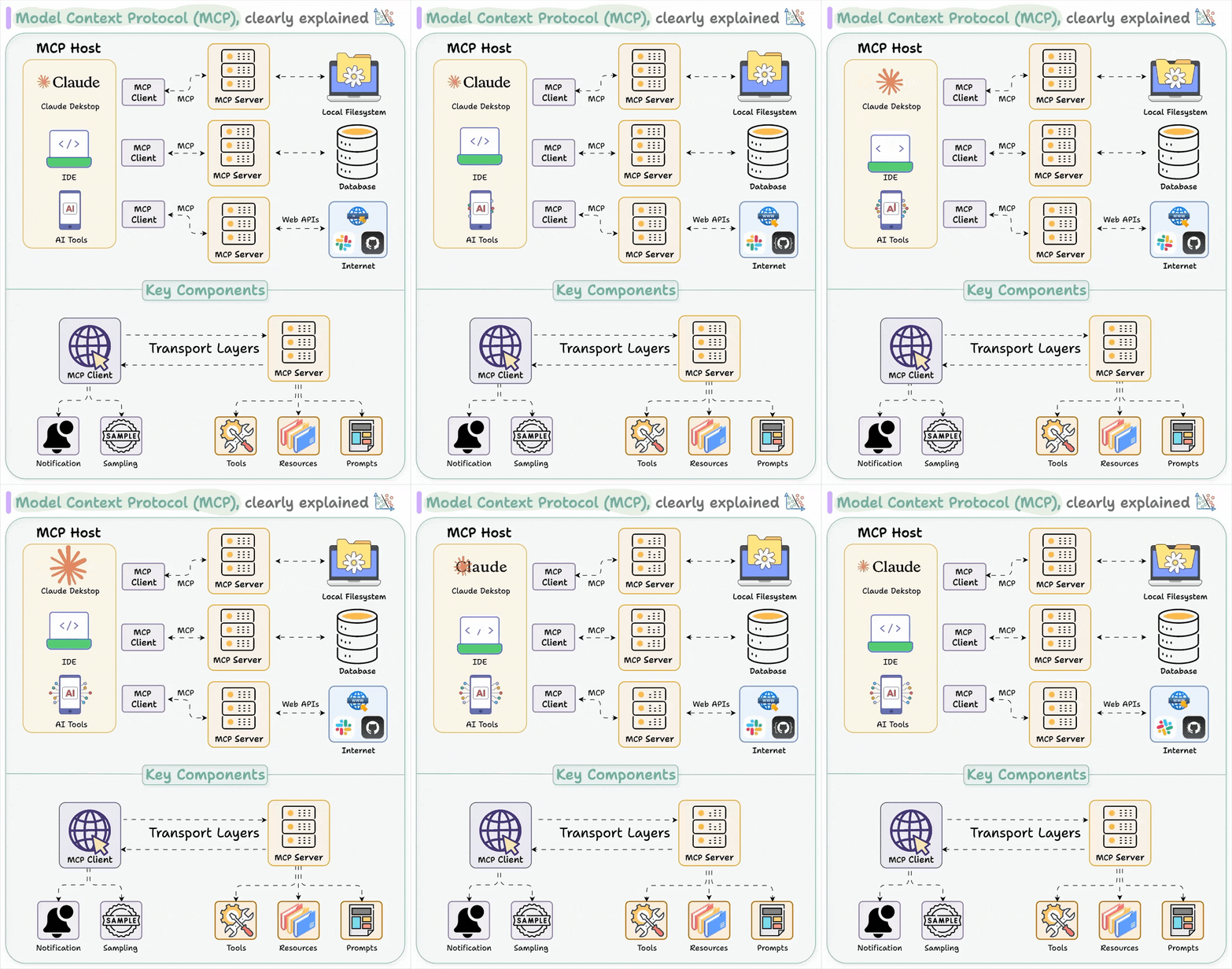
MCP uses a client-server architecture:
- Host: The main AI application that the user interacts with (e.g., an IDE plugin, a chatbot interface like Claude Desktop). It initiates and manages connections.
- Client: A component within the Host that manages the connection to a single MCP Server. The Host spawns one client per server connection, sandboxing it for security.
- Server: An external program that provides capabilities. It "serves" context to the Host via the MCP protocol. It could wrap a database, a set of APIs, or access to a local filesystem.
The communication itself happens via JSON-RPC 2.0, a lightweight remote procedure call protocol. The use of JSON makes the messages human-readable and, more importantly, easily parsable by LLMs.
The Three Primitives
An MCP server exposes its capabilities through three main primitives, which you can think of as the standardized "types" of context it can provide:
- Tools: These are functions the AI model can execute. Each tool has a description explaining what it does, when to use it, and what its inputs and outputs are. This is the foundation of agentic action.
- Resources: This is raw data or context that can be provided to the model, perfect for Retrieval-Augmented Generation (RAG). This could be the content of a file, a database schema, or search results.
- Prompts: These are pre-defined prompt templates or workflows, often triggered by the user (e.g., via a slash command like
/summarize_document). They provide a shortcut for common tasks.
An agent connects to an MCP server and can dynamically discover these primitives, understanding what actions it can take and what information it can access.
Why MCP is "AI-Native": Discovery vs. Definition
You might be thinking, "We already have protocols for service communication, like gRPC. Why invent a new one?" This is a crucial question, and the answer lies in the unique needs of an LLM-powered agent.
Let's explore the difference.
MCP vs gRPC: How AI Agents & LLMs Connect to Tools & Data
This excellent video from IBM Technology contrasts MCP with gRPC, a widely-used RPC framework. This comparison highlights exactly why a new, 'AI-native' protocol like MCP is necessary.
Watch the segments from 0:00-3:38 and 6:50-8:06. Focus on the distinction between gRPC's 'structural' discovery (protobuf definitions) and MCP's 'semantic' discovery (natural language descriptions).
As the video explains, the key difference is semantic discovery.
- gRPC tells an application what methods are available and their technical signatures (e.g.,
get_weather(location: string) -> float). It's structurally rigid and fast. - MCP tells an LLM what methods are available, their signatures, and provides a natural language description of when, why, and how to use them (e.g., "Use this tool when the user asks about the temperature or weather conditions.").
This semantic layer is vital for a probabilistic system like an LLM, which needs to reason about which tool is appropriate for a given task. MCP is built for the LLM to be the one making the call, whereas gRPC requires a deterministic adapter layer to translate user intent into a specific function call.
Test your understanding!
You have designed an agent that needs to interact with a company's internal CRM. The CRM has an API for create_ticket, update_ticket_status, and get_user_details.
If you were to use a standard API with function calling (like OpenAI's), what information would you primarily provide to the LLM? Now, if you were to expose this API via an MCP server, what additional, crucial information would you include in the tools definitions, and why is that information so important for the agent's performance?
Show answer
With standard function calling, you would primarily provide the function names (create_ticket, etc.) and their parameter schemas (e.g., create_ticket requires title: string, description: string, priority: int).
With MCP, you would provide the same structural information but also add a rich, natural language description for each tool. For example:
- For
create_ticket: "Use this tool to create a new support ticket when a user reports a new problem or bug. Do not use this to update an existing issue." - For
update_ticket_status: "Use this tool to change the status of an existing ticket (e.g., to 'in-progress' or 'resolved') when a user provides an update or a resolution. You will need the ticket ID."
This additional semantic information is crucial because it helps the LLM disambiguate between tools and understand the intent behind them, reducing errors and improving the reliability of its tool-use decisions.
The Strategic Importance: Openness and Security
Finally, a key part of MCP's purpose lies in its design as an open standard. By being open-source, it aims to prevent vendor lock-in and encourage a broad ecosystem of compatible tools and agents.
However, giving agents the power to access data and execute code introduces significant security risks. A well-designed standard must address this from the ground up.
The official MCP specification includes a vital section on security. Understanding these principles is non-negotiable for anyone looking to build production-grade agentic systems.
Read the section 'Security and Trust & Safety' and focus on the four 'Key Principles': User Consent and Control, Data Privacy, Tool Safety, and LLM Sampling Controls.
These principles emphasize that the user must always be in control. The Host application is responsible for enforcing these rules, acting as a gatekeeper that ensures the agent only performs actions explicitly authorized by the user.
Conclusion
In this lesson, you've unpacked the purpose and design of the Model Context Protocol. You've seen that as agentic systems scale, the need for a standardized communication layer becomes paramount to avoid an unmanageable web of custom integrations.
Key Takeaways:
- The Problem: The
N×Mintegration challenge makes scaling agent-tool ecosystems difficult and expensive. - The Solution: MCP provides a standardized, open-source protocol for agent-tool communication, transforming the problem into a more manageable
N+Mintegration. - Core Architecture: MCP uses a Host/Client/Server model with JSON-RPC for communication.
- Key Primitives: It standardizes context into three types: Tools (actions), Resources (data), and Prompts (templates).
- AI-Native Design: Unlike traditional RPC frameworks, MCP is built for LLMs. It includes rich semantic descriptions that enable agents to reason about when and why to use a tool, a feature known as semantic discovery.
- Security is Foundational: The protocol is designed with user consent and control as a core principle to safely manage data access and code execution.
What's Next?
You have now completed the "Agentic AI Systems and Orchestration" module. You've journeyed from enabling simple tool use and memory to designing complex planning workflows and now, finally, understanding the protocol that will allow these systems to scale and interoperate.
With this deep understanding of how to build and orchestrate advanced LLM applications, the next logical step is to learn how to deploy, serve, and operate them in a production environment. In our next lesson, we will kick off the final module, "LLM Operations," by diving into high-performance inference servers like vLLM and TensorRT-LLM, which are essential for serving your powerful agents to users efficiently.