Hello! Welcome to your seventh lesson in the "Foundations of Sequence Modeling" module.
In our last lesson, we identified the three critical limitations of recurrent architectures, even advanced ones like LSTMs: the sequential processing bottleneck, the fixed-size information bottleneck, and the problem of long path lengths. These issues fundamentally constrained the performance, efficiency, and scalability of sequence models.
Today, we introduce the solution: the attention mechanism. This concept is arguably the most important single idea that enabled the transition from RNNs to modern LLMs. Our primary goal is to understand how attention directly smashes the sequential processing bottleneck, but we'll also see how it elegantly solves the other two limitations along the way. This marks a pivotal moment in our journey, as mastering attention is the key to understanding the Transformer architecture.
The Core Idea: Focusing on What Matters
Before diving into the mechanics, let's build an intuition. Imagine a human translating a long, complex sentence. They don't just read the source sentence once, memorize it, and then write the translation. Instead, for each word they write, their eyes dart back to the source sentence, focusing on the words most relevant to the one they are currently translating.
This is the essence of attention. It's a mechanism that allows a model, at every step of its process, to "look back" at the entire input and assign a score of importance to each part. It then creates a custom, dynamic context vector based on a weighted sum of the inputs, emphasizing the parts it deems most relevant.
This contrasts sharply with the classic RNN encoder-decoder, which forces the encoder to compress the entire input into a single, static vector. It's the difference between translating with the source text in front of you versus trying to translate from a single, hastily scribbled summary sentence.
This first video from 3Blue1Brown provides an excellent high-level intuition for why context is so critical and how attention helps provide it.
Attention in transformers, step-by-step | Deep Learning Chapter 6
Watch this introductory segment to understand the conceptual problem that attention solves. It uses clear examples to show how a word's meaning is defined by its context and sets the stage for how a model can learn to find that context.
Watch from the beginning to 03:43. Focus on how the meaning of a word like 'mole' changes with context and how an ideal model would update a word's representation based on its neighbors.
Breaking the Sequential Chain: Parallel Processing
The most revolutionary aspect of attention is how it breaks the strict sequential dependency of RNNs. In an RNN, computing the hidden state for word #5 requires the hidden state from word #4, which requires #3, and so on.
Attention throws this requirement away. The attention score for any given token can be calculated with respect to all other tokens simultaneously. The core computation is a series of matrix multiplications which are highly parallelizable, making them a perfect fit for modern GPUs.
This means that instead of processing a sequence in O(N) sequential steps (where N is sequence length), the model can process all tokens at once.
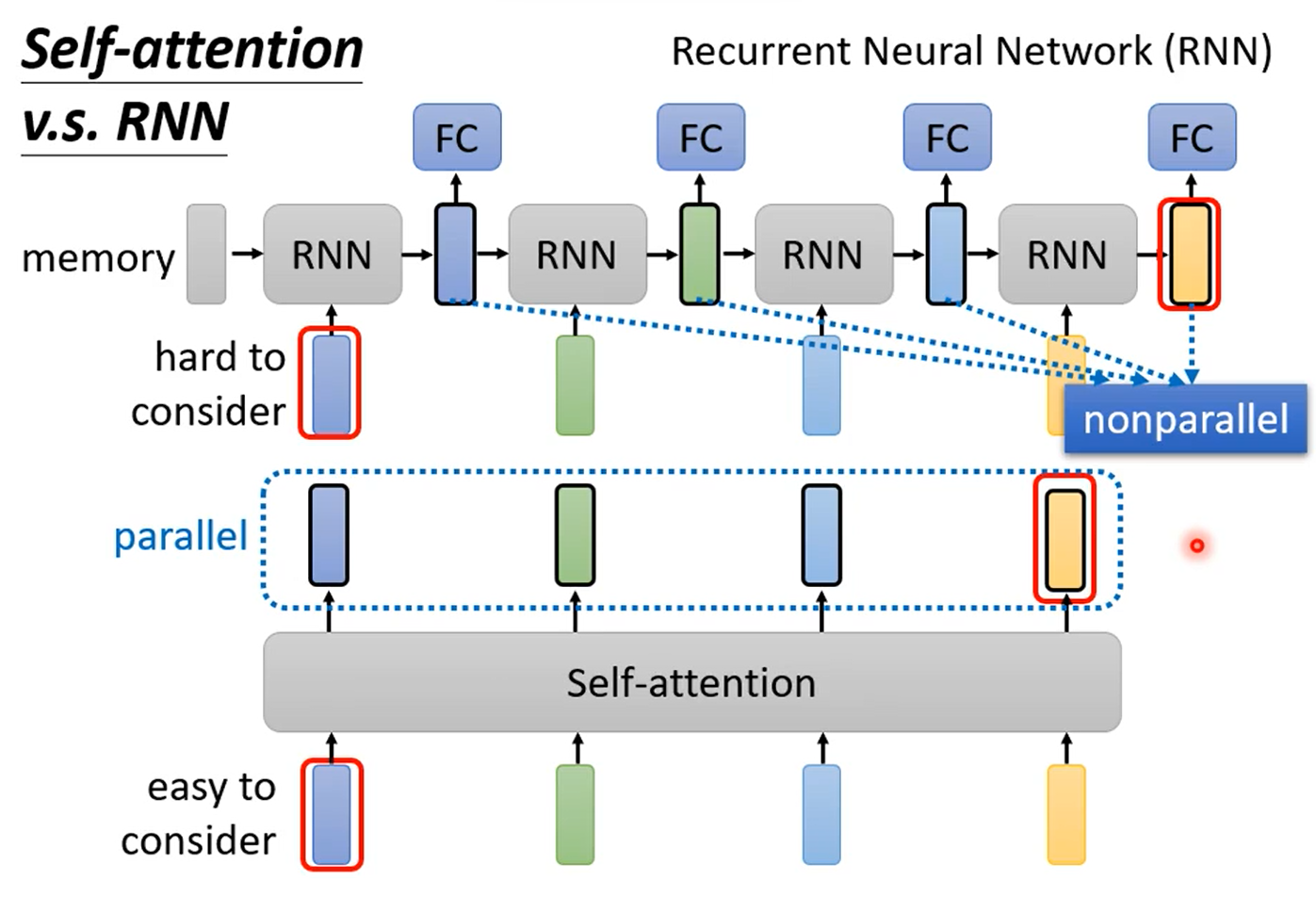
This is not just a minor optimization; it is a fundamental architectural shift that enables the training of vastly larger models on much longer sequences in a fraction of the time.
The following resources explain this critical advantage in detail.
Attention Is All You Need - A Deep Dive into the ...
This article from Towards AI directly explains the power of parallelization unlocked by the Transformer's attention mechanism. It's a concise and clear explanation of the core learning outcome for today.
Read the section 'The Power of Parallelization' under heading 3. Pay close attention to the statement: 'One of the Transformer’s key advantages over RNN-based architectures is its ability to process all elements of the input sequence in parallel.'
What is an attention mechanism?
This article from IBM provides another perspective, framing the advantages of attention over both RNNs and CNNs. It reinforces the concept of breaking the serialized processing of RNNs.
Read the section 'Why are attention mechanisms important?'. Focus on the bullet points 'Flexibility over time' and 'Parallelization' to see how attention directly addresses the RNN's sequential nature.
To hear this point emphasized, this very short clip from the 3Blue1Brown video is perfect.
Attention in transformers, step-by-step | Deep Learning Chapter 6
This clip succinctly states that the parallelizable nature of attention is a huge reason for its success, as it allows for massive scaling on GPUs.
Watch from 24:54 to 25:22. This is a key takeaway on why attention-based architectures have scaled so effectively.
Finally, this next video segment demonstrates the practical implication of this parallelism during the training process, contrasting it with the token-by-token nature of inference.
Attention is all you need (Transformer) - Model explanation (including math), Inference and Training
This video by Umar Jamil provides a clear walkthrough of the training and inference process in a Transformer. The key insight is seeing how the entire sequence is processed in 'one time step' during training, directly enabled by the parallel nature of attention.
Watch from 44:21 to 51:40. Focus on the part where the presenter explains that training happens in 'one pass' or 'one time step,' unlike the sequential nature of RNNs. This is a direct consequence of attention's parallelizability.
Solving All Three Bottlenecks: How Attention Works
Now that you understand that attention enables parallel processing, let's briefly look at how it works. This will also reveal how it solves the other two RNN limitations. The mechanism is based on three components for each input token: a Query, a Key, and a Value. Given your background, the analogy to a key-value database or a Python dictionary is apt.
- Query (Q): Represents the current token's need for information. It's a vector asking, "What context am I looking for?"
- Key (K): Represents the "label" or content of a token that can be queried. It's a vector that responds, "This is the information I hold."
- Value (V): Represents the actual content or embedding of a token. It's the information that will be passed on if the Key matches the Query.
The process is as follows:
- A token's Query vector is compared against every other token's Key vector, usually via a dot product. This produces an "attention score" indicating relevance.
- These raw scores are passed through a
softmaxfunction to create normalized attention weights—a probability distribution that sums to 1. - These weights are used to compute a weighted sum of all tokens' Value vectors.
The result is a new vector for our token that is not just its own embedding, but a blend of all other token embeddings, weighted by their relevance.
Watch these segments to see this process beautifully visualized.
Attention in transformers, step-by-step | Deep Learning Chapter 6
These sections from the 3Blue1Brown video masterfully explain the Query, Key, and Value concepts and walk through the calculation of the final context-rich embedding. This will solidify your understanding of the mechanics.
Watch from 06:09 to 11:09, and then from 13:04 to 15:44. Focus on how Queries, Keys, and Values are created and how the final attention-weighted output is computed. The grid visualization of attention scores is particularly insightful.
This mechanism simultaneously solves the other two bottlenecks:
- Information Bottleneck: Solved. Instead of one fixed-size context vector, attention creates a unique, dynamic context vector for every token at every step, allowing it to focus on different parts of the input as needed. The image below shows this in an earlier attention-based seq2seq model.
- Long Path Lengths: Solved. The attention mechanism computes a direct, weighted connection between any two tokens in the sequence, regardless of their distance. The path length is a constant O(1). A token at the end of a paragraph can directly attend to a token at the very beginning, allowing the model to capture long-range dependencies with unprecedented effectiveness.

Test your understanding!
You have two models to train on a very long text dataset (e.g., sequences of 4000 tokens). Model A is an LSTM, and Model B uses an attention mechanism. You have access to two types of hardware: a standard single-core CPU and a powerful multi-core GPU.
Which model's training time will benefit more from moving from the CPU to the GPU, and why?
Show answer
Model B, the attention-based model, will see a vastly greater speedup from moving to a GPU.
The reason is that the LSTM's computation is inherently sequential. Even with a powerful GPU, it must process the 4000 tokens one after another. While some operations within a single LSTM cell can be parallelized, the overall sequence processing remains a bottleneck.
The attention mechanism, however, performs its core computation using large matrix multiplications that can be massively parallelized. A GPU is designed to excel at exactly this type of operation. It can process the relationships between all 4000 tokens simultaneously, leading to a dramatic reduction in training time compared to the sequential processing on a CPU.
Conclusion
Today you've learned about the attention mechanism, the innovation that broke the chains of recurrent processing and paved the way for modern AI.
Key Takeaways:
- Solves the Sequential Bottleneck: Attention's core computations are based on matrix multiplications that can be performed in parallel for all tokens in a sequence, making it incredibly efficient on modern hardware like GPUs.
- Solves the Information Bottleneck: It creates dynamic context vectors for each output step, allowing the model to focus on the most relevant parts of the input, rather than relying on a single fixed-size vector.
- Solves the Long Path Length Problem: It creates direct O(1) paths between any two tokens in a sequence, enabling the model to effectively capture very long-range dependencies.
What's Next?
We've established that attention is far more parallelizable than recurrence. But what about the computational cost? That parallel power comes with its own trade-offs. The calculation of attention scores between every pair of tokens has a complexity that is quadratic in the sequence length. In the next lesson, we will directly compare the computational complexity of recurrent versus attention-based architectures, setting you up to understand why a 4000-token context window is common, but a 4-million-token one is not (yet).