Hello! Welcome to your sixth lesson.
In our last session, we explored how LSTMs and GRUs masterfully manage their memory using gates, successfully mitigating the vanishing and exploding gradient problems that plagued simple RNNs. This was a monumental leap, enabling models to learn much longer dependencies.
However, even these advanced architectures carry a fundamental flaw inherited from their recurrent nature. Today, we will dissect the remaining limitations of all recurrent architectures. Understanding these constraints is crucial, as they were the driving force behind the next, and arguably most significant, paradigm shift in sequence modeling: the move to attention-based models like the Transformer.
Our goal is to explain why, despite their successes, LSTMs and GRUs hit a ceiling in performance and efficiency, paving the way for a new approach.
The Achilles' Heel of Recurrence
While LSTMs fixed the gradient flow problem, they did not fix the underlying architectural problems of recurrence itself. These limitations can be grouped into three main categories.
1. The Sequential Processing Bottleneck
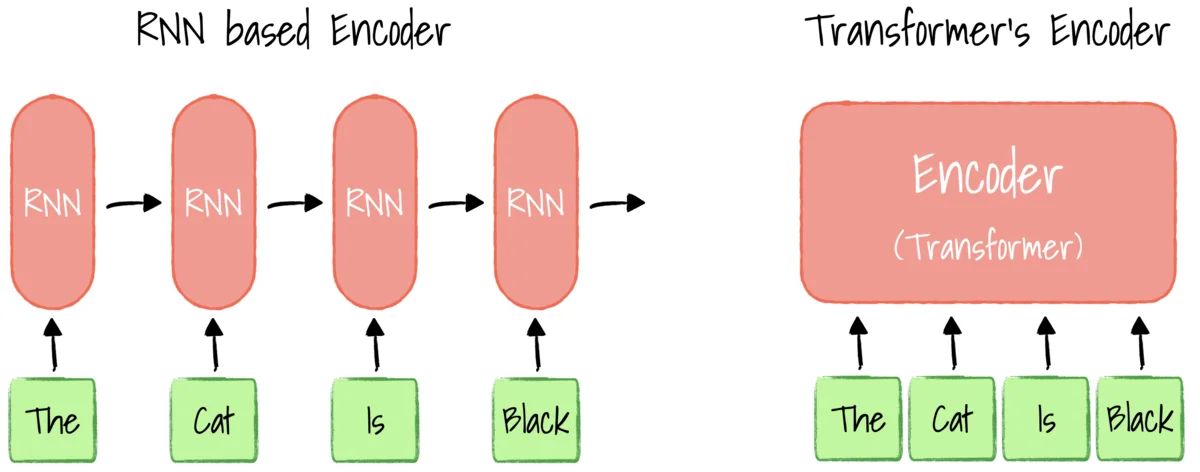
This is the most significant practical limitation. Recurrent networks, by definition, process sequences step-by-step. The computation of the hidden state at timestep , , is strictly dependent on the hidden state from the previous timestep, .
You cannot calculate the state for the tenth word in a sentence until you have calculated it for the ninth, which requires the eighth, and so on. This creates an un-break-able sequential dependency.
Think of it like a factory assembly line where each worker must wait for the person before them to finish their task. You can't have all workers operate simultaneously on the same product.
This poses a massive problem for modern hardware. GPUs and TPUs are designed for massive parallel computation—performing thousands of identical operations at the same time. The sequential nature of RNNs prevents them from fully leveraging this power for a single sequence, leading to significantly longer training and inference times, especially for long sequences.
This image provides a clear visual contrast between the sequential RNN approach and the parallel approach that new architectures enable.
2. The Fixed-Size Information Bottleneck
In the classic encoder-decoder architecture you learned about, the encoder's job is to read the entire input sequence and compress all of its information into a single, fixed-size vector (often called the "context vector" or "thought vector"). This vector is typically the final hidden state of the encoder RNN.
This design forces the model to cram the entire meaning of a potentially long and complex sequence—say, a full paragraph for translation—into a single, dense vector. This is a severe information bottleneck. It is extraordinarily difficult to represent all the nuances, details, and dependencies of a long text in one fixed-size summary. As the input sequence gets longer, the model is more likely to forget details from the beginning.
It's analogous to being asked to summarize a 500-page novel in a single sentence. You will inevitably lose a vast amount of critical information. The decoder then has to reconstruct the entire output sequence based only on this compressed, and likely lossy, summary.
3. The Problem of Path Length and Fading Memory
For you, aiming for deep mastery, this is a crucial concept. While LSTMs are much better than simple RNNs at handling long-range dependencies, they are not a perfect solution. The problem lies in the path length.
To connect information between two points in a sequence (e.g., a subject at the start of a paragraph and a pronoun at the end), the information and the learning signal (gradient) must travel through every single intermediate timestep. The number of steps the information has to traverse is proportional to the distance between the tokens, a path length of O(n) for a sequence of length n.
At each step, the information passes through multiple gates and transformations. While the gates in an LSTM are designed to preserve information, they are not perfect. Over a very long path, the signal can still degrade or be subtly altered at each step. This makes it difficult for the model to learn the precise relationship between very distant elements in a sequence.
The following resources provide excellent, detailed explanations of these limitations.
Limitations of Traditional RNN Approaches
This article, 'Limitations of Traditional RNN Approaches', provides a clear, structured breakdown of the issues we've just discussed. It's a perfect summary of the challenges that motivated the shift away from recurrence.
Please read the sections titled 'The Challenge of Long-Range Dependencies', 'Sequential Computation Hinders Parallelization', and 'Fixed-Size Encoding Limitation'. Notice how they map directly to our discussion.
Why does the transformer do better than RNN and LSTM?
For a more technical and comparative perspective, this discussion provides a deeper insight. It's particularly useful for its explanation of 'path length', a key concept for understanding the fundamental advantages of newer architectures.
Read the first answer's 'RNN / LSTM' section and the third answer in its entirety. The third answer powerfully introduces the concept of 'path length', contrasting the O(n) path in RNNs with the O(1) path that we'll soon see in Transformers. This is a critical idea for deep understanding.
To hear these points summarized in a lecture context, the following short clip is ideal.
MIT 6.S191: Recurrent Neural Networks, Transformers, and Attention
This segment from an MIT lecture on sequence models concisely summarizes the core limitations of recurrent architectures, reinforcing what we've covered.
Please watch from 41:07 to 42:58. The speaker outlines the encoding bottleneck, the difficulty in parallelization, and the limited long-term memory capacity.
Test your understanding!
Imagine you are tasked with building a system to summarize multi-page legal contracts (e.g., 10,000+ words) into a few bullet points. If you were using an LSTM-based seq2seq model, which of the three limitations discussed would be most detrimental to your model's performance, and why?
Show answer
The two most critical limitations would be:
-
The Fixed-Size Information Bottleneck: This is arguably the biggest problem. Trying to compress a 10,000-word legal document, with all its clauses and specific terminology, into a single fixed-size vector would be practically impossible. The model would inevitably lose critical details, making an accurate summary impossible.
-
The Problem of Path Length: To create a good summary, the model needs to understand connections between clauses that might be thousands of words apart. For an LSTM, the path length between these clauses would be enormous, making it extremely difficult for gradients to flow effectively and for the model to maintain the memory of a specific detail from page 2 when it's generating a summary point related to page 48.
While the sequential processing bottleneck would make training the model extremely slow, the other two limitations would more directly impact the quality and feasibility of the final summary.
Conclusion
You now understand that while LSTMs and GRUs were a brilliant solution to the gradient flow problem, they were still constrained by the fundamental architecture of recurrence.
Key Takeaways:
- Sequential Bottleneck: RNNs process data serially ( depends on ), preventing parallelization within a sequence and making them inefficient on modern hardware.
- Information Bottleneck: Classic seq2seq models compress the entire input into one fixed-size vector, causing information loss, especially for long sequences.
- Long Path Lengths: Information and gradients must travel step-by-step through the sequence, leading to signal degradation over very long distances, even with LSTMs.
These three problems—a slow architecture that struggles to remember—created an urgent need for a new approach. What if a model could process all input elements at once, eliminating the sequential bottleneck? And what if, for every output it generates, it could look back and directly access any part of the original input, eliminating the information bottleneck and the path length problem?
What's Next?
This is precisely what the attention mechanism allows. In our next lesson, you will learn how attention works. It is the core innovation that breaks the sequential chain, allowing models to selectively focus on the most relevant parts of the input at any given time. This not only solves the limitations of RNNs but also unlocks unprecedented performance and scalability, directly leading to the Transformer architecture that powers every modern LLM.