Hello! Welcome to the first lesson of our "Advanced Supervised Models" module. In our previous lessons, we explored ensemble methods, seeing how combining many decision trees in clever ways—either in parallel with Random Forests or sequentially with Gradient Boosting—can lead to powerful predictive models.
Today, we shift our focus to a completely different but equally powerful approach to classification. Your learning outcome is to explain the core concepts of Support Vector Machines (SVM), including the maximal margin, support vectors, and the kernel trick, for an exam context. We will demystify how SVMs find the optimal way to divide data, what makes them robust, and how they can handle even complex, non-linear patterns.
1. The Core Idea: Finding the Best Divider
Imagine you have a dataset with two classes of points, say, approved and denied loan applications, plotted on a graph. Your goal is to draw a line that separates the two groups. It's likely that you could draw many different lines that successfully separate the training data. So, which one is the best?
A Support Vector Machine answers this by finding the line that is as far as possible from the nearest data point in each of the two classes. This "best" line is called the hyperplane, and the "cushion" or "safety zone" around it is called the margin.
In two dimensions, a hyperplane is simply a line. In three dimensions, it's a flat plane. In more than three dimensions (which we can't easily visualize), it's a more general object called a hyperplane. The core idea remains the same: it's a flat decision surface that divides the space.
Josh Starmer's StatQuest video provides a wonderfully intuitive explanation of this core concept, starting from one dimension and building up.
Support Vector Machines Part 1 (of 3): Main Ideas!!!
This video, "Support Vector Machines Part 1 (of 3): Main Ideas!!!", explains the foundational ideas of SVM in a very accessible way.
First, watch the segment that introduces the concept of finding a threshold and why simply picking one isn't enough. Focus on the idea of the maximal margin, which is the threshold that is farthest from the observations on either side (maximal margin). Then, watch the segment that explains how this concept extends from a point on a line to a plane in 3D, introducing the term hyperplane (data in 3D).
The main principle of SVM is to find the hyperplane that gives the largest possible margin. This is known as finding the Maximal Margin Hyperplane. The intuition is that a larger margin leads to a more robust classifier that is less likely to misclassify new, unseen data points that are near the boundary.
2. Support Vectors: The Points That Matter
So, how does the SVM find this optimal hyperplane? This is where the concept of support vectors comes in.
Support Vectors are the data points that lie closest to the hyperplane—they are the points on the very edge of the margin.
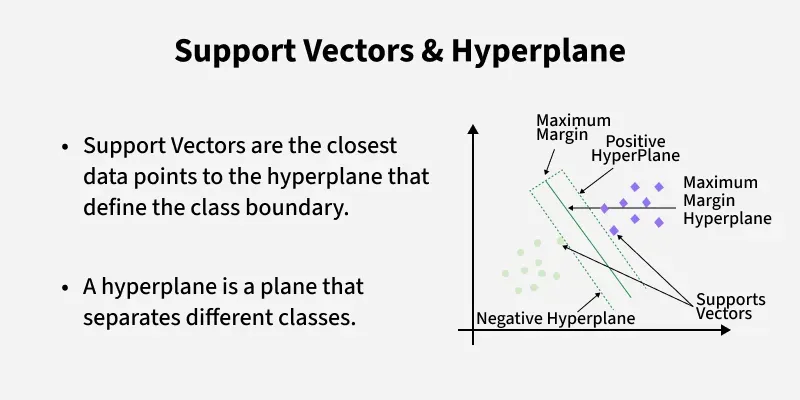
These points are "supporting" the hyperplane and defining its position and orientation. If you were to move a support vector, the optimal hyperplane would move too. Crucially, if you were to move any of the other data points (the ones not on the margin), the hyperplane would not change at all! This is a key difference from other models like logistic regression, where every data point contributes to the final decision boundary.
For an exam, remember this: the SVM algorithm is only concerned with the support vectors. This makes it computationally efficient, as it only needs to consider a small subset of the data.
This short video explains the concept of support vectors and their importance very clearly.
Support Vector Machines: All you need to know!
The video "Support Vector Machines: All you need to know!" provides a concise explanation of the main concepts.
Watch the section from the beginning to understand how SVM chooses the best hyperplane and how support vectors are the critical points that define it.
Dealing with Imperfect Data: The Soft Margin
The idea of a maximal margin works beautifully when the data is perfectly separable by a line. But what if it's not? Real-world data is often noisy, and there might be outliers or overlapping classes.
A strict "hard margin" SVM would fail in such cases. To solve this, we use a Soft Margin Classifier. This approach relaxes the rules and allows some data points to be on the wrong side of the margin, or even on the wrong side of the hyperplane (i.e., misclassified). It's a classic example of the bias-variance trade-off we've discussed before. We introduce a small amount of bias (by allowing some errors on the training data) to build a model that generalizes better to new data and is less sensitive to outliers (lower variance).
The article "Support Vector Machines: A Guide for Beginners" from QuantStart has a great conceptual explanation of this.
Support Vector Machines: A Guide for Beginners
This article explains the theory behind SVMs. We'll focus on the conceptual parts about the margin and what happens when data isn't perfectly separable.
First, read the section "Deriving the Classifier" to solidify your understanding of the maximal margin hyperplane and support vectors. Then, read the section "Support Vector Classifiers" to understand why we need a soft margin and how it works by allowing some misclassifications to create a more robust model.
In a soft-margin SVM, there is a tuning parameter (often denoted as C) that controls this trade-off.
- A small
Ccreates a wider margin but tolerates more margin violations. This is a higher bias, lower variance model. - A large
Cpushes for a narrower margin with fewer violations, making the model more sensitive to the training data. This is a lower bias, higher variance model.
3. Handling Non-Linear Data: The Kernel Trick
So far, we've only talked about linear separators. But what if your data has a non-linear pattern, like a cluster of points surrounded by another class? No straight line could ever separate them.
This is where the true power of SVMs comes from: the kernel trick.
The core idea is simple: if you can't separate the data in its current dimension, project it into a higher dimension where a linear separator might exist.
The StatQuest video provides the best possible intuitive example of this.
Support Vector Machines Part 1 (of 3): Main Ideas!!!
We'll return to the StatQuest video to understand the final, most powerful component of SVMs.
First, watch the section that shows how data that is inseparable in one dimension can be made separable by moving it into a higher dimension. This is the fundamental idea. Then, watch the final section to learn how kernel functions achieve this and what the famous kernel trick is (kernel trick detail).
As the video explains, you don't actually have to perform the computationally expensive step of transforming the data. The kernel trick uses special functions (kernels) to calculate the relationships between points as if they were in the higher-dimensional space, without ever creating that space. It's a mathematical shortcut that makes SVMs incredibly powerful and efficient.
For your exam, you should be familiar with the names and general purposes of a few common kernels:
- Linear Kernel: This is the baseline. It doesn't perform any transformation and results in a standard linear classifier.
- Polynomial Kernel: This can create curved, polynomial-shaped decision boundaries.
- Radial Basis Function (RBF) Kernel: This is a very popular and powerful default choice. It can create complex, localized boundaries and can be thought of as measuring the similarity of a new point to the support vectors.
This article from Analytics Vidhya gives a good summary of the kernel trick and these common functions.
This article provides a concise overview of kernels, which is perfect for an exam-focused review.
Read the section "Kernels in Support Vector Machine". Focus on understanding the purpose of the kernel trick. Then, briefly review the descriptions of the Polynomial, Sigmoid, and RBF kernels to be able to recognize them.
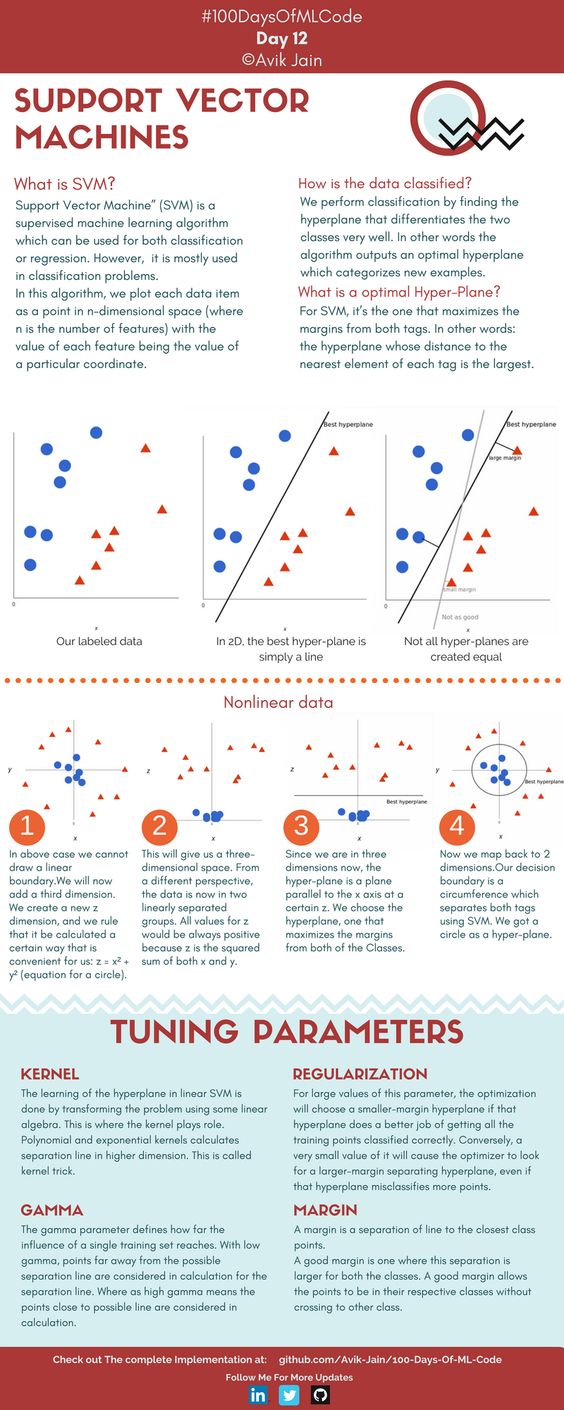
To bring all these concepts together, the following infographic provides a fantastic one-page summary of everything we've discussed.
Conclusion
You have now learned about Support Vector Machines, a powerful and versatile classification algorithm. You are equipped to answer exam questions about its core mechanics.
Here are your key takeaways:
- Core Idea: SVMs find the optimal hyperplane that separates two classes by maximizing the margin between them.
- Support Vectors: The position of the hyperplane is determined only by the support vectors—the data points closest to the boundary.
- Soft Margin: To handle real-world, noisy data, SVMs use a soft margin that allows some misclassifications in order to create a more robust, generalizable model.
- The Kernel Trick: For non-linear data, SVMs use the kernel trick to efficiently find a separating hyperplane in a higher-dimensional space, resulting in a non-linear decision boundary in the original space.
In our next lesson, we will move on to another cornerstone of modern machine learning: Artificial Neural Networks (ANNs). We'll explore the structure of these brain-inspired models and understand the building blocks of deep learning.