Welcome to our final lesson in the "Tree-Based Models and Ensembles" module. In our last session, we established the foundational ideas of ensemble learning, distinguishing between Bagging's parallel approach to reduce variance and Boosting's sequential method for reducing bias. We answered the question, "Could a team of models be better than one?" with a resounding yes.
Today, we will build directly on that foundation. Your learning outcome is to describe how common ensemble methods like Random Forests and Gradient Boosting are presented in exam questions. We will move from the general concepts of Bagging and Boosting to their most famous and powerful implementations. You'll learn how each algorithm works at a high level, their key differences, and the types of exam questions they are likely to appear in. This will equip you to confidently compare and contrast these two giants of machine learning.
1. Random Forest: The Power of Diversified Decision-Making
Random Forest is a direct and popular application of the Bagging technique we discussed previously. It creates a "forest" of decision trees and combines their outputs. However, it adds one extra crucial step to the Bagging process to improve performance even further.
The core idea is similar to diversification in a financial portfolio. A single asset can be volatile (high variance). A portfolio of different, uncorrelated assets can have the same or higher expected return but with much lower overall volatility. Random Forest does the same with decision trees: it builds many uncorrelated trees and averages their predictions to create a final result that is much less volatile and more accurate than any single tree.
Let's look at the architecture.
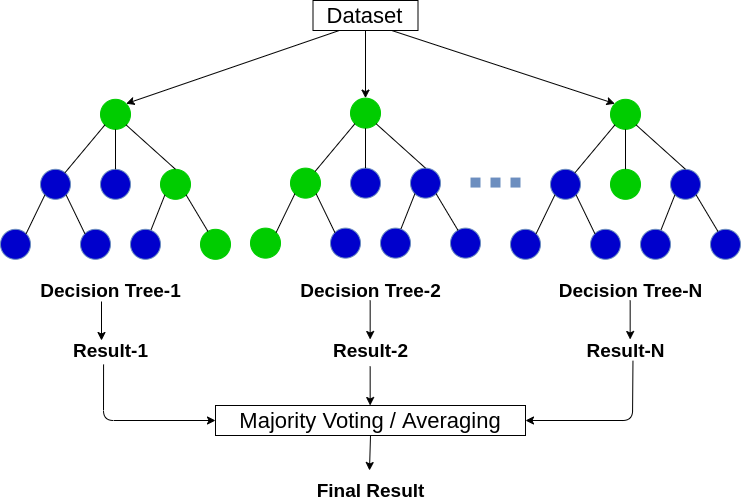
The algorithm follows these steps:
- Bootstrap Aggregating (Bagging): From your training dataset of
Nsamples, createknew datasets by samplingNtimes with replacement. This is the same bootstrapping process we saw in the last lesson. - Random Feature Selection: This is the key addition that makes a Random Forest "random." When building each decision tree, at every split point, the algorithm considers only a small, random subset of the available features instead of all of them. This forces the trees to be different from one another and prevents one or two very strong features from dominating all the trees in the forest.
- Build and Train: Train a separate decision tree on each of the
kbootstrapped datasets, using the random feature selection at each split. These trees are typically grown deep and are not pruned, meaning they have low bias but high variance on their own. - Aggregate Predictions: For a new data point, pass it through all
ktrees.- For a classification task, the final prediction is the class that gets the most votes (majority vote).
- For a regression task, the final prediction is the average of all the individual tree predictions.
This video provides an excellent walkthrough of this entire process.
Random Forest Ensemble Learning Algorithm | Random Forest Learning in Machine Learning Mahesh Huddar
The video "Random Forest Ensemble Learning Algorithm" by Mahesh Huddar explains the step-by-step process of building a random forest.
Watch the section that explains the core algorithm, from creating data subsets to making the final prediction. Pay close attention to the two levels of randomness: sampling data (data selection) and sampling features (feature selection).
For your exam, you should remember that Random Forest is an application of Bagging, its goal is to reduce variance, and it achieves this by training many deep, uncorrelated trees in parallel.
2. Gradient Boosting: The Art of Sequential Improvement
Gradient Boosting is the most prominent member of the Boosting family. Where Random Forest builds trees independently, Gradient Boosting builds them sequentially, with each new tree learning from the errors of the collective before it.
The process is iterative and focused on error correction:
- Initial Prediction: The model starts with a very simple first guess. For a regression problem, this is often just the average value of the target variable for all data points.
- Calculate Residuals: The algorithm calculates the "residuals" – the errors made by the current model for each data point (i.e.,
actual value - predicted value). - Train on Errors: A new, weak learner (typically a very shallow decision tree or "stump") is trained to predict these residuals. The new tree doesn't predict the target itself, but rather the error of the current ensemble.
- Update the Model: The predictions from this new tree (multiplied by a small factor called the learning rate) are added to the overall model's predictions. The learning rate prevents the model from correcting the error too aggressively, which helps avoid overfitting.
- Repeat: The process repeats. New residuals are calculated based on the updated model, and another tree is trained to correct the new, smaller errors. This continues for a specified number of iterations.
The final prediction is the sum of the initial prediction and all the error-correcting adjustments made by each tree in the sequence.

This video provides a very clear, conceptual explanation of this sequential learning process.
Ensemble (Boosting, Bagging, and Stacking) in Machine Learning: Easy Explanation for Data Scientists
This segment from Emma Ding's video "Ensemble (Boosting, Bagging, and Stacking) in Machine Learning" explains the core idea behind boosting and introduces Gradient Boosted Trees.
Watch the section from the explanation of boosting. Focus on how it starts with a weak learner and sequentially adds new learners that focus on the mistakes of their predecessors, thereby reducing bias.
For your exam, remember that Gradient Boosting is an application of Boosting, its primary goal is to reduce bias, and it does this by training many shallow, weak trees sequentially.
3. Exam Focus: Random Forest vs. Gradient Boosting
Exam questions frequently ask you to compare and contrast these two algorithms. Understanding their fundamental differences is key to answering these questions correctly. This article from GeeksforGeeks provides an excellent, detailed comparison.
Gradient Boosting vs Random Forest
This article directly compares the two algorithms across multiple dimensions, which is perfect for exam preparation.
Read the sections on the basic algorithm, training approach, performance, and handling overfitting. Finally, carefully study the excellent summary table and the concluding sections on when to use each.
Based on the article and our discussion, here is a summary of the most critical points for your exam:
| Feature | Random Forest (Bagging) | Gradient Boosting (Boosting) |
|---|---|---|
| Model Building | Parallel. Many independent trees are built at once. | Sequential. Trees are built one after another. |
| Primary Goal | Reduce Variance. Averages many overfit models. | Reduce Bias. Sequentially adds models to correct errors. |
| Base Learners | Deep trees. Fully grown, complex "strong" learners. | Shallow trees. Simple, weak "stumps" or small trees. |
| Training Speed | Faster. Can be easily parallelized across CPU cores. | Slower. The sequential nature prevents parallelization. |
| Performance | Strong, robust, and less prone to overfitting. A great "out-of-the-box" algorithm. | Can achieve higher accuracy but is sensitive to hyperparameters and can overfit if not tuned carefully. |
| Tuning | Less sensitive to hyperparameters. Works well with default settings. | Highly sensitive to hyperparameters like learning rate and number of trees. Requires careful tuning. |
Typical Exam Scenario Question:
-
"You have a large, noisy dataset and need a reliable model quickly. Which ensemble method would you choose and why?"
- Answer: Random Forest. It is robust to noise, less prone to overfitting, and its parallel nature allows for faster training on large datasets.
-
"You are in a competition where maximum predictive accuracy is the only goal, and you have time for careful model tuning. Which method might you prefer?"
- Answer: Gradient Boosting. While it requires more careful tuning and is slower to train, it often achieves a higher level of accuracy by sequentially minimizing errors.
Conclusion
You have now explored the two most influential ensemble algorithms in machine learning. By understanding their inner workings and trade-offs, you are well-prepared to tackle exam questions that require you to compare them.
Here are your key takeaways:
- Random Forest uses Bagging to build many deep trees in parallel, averaging them to reduce variance. It is robust, fast to train, and easy to use.
- Gradient Boosting uses Boosting to build many shallow trees sequentially, with each tree correcting its predecessor's errors to reduce bias. It can be more accurate but is slower and requires careful tuning.
- The choice between them is a classic trade-off: Random Forest for robustness and ease of use, Gradient Boosting for pushing the limits of predictive accuracy.
In our next lesson, we will step away from tree-based models and explore a completely different, yet powerful, method for classification: Support Vector Machines (SVMs). We will learn how SVMs find the optimal boundary to separate data points.