This module moves from identifying testosterone deficiency to deciding whether treatment is worthwhile. A treatment decision starts with symptoms, consistently low testosterone on appropriately timed tests, and an assessment of possible causes. It does not start with a symptom list or a promise to “boost” a number.
In this lesson, you will compare what testosterone therapy has demonstrated in trials with what remains uncertain. The distinction matters most when a hoped-for benefit—such as relief from fatigue—is less predictable than a risk that can be measured during treatment.
What improvements have trials actually shown?
A useful starting point is the Testosterone Trials: coordinated, placebo-controlled studies of older men with low testosterone. They provide evidence about several outcomes under studied conditions, not a guarantee that every person with a low result will benefit.
Lessons From the Testosterone Trials
Read the abstract of “Lessons From the Testosterone Trials” to compare outcomes measured in the same research program.
In the abstract near the top of the page, read from its opening sentence about the seven trials through the final sentence about the need for larger, longer safety studies. Track the different findings for sexual function, vitality, anemia, bone measurements, and cardiovascular testing rather than treating “benefit” as a single outcome.
The clearest symptomatic signal was sexual function: on average, treatment improved sexual activity and desire, with some improvement in erectile function. That does not mean testosterone is a reliable solution for every erection problem. Erectile function has multiple contributors, and an average improvement in a trial can be modest for an individual. A realistic treatment goal is improvement in a symptom that is present—not simply achieving a laboratory value.
The trials also found that testosterone increased hemoglobin, including in participants with unexplained anemia and in those whose anemia had a known cause. This can be a genuine benefit for a person who has both confirmed testosterone deficiency and anemia. It does not replace an evaluation for other causes of anemia, however: finding a low testosterone result should not bring that investigation to an end.
For bone health, treatment increased volumetric bone mineral density and estimated bone strength in the spine and hip. The distinction between a measurement and a patient-important outcome is crucial here. Greater density or modeled strength does not, by itself, prove fewer fractures. Subsequent large-trial evidence has not established testosterone therapy as a fracture-prevention treatment; fractures must not be assumed to fall because a bone-density graph rises.
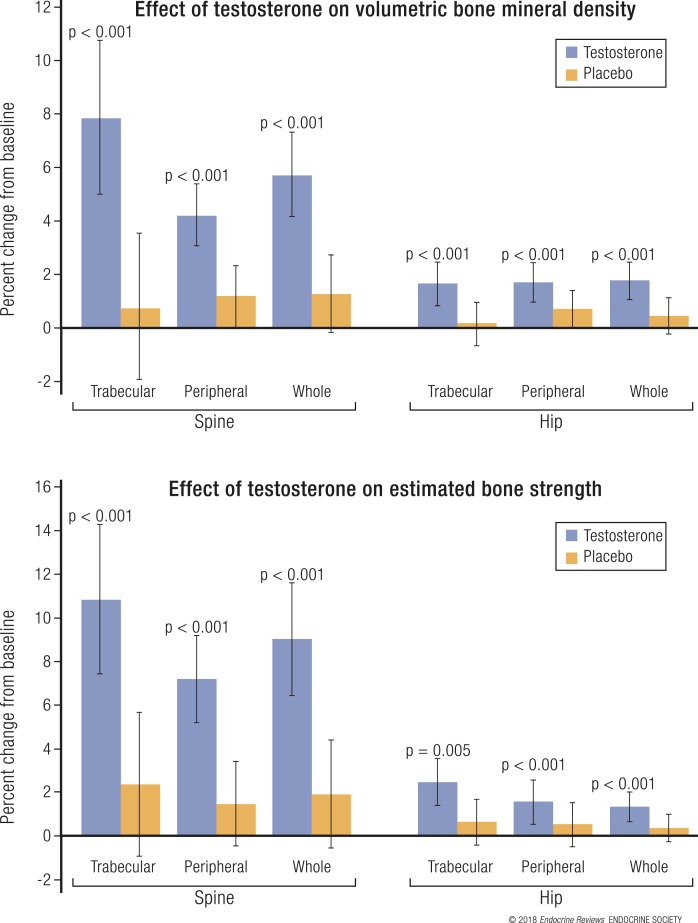
The graph shows why outcome labels deserve close reading. Its bars report percentage change from baseline, while its lower panel reports estimated strength. Those results support an effect on the measured properties of bone; they do not show how many people avoided a fracture.
Fatigue presents a different picture. In the Trials’ vitality study, testosterone did not improve the primary measure of energy, although mood and depressive symptoms improved slightly. Other studies have not made fatigue or energy a reliably predictable treatment benefit. Fatigue is real, but it has many possible causes. If fatigue is the main concern, a low testosterone result should not crowd out evaluation of sleep, illness, medications, mood, or other contributors.
A benefit can become a safety problem
The hemoglobin finding illustrates why benefits and risks cannot be considered separately. Testosterone can stimulate red-cell production enough to correct anemia, but it can also raise the red-cell concentration too far. Clinicians follow hematocrit—the proportion of blood volume occupied by red cells—because an excessive rise requires action, whether or not the person feels different.
The following guideline passage puts the benefit claims beside the practical risks. Its cardiovascular counseling reflects the evidence available when it was written; a later, larger trial is considered in the next section.
Evaluation and Management of Testosterone Deficiency
Read selected statements in the American Urological Association guideline for a clinical comparison of likely benefits, uncertain benefits, and treatment-specific harms.
Start on p. 426 under “Counseling Regarding Treatment of Testosterone Deficiency,” statements 14–15. Read benefits and uncertainties, ending after the list that includes energy, fatigue, and quality-of-life measures. Then go back to p. 425, statement 11, beginning “Prior to offering testosterone therapy.” Read the baseline check and continue through the end of that statement, including the intervention threshold and the observation about injections. Finally, on p. 428 under “Treatment of Testosterone Deficiency,” read statements 25–26. Statement 25 begins with the recommendation against alkylated oral testosterone and ends with its discussion of liver toxicity, including liver harms. Statement 26 begins with the recommendation to discuss gel or cream transference; read the transfer warning through its advice about contact with application sites.
The guideline recommends checking hemoglobin and hematocrit before treatment. If baseline hematocrit exceeds 50%, the clinician should consider withholding testosterone while investigating why it is high. During treatment, a hematocrit of 54% or higher warrants intervention, such as reducing the dose or temporarily stopping therapy. Injectable testosterone has been associated with particularly large rises in hemoglobin and hematocrit. The aim is not to raise red cells as much as possible; it is to treat a deficiency without creating another problem.
Risks also differ by formulation. A skin gel can transfer testosterone to another person through contact with an unwashed or uncovered application site—especially concerning for children and others who should not receive it. Injections can produce greater hematocrit increases. Older alkylated oral testosterone, such as methyltestosterone, is associated with liver toxicity; that warning should not be indiscriminately applied to every modern oral formulation. Formulation choice therefore changes the practical safety discussion, even when the intended hormone effect is the same.
Blood pressure can also rise with testosterone products, so a person whose blood pressure is already elevated needs particular attention to that risk. A trial result about heart attacks and strokes does not make a blood-pressure increase irrelevant.
What does cardiovascular safety evidence establish?
Low testosterone has been associated with greater cardiovascular risk in observational research. That association does not establish that low testosterone causes heart disease, or that prescribing testosterone prevents it: health conditions may contribute both to lower testosterone and to cardiovascular risk. To test treatment safety more directly, researchers need a comparison between treated and placebo groups.
A large randomized trial, TRAVERSE, substantially improved the evidence available after earlier guideline discussions. The NEJM Group summary gives its design and main result.
Cardiovascular Safety of Testosterone Therapy | NEJM
Watch “Cardiovascular Safety of Testosterone Therapy” from NEJM Group for the trial population, the outcome researchers counted, and the limits of its reassuring main finding.
Watch the trial design for who entered the study and the use of testosterone gel versus placebo. Continue with the primary outcome, which combines cardiovascular death, nonfatal heart attack, and nonfatal stroke. In the main result, note the roughly seven-percent event rate in each group. Finish with the prostate finding to distinguish a change in a blood marker from a difference in diagnosed cancer during the study.
TRAVERSE enrolled roughly 5,200 men aged 45–80 who had symptoms, two low testosterone measurements, and established cardiovascular disease or elevated cardiovascular risk. They received dose-adjusted testosterone gel or placebo. Over a median follow-up of about 33 months, the trial found testosterone non-inferior to placebo for its primary combined outcome of cardiovascular death, nonfatal heart attack, or nonfatal stroke; an event occurred in roughly 7% of each group.
That is meaningful reassurance for a population and treatment like those studied. It is not proof of zero cardiovascular risk, a heart-protective benefit, or identical safety with every dose, formulation, patient group, and treatment duration. Nor does the main combined result erase other safety signals: the testosterone group had more reports of atrial fibrillation, pulmonary embolism, and acute kidney injury. Blood-pressure changes and hematocrit still require attention. In short, “no increase detected in the trial’s primary major cardiovascular outcome” is more accurate than either “testosterone is dangerous for everyone” or “testosterone is completely safe.”
Putting the evidence on the same scale
The value of treatment depends partly on which outcome you are trying to change. Sexual symptoms, anemia, and bone measurements have demonstrated treatment responses, though their clinical importance varies by person and by outcome. Fatigue is a much less dependable target. Meanwhile, red-cell elevation, blood-pressure effects, and formulation-specific harms are concrete considerations even when treatment improves a symptom.
This is why clinicians discuss a trial of treatment with defined goals, rather than an indefinite commitment based on a number alone. They need to know what improvement would count as worthwhile, whether another cause needs treatment, and whether the likely benefit justifies the risks for that person. A rising bone-density measure cannot substitute for evidence of fracture prevention; a higher hemoglobin is not automatically desirable; and a reassuring cardiovascular trial cannot substitute for individual safety checks.
Testosterone therapy has evidence of benefit for some sexual symptoms, anemia, and measured bone properties, while improvement in fatigue and energy is uncertain. Its risks include excessive red-cell concentration, possible blood-pressure increases, and harms that depend on how it is delivered. The best cardiovascular trial is reassuring about its primary outcome under the conditions studied, but does not establish universal or long-term safety.
The next lesson turns to a separate decision-changing issue: externally supplied testosterone can suppress sperm production, so fertility plans must be discussed before treatment begins.