Introduction
In our last lesson, we built a playbook for navigating the "normal" rhythm of markets: the business cycle and the sector rotations it drives. You learned how professionals anticipate shifts from recovery to expansion, slowdown, and recession. But what happens when the drumbeat of the cycle is shattered by a sudden, violent event? This lesson tackles that exact scenario: the world of geopolitical and macro shock risk.
Your objective is to learn how to trace the transmission of a shock—like a war, a pandemic, or major sanctions—from a headline event into a tangible market impact. We will dissect the channels through which these shocks travel and map their cascading effects across assets. By the end, you won't just see the chaos; you will have a framework to analyze it, distinguishing between temporary noise and a fundamental shift in the market regime. This is the skill that separates those who panic from those who see the new board layout.
The Anatomy of a Shock: From Event to Price
A common mistake is to think a geopolitical event directly causes a price change. It doesn't. A war in a distant country has no direct API call to the stock market. Instead, the event acts as a catalyst, triggering reactions through two primary pathways: the economic channel (what actually changes) and the sentiment channel (what people fear will change).
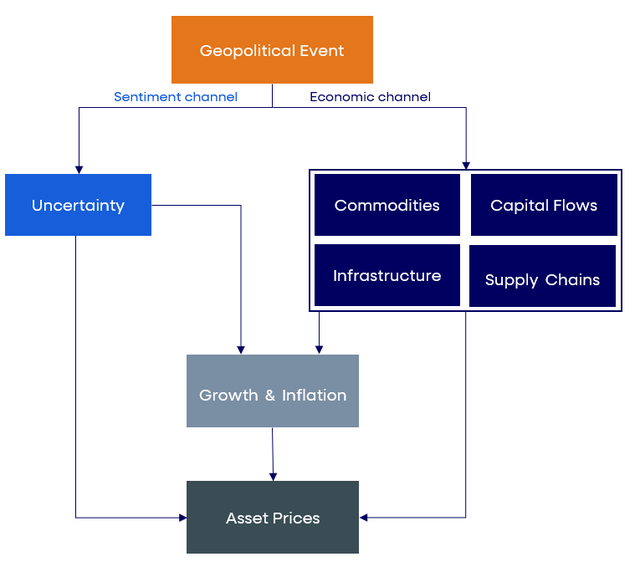
The sentiment channel is driven by perception and moves instantly. It's the "what if?" that flashes across trading desks, causing an immediate spike in fear and a sell-off in risky assets. The economic channel is slower; it's the real-world disruption to earnings, supply chains, and inflation that follows. A professional operator must track both.
The Five Transmission Channels
To make this model operational, we can break these two broad pathways down into five specific, observable transmission channels. Think of this as your diagnostic checklist when a major event hits the news.

Let's dissect each of these five channels.
Channel 1: Energy / Commodity (Speed: Hours)
This is often the fastest and most direct channel. Conflicts or instability in resource-rich regions like the Middle East or Russia have an immediate impact on commodity prices, especially oil and natural gas. This isn't just about supply being cut off; it's about the risk of supply being cut off, which gets priced into futures markets instantly.
The following article from AnalystPrep provides an excellent case study using the Iran conflict to illustrate how these shocks travel through the system, starting with oil.
How CFA® and FRM® Candidates Should Analyze the Iran Conflict ...
This article provides a professional-grade framework for tracing a geopolitical event through the financial system. It clearly distinguishes between fundamental and sentiment-driven reactions.
Start by reading the introduction to understand the goal: analyzing the transmission mechanism. Next, focus on the section distinguishing between fundamental and sentiment transmission. Finally, read the section on how oil markets react, paying attention to the role of the Strait of Hormuz and how risk is priced into futures.
As the article highlights, an event in a geographic chokepoint like the Strait of Hormuz sends ripples through the entire energy complex, immediately affecting the input costs for a vast array of industries.
Channel 2: Trade / Tariffs (Speed: Days to Months)
This channel involves direct disruptions to the flow of goods and services. This can happen in several ways:
- Physical Disruption: War closes a port or a key shipping lane (e.g., the Red Sea).
- Supply Chain Breaks: A pandemic shuts down factories in a key manufacturing hub.
- Sanctions: Nations weaponize trade and finance to exert political pressure.
Sanctions are a particularly complex form of shock. They are designed to cripple a target economy but often act as a "double-edged sword," creating significant cascading effects for the sanctioning countries and neutral third parties.
The following video from Economics Explained uses the 2022 Russia sanctions to break down these second- and third-order consequences.
Do Sanctions Work? | Economics Explained
This video provides a clear, practical explanation of how economic sanctions work and, more importantly, how their effects cascade through the global economy.
First, watch from the definition of sanctions to understand what they are and why they are a political tool, not just a trade restriction. Then, see the specific measures taken against Russia, like blocking high-tech goods and access to the SWIFT network. Most importantly, watch the section explaining the "double-edged sword" nature of sanctions. Pay close attention to the examples of disruptions to food supply (wheat), financial blowback (unpaid debt), and asset seizures (aircraft leasing). This is the "cascading effect" in action.
The video's examples—Egyptian wheat shortages, European banks facing defaults on Russian debt, and Irish aircraft lessors losing billions in assets—are perfect illustrations of how a targeted action can create widespread, unforeseen damage.
Channel 3: Uncertainty Premium (Speed: Minutes)
This is the pure sentiment channel. A shock event dramatically increases uncertainty about the future. Investors don't know the scope, duration, or ultimate outcome of the crisis. In response, they demand a higher premium to take on risk. This manifests in several ways:
- Volatility Spikes: The CBOE Volatility Index (VIX), often called the "fear index," surges as traders buy options to protect their portfolios.
- Widening Credit Spreads: The difference in yield between risky corporate bonds and "safe" government bonds increases as lenders demand more compensation for the risk of default.
- Lower Equity Valuations: Higher uncertainty translates to a higher discount rate applied to future earnings, pushing the present value of stocks lower, even if earnings estimates haven't changed yet.
The IMF video below discusses how this uncertainty is a core part of the transmission mechanism.
Geopolitical Risks: Implications for Asset Prices and Financial Stability
This clip from an IMF discussion explains how uncertainty is a key channel through which shocks affect the real economy and markets.
Watch the segment from the discussion on uncertainty. Note the distinction between "hard data" (which lags) and "sentiment indicators" (which move fast) and how uncertainty directly impacts corporate investment (capex) and consumer spending.
Channel 4: Capital Flows (Speed: Days)
In response to rising uncertainty, money moves. This "flight to safety" is a predictable pattern. Capital flows out of regions and assets perceived as risky and into those perceived as safe.
- From: Emerging markets, high-risk corporate debt, and currencies of affected nations.
- To: "Safe-haven" assets like the U.S. dollar, U.S. Treasury bonds, the Swiss franc, and gold.
This reprices currencies and can starve riskier markets of liquidity at the worst possible moment.
Channel 5: Policy (Speed: Weeks)
Governments and central banks are not passive observers; they react to shocks. Their policy response becomes its own transmission channel, which can either dampen or amplify the initial shock.
- Fiscal Policy: Governments might respond with stimulus packages (like the CARES Act during COVID) or increased military spending (during a war).
- Monetary Policy: A major oil shock that fuels inflation might force a central bank to delay planned interest rate cuts or even hike rates, tightening financial conditions and putting further pressure on the economy and markets.
This feedback loop is critical. A conflict in the Middle East can directly lead to tighter monetary policy in the United States, linking a geopolitical event to the cost of capital for every business.
Tracing the Cascade: Winners and Losers
Once a shock propagates through these channels, it doesn't affect all assets equally. It creates a clear dispersion of winners and losers. We can trace this by reading the same AnalystPrep article we started with.
How CFA® and FRM® Candidates Should Analyze the Iran Conflict ...
Now we connect the shock to specific market outcomes. This reading traces the path from the commodity spike to the final impact on different sectors.
Read the three sections starting with the step-by-step impact of an oil shock, from commodities to inflation to the interest rate reaction. Then, review the summary of how different asset classes (equities, bonds, currencies, commodities) typically react. Finally, and most importantly, study the section on sector-level impacts.
As the article outlines, the playbook is logical:
- Vulnerable: Airlines (fuel costs), Transportation (fuel costs), Consumer Discretionary (consumers have less money), and energy-importing countries.
- Beneficiaries: Oil & Gas producers, Defense companies, and commodity-exporting countries.
Transitory Shock vs. Structural Regime Change
This is the final and most important question for an operator: Is this event a temporary squall that will pass (a transitory shock), or has it permanently altered the landscape (a structural shock)?
- Transitory Shock: Affects sentiment, not fundamentals. It's a "buy the dip" opportunity. The market experiences a sharp, V-shaped recovery as fear subsides. Most geopolitical events historically fall into this category. The market drawdown is typically short and shallow.
- Structural Shock: Permanently alters earnings, supply chains, or policy. Examples include the COVID pandemic (reshaped remote work and supply chains) and the Russia-Ukraine war (fundamentally altered European energy policy). These events require a full repricing of assets and lead to deeper, longer-lasting drawdowns.
The market's view on this has evolved. For decades, the mantra was to "see through the noise." Today, there's a greater recognition that some shocks represent a true regime change.
Geopolitical Risks: Implications for Asset Prices and Financial Stability
This final clip discusses the critical difference between viewing geopolitical events as temporary noise versus permanent regime changes.
Watch the discussion starting from how markets' view has shifted. The speaker makes the key point that events like COVID and the Russia-Ukraine war are seen as more permanent, leading to a "new world order" and a re-evaluation of long-term trends like globalization.
Conclusion
You now have a structured framework for analyzing the most chaotic market events. Instead of reacting to headlines, you can systematically trace the impact of a geopolitical shock through its transmission channels.
Key Takeaways:
- Dual Pathways: Shocks travel through both a fast-moving Sentiment Channel (fear, uncertainty) and a slower Economic Channel (real disruption).
- The Five Channels: Your operational checklist includes Energy/Commodities, Trade/Tariffs, Uncertainty Premium, Capital Flows, and Policy Response.
- Cascading Effects: The initial shock ripples outwards, creating predictable winners (e.g., energy producers, defense) and losers (e.g., airlines, consumer discretionary) across sectors and asset classes.
- Transitory vs. Structural: The most critical judgment is whether a shock is a temporary fear event ("buy the dip") or a permanent regime change that requires a fundamental repricing of risk.
We have now concluded our survey of the macro landscape, from the predictable rhythm of the business cycle to the violent disruption of external shocks. With this top-down perspective established, we will pivot in our next module, "Market Structure and How Prices Really Move." We will go from the why of market movements to the how, starting with the fundamental plumbing of the market: how stock exchanges actually work.