In our last lesson, we established the fundamental rules of the market: the interplay of money, risk, return, and time. We learned that a rupee today is worth more than a rupee tomorrow, a principle quantified by the time value of money. These are the laws of physics that govern the financial universe.
Today, we move from physics to biology. The market is not a sterile laboratory; it's a jungle, a dynamic ecosystem teeming with different species, each with its own strategy for survival and dominance. Your goal is not to memorize a list of these players, but to understand the food chain. This lesson addresses the core of the learning outcome: Who are the major players? What are their incentives and advantages? And, most importantly, who typically ends up holding the bag when the game is over? Understanding this power dynamic is the first step to moving from prey to predator.
The Market Ecosystem: A Hierarchy of Power
Before we dissect each player, let's look at the battlefield from a high level. The market is not a homogenous crowd of "investors." It's a highly stratified system with a clear hierarchy.
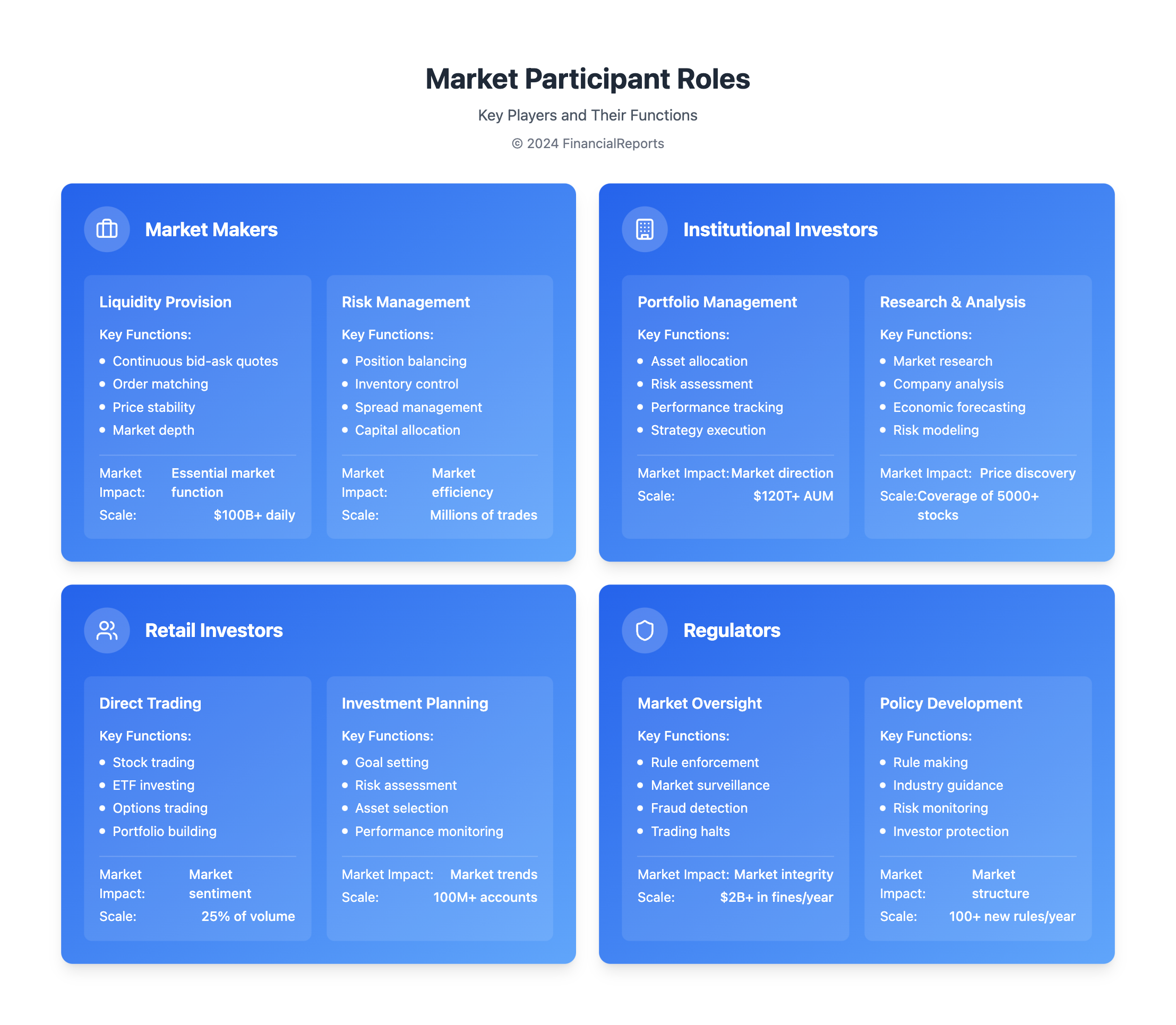
This gives us a clean, official map. Now, let's look at the unofficial power dynamic, which is often more telling.
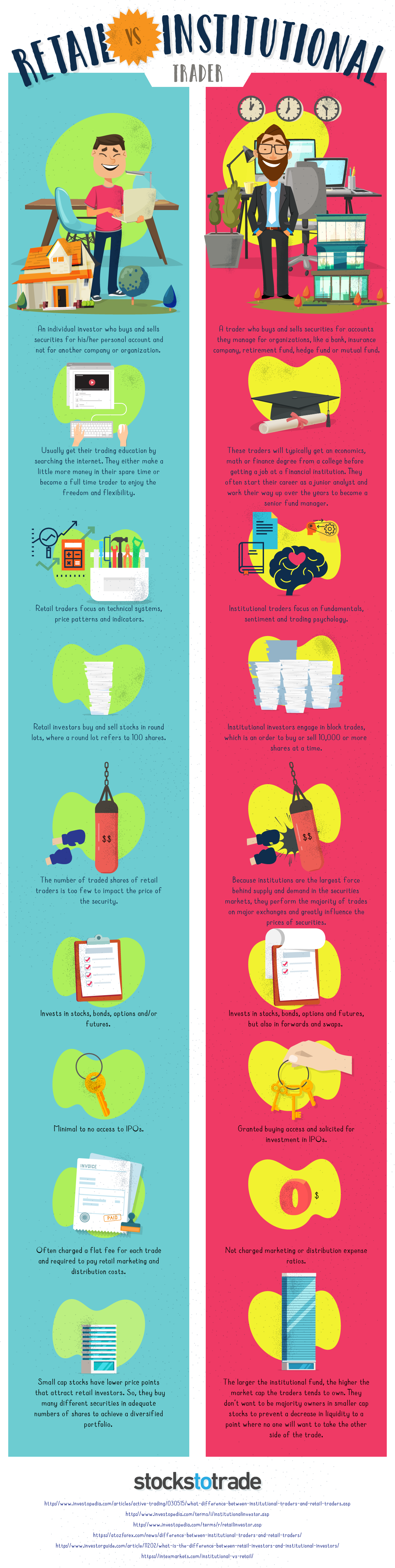
As you can see, it's not a level playing field. Let's break down each player, starting from the bottom of the food chain.
Player 1: Retail Investors (The "Uninformed Flow")
This category includes you, me, and millions of other individuals trading with our own capital through brokerage accounts like Zerodha or Groww.
- Role & Incentive: To grow personal wealth through investing or speculation. Motivations can range from long-term retirement planning to short-term gambling on "meme stocks."
- Edge: The primary advantage for a retail trader is flexibility. A retail trader can enter or exit a position instantly, take niche positions in small stocks that institutions can't touch, and doesn't have to report performance to a board of directors.
- Weakness: This is a long list. Retail traders are typically undercapitalized, trade on emotion (fear and greed), have slower access to information, and use predictable strategies taught in pop-finance books and YouTube videos.
Professionals have a name for the collective orders of retail traders: "uninformed flow." This isn't necessarily an insult; it's a technical description. It means the orders are not typically driven by a deep informational advantage but rather by public news, simple chart patterns, or sentiment. As we'll see, this predictability makes retail flow a resource to be harvested by more sophisticated players.
Player 2: Institutional Investors (The Whales)
These are the giants: mutual funds, pension funds, insurance companies, and sovereign wealth funds. They manage enormous pools of capital (Assets Under Management or AUM) on behalf of millions of clients.
- Role & Incentive: Their primary goal is often relative performance—to beat a specific benchmark (like the Nifty 50 index) or to generate stable, predictable returns for their clients. They earn fees based on the amount of money they manage. This means their first priority is often capital preservation and risk management, not necessarily shooting for the highest possible returns.
- Edge: Deep research departments, direct access to company management, vast capital, and the ability to influence market narratives. They can commission detailed, proprietary research that is unavailable to the public.
- Weakness: Their immense size makes them slow and cumbersome, like giant oil tankers. They face a problem called market impact. If a mutual fund wants to buy a large stake in a company, its own buying pressure will drive the price up. Conversely, if it tries to sell, it will push the price down. They cannot get in or out of positions quietly.
Player 3: Market Makers (The House)
Market makers are the most misunderstood players. On the surface, their role is essential and beneficial. Underneath, their incentives create a predatory dynamic that you must understand to survive.
First, let's cover their official function. They are financial firms that partner with exchanges to provide liquidity, ensuring that there is always someone to trade with. They do this by simultaneously quoting a "bid" price (the price at which they will buy) and an "ask" price (the price at which they will sell).
What Exactly Do Market Makers Do? (& How They Manipulate The Market)
The video "What Exactly Do Market Makers Do?" provides a clear, concise explanation of their official role. We'll start here before getting into the real game.
First, watch this section to understand the definition of a market maker, how they provide liquidity, and the mechanics of the bid-ask spread. Then, watch from this part to see how they generate profit from this spread.
The difference between the bid and the ask is the spread, and it's their primary, risk-free profit source. In an ideal world, that's all they would do. But in the real world, they have evolved into something far more complex.
The Real Game: Harvesting the Uninformed
Why is retail order flow so valuable to market makers? In many markets, especially the US, large market-making firms pay retail brokers millions of dollars for the right to execute their customers' orders. This practice is called Payment for Order Flow (PFOF).
Why would they pay for your trades? Because, as we established, retail flow is "uninformed" and therefore predictable. Trading against it is a low-risk, high-probability business.
Professional Traders vs. Retail - DayTrading.com
This article from DayTrading.com gives a brutal and honest breakdown of PFOF.
Read the section on exploiting retail order flow. Pay close attention to the core reason they pay: retail orders are considered "uninformed" and present limited "adverse selection risk."
Market makers don't just passively collect the spread. They actively manipulate prices to trigger predictable retail behavior, primarily to create liquidity for themselves or for their large institutional clients. The most common tactic is stop-loss hunting.
How Market Makers Stop You Out | 2020
The video "How Market Makers Stop You Out" offers a raw, operator's perspective on this tactic. It's less a formal explanation and more a field guide to how the game is played.
Watch from this segment for a detailed walkthrough of how market makers push prices below obvious support levels to trigger a cascade of stop-loss orders. Then, watch the following part which explains why retail traders are so predictable.
The key insight is that taking out your stop-loss isn't personal. Your sell order provides the liquidity a large player needs to execute their buy order without driving the price up. You are not the target; you are the resource.
This is just one of many manipulation tactics.
What Exactly Do Market Makers Do? (& How They Manipulate The Market)
Let's revisit the "Logically Answered" video to see a summary of other common manipulation tactics.
Focus on the section covering manipulation strategies. Note the descriptions of spoofing (placing fake orders to create a false sense of supply or demand) and leveraging the news cycle.
Player 4: Hedge Funds & Proprietary Trading Firms (The Predators)
If institutional investors are whales, hedge funds and prop firms are the sharks and orcas. They are more agile, more aggressive, and operate with far fewer constraints.
- Role & Incentive: To generate absolute returns, regardless of what the overall market is doing. Their fee structure, often "2 and 20" (2% management fee and 20% of profits), creates a powerful incentive to take significant, calculated risks.
- Edge: Their advantages are numerous and highly technical.
- Speed: High-Frequency Trading (HFT) firms use co-located servers and microwave networks to execute trades in microseconds, arbitraging tiny price discrepancies before anyone else even sees them.
- Quantitative Models: They use complex statistical models ("stat arb") to identify and exploit historical price relationships between assets.
- Behavioral Exploitation: They design strategies to profit from the predictable emotional biases of retail traders—fear, greed, and herding.
Professional Traders vs. Retail - DayTrading.com
The DayTrading.com article details the advanced weaponry used by these predators.
First, read about High-Frequency Trading to grasp the pure speed advantage. Next, review the sections on Statistical Arbitrage and Behavioral Exploitation to understand how they use math and psychology as weapons.
The Apex Predator Mindset: "Painting the Price Action"
To truly develop an operator's mindset, you must understand the most extreme form of market control. In less liquid markets like small-cap stocks or certain crypto assets, a single powerful entity can effectively become the market. They don't just react to price; they create it. This is called "painting the price action."
Their goal is not a corporate action like a financing deal; their goal is "P/L via liquidity hunting." They create artificial price movements to trap other traders and liquidate their accounts, collecting the profit.
Rig me some smallcaps stocks - Trade The Matrix
This article from Trade The Matrix offers a very advanced and unfiltered look into the mind of a market rigger. The language is informal, but the concepts are what separate amateurs from professionals.
Read the section debunking the idea that rigging is only for offerings, focusing on the concept of P/L liquidity hunting. Understand the definition of liquidity raiding and how it targets over-leveraged and emotional traders. Then, jump to the section on painting the price action to see how they take an asset "hostage." Finally, read about how they use "perfectly painted lows" as bait to lure traders into a trap.
The core idea is that in a rigged game, what looks like strong support or frantic buying is often a deliberately constructed trap. The "house" is building a position on one side while creating a price structure that encourages you to take the other side, just before they pull the rug.
Conclusion: Who Holds the Bag?
The market is a system for transferring wealth. Based on the incentives and advantages we've discussed, the flow of capital is generally from the less informed to the more informed, from the slow to the fast, and from the emotional to the systematic.
- Retail Traders are the foundation of the pyramid. Their predictable behavior and "uninformed flow" provide the liquidity and profits that fuel the upper levels. They are, most often, the ones left holding the bag.
- Institutional Investors are large, powerful, but constrained. They play a more measured game, often serving as a source of large-scale liquidity for the faster players.
- Hedge Funds and Prop Firms are the active predators, using speed, math, and psychology to exploit inefficiencies.
- Market Makers are the ultimate house. They profit from nearly every transaction and, in many cases, actively engineer the price action to maximize that profit.
Your journey to becoming a market master is a journey of climbing this food chain. It begins by recognizing that you are starting at the bottom and that your initial thoughts and reactions are likely the exact ones the "smart money" is expecting and positioning against.
In the next lesson, we will move on to the specific assets these players trade. We'll explore the different "games" played in stocks, bonds, commodities, and other asset classes, and how the nature of the asset changes the rules of engagement.