Introduction
In our last lesson on short selling, we dissected the explosive phenomenon of a short squeeze—a situation where forced buying from panicked short sellers creates a violent price spike detached from fundamentals. Today, we turn our attention to a far larger, more systematic, and arguably more distorting form of forced buying and selling: the trillions of dollars flowing through passive investment vehicles.
Your goal for this lesson is to analyze how these massive, automated flows into indexes and ETFs can systematically distort individual stock prices away from their fundamental value. This isn't just a theoretical side-effect; it is arguably one of the most powerful structural forces in modern markets. Understanding this dynamic is crucial for developing the "operator's instinct" you seek—the ability to sense when a stock's price is being driven by a powerful tide of capital rather than by a company's actual performance. This lesson tackles the "market is broken" thesis head-on, explaining why good companies can underperform and why seemingly mediocre ones can rise on an ocean of indiscriminate buying.
The Rise of the Price-Insensitive Investor
First, let's be clear about what we mean by "passive investing." This primarily refers to index funds and Exchange-Traded Funds (ETFs) that are designed to replicate a market index, like the Nifty 50 or the S&P 500. Their core operating principle is simple and rigid: buy and hold all the stocks in the index in direct proportion to their market capitalization.
There is no analysis of business quality, valuation, or future prospects. If a company constitutes 5% of the index's market cap, the fund allocates 5% of its assets to that stock. If a company's stock price goes up, its market cap increases, and the fund is forced to buy more of it with every new dollar of inflow. This creates a powerful, self-reinforcing feedback loop.
Investor and strategist Mike Green, a leading voice on this topic, argues that the term "passive" is a misnomer. These funds are not passive observers; they are active, systematic participants whose rules have profound market consequences.
The Risks of The Rise of Passive Investing with Mike Green
In this segment from the Excess Returns podcast, Mike Green explains why passive funds are not truly passive and illustrates how their systematic rules create price distortions.
First, listen to his argument challenging the traditional definition of passive investing, reframing these funds as active players with fixed rules. Next, see a concrete example of this effect in action with his discussion of Super Micro Computer and GameStop. He explains how, as a stock's price rises, passive funds are forced to allocate more capital to it, reinforcing the upward trend regardless of fundamentals.
This dynamic works both ways. When money flows out of these funds during a market panic, they sell indiscriminately, pushing all stocks down together, creating a vicious cycle on the way down.
The Inelastic Market: Why Flows Have an Outsized Impact
For a long time, economists assumed that markets were highly "elastic." This meant that a large change in demand (e.g., $1 billion of buying) would only cause a small change in price, as other investors would quickly step in to sell. The rise of passive investing has shattered this assumption.
We now live in an "inelastic" market. Because so much capital is locked up in price-insensitive passive strategies, there are fewer active, discretionary traders available to take the other side of a trade. To get a transaction done, the price has to move much more significantly to tempt the remaining active players.
This concept has been formalized in the Inelastic Markets Hypothesis. To understand it, let's turn to a research paper that breaks down this new reality.
[PDF] From Diversification to Distortion: The Impact of Passive Investment ...
This paper from C WorldWide Asset Management provides an excellent summary of the Inelastic Markets Hypothesis and its consequences.
Please read the section titled "From Efficient to Inelastic Markets." Focus on the core finding, which rejects the old model where price is based on future dividends. Instead, in the new model, a $1 investment can increase the total market's value by an estimated $5. This is the multiplier effect of inelasticity. The authors note that as passive's share grows, the market stops mean-reverting and instead develops a positive drift, where the largest stocks are pushed up the most.
The key takeaway is a simple but powerful rule of thumb: for every $1 of net inflow into the stock market, the aggregate market capitalization increases by about $5. This is a direct consequence of a market structure where a huge portion of participants are, as Mike Green puts it, "blind and immune to the signals."
Counter-intuitively, this effect is strongest for the largest companies. You might assume giants like Apple or Reliance are the most liquid, but their daily trading volume is much smaller relative to their enormous market capitalization compared to smaller stocks. This means a wave of passive buying has a greater price impact on the very stocks that have the highest weighting in the index.
Consequence 1: Price Discovery Is Broken
If prices are being driven by indiscriminate flows rather than fundamental analysis, what happens to the market's core function of efficient capital allocation? According to famed investor David Einhorn, it breaks.
The traditional ecosystem of active managers who analyzed financial statements and drove stock prices toward their intrinsic value has been hollowed out. Their assets have been reallocated to passive funds. The remaining active players—like quantitative funds and short-term "pod shops"—are often more focused on predicting short-term price moves and catalysts than on long-term fundamental value.
The result? The market has fewer and fewer participants who care about, or are even aware of, a company's true worth.
Entering the Fall 2025 | Still Broken? More Broken? Never Broken?
In this interview with Simplify Asset Management, David Einhorn gives a sobering assessment of the modern market structure.
First, watch his explanation of how the dominant players used to be long-term, fundamental analysts who helped stocks converge toward their value. Next, understand his point that the remaining active community has also changed. Strategies like quant and momentum are also not value-converging strategies. Finally, absorb the critical consequence for fundamental analysis: he argues that poring over financial statements for the short side is now a wasted effort because nobody cares. The people buying the stocks are often blissfully unaware of the details.
This creates a market where stocks can remain wildly disconnected from their fundamentals for long periods, driven purely by the mechanical logic of passive flows.
Consequence 2: Forced Buying from Index Rebalancing
One of the most concrete and tradable examples of this distortion occurs during index rebalancing. When a company's stock is added to a major index (like the MSCI, S&P 500, or Nifty 50), every passive fund tracking that index must buy the stock to update its portfolio.
This is not a suggestion; it's a rule. This creates a massive, predictable wave of demand on a specific date. Speculators and algorithmic traders know this, so they often buy the stock in the weeks leading up to the inclusion date, front-running the passive funds and driving the price up before the forced buying even begins.
The infographic below shows the estimated dollar inflows for several Indian companies during a MSCI index rebalancing event. These are not small numbers; they represent hundreds of millions of dollars in forced, price-insensitive buying.
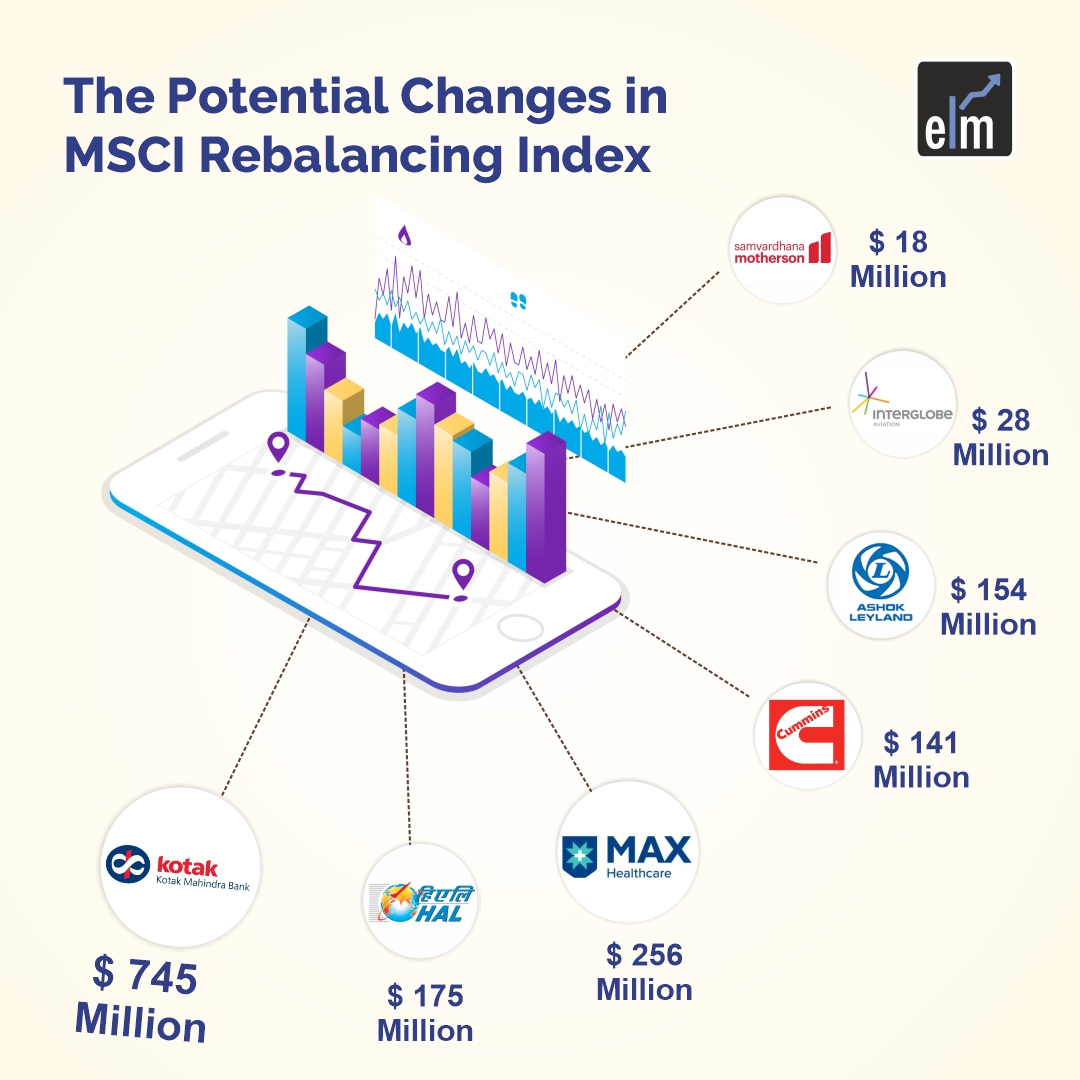
This mechanical process leads to several documented effects:
- Price Pressure: Stocks added to an index tend to experience a price run-up before inclusion and often underperform afterward.
- Increased Correlation: Once in the index, the stock's price starts moving more in line with the overall index, regardless of its own business specifics.
- Amplified Volatility: During market-wide shocks, stocks with high ETF ownership can become more volatile as passive funds are forced to sell in unison.
Conclusion
You now have a new mental model for understanding a huge driver of modern market behavior. Passive investing, despite its name, is a relentlessly active force. Its simple, market-cap-based rules create powerful feedback loops that can detach stock prices from reality.
Key Takeaways:
- The Distortion Engine: Passive funds operate on a simple rule: buy more of what's going up and sell more of what's going down, based on market cap. This creates self-reinforcing price spirals.
- The Inelastic Market: Due to the dominance of price-insensitive passive funds, market prices have become highly sensitive to flows. A small net inflow can create a much larger increase in market capitalization.
- Broken Price Discovery: The traditional role of fundamental analysis in setting prices has been severely diminished. As David Einhorn stated, many market participants are "unaware" of and "don't care" about fundamental value.
- Predictable Distortions: Events like index rebalancing create forced, predictable buying and selling, offering opportunities for those who understand the mechanics.
In our next lesson, we will broaden our lens to look at Market Microstructure and Price Discovery. We'll move beyond the macro force of passive flows to examine how the moment-to-moment interaction of buy and sell orders, order types, and liquidity shapes the price you actually see on the screen.