Introduction
In our last lesson, we established a critical principle for market operators: the visible order book often lies. You learned that slippage isn't just bad luck; it's a direct consequence of demanding more liquidity than a "thin" market can offer. We also touched upon the forces that make the order book deceptive, such as phantom orders from high-frequency algorithms and large hidden "iceberg" orders from institutions.
This lesson drills down into the very machinery that creates this complex and often invisible market structure. We will dissect the roles of algorithmic trading, its hyper-fast subset High-Frequency Trading (HFT), and the private venues known as dark pools. Your goal is to understand the incentives driving these players, the technological "arms race" they are engaged in, and how their interactions shape the price discovery process for everyone else. Mastering this is key to moving beyond reading simple price charts and starting to understand the forces that move the price.
Algorithmic Trading: The Foundation of Modern Execution
Before we dive into the more exotic players, it's crucial to understand the broad category they belong to. Algorithmic trading (or "algo trading") is simply the use of computer programs to execute trading orders. This isn't just the domain of ultra-fast hedge funds. Any strategy that uses automated, pre-programmed instructions to manage trades falls under this umbrella.
A common and fundamental use of algorithmic trading is by large institutions to execute "block trades"—orders for hundreds of thousands or millions of shares. If a mutual fund tried to sell 500,000 shares of a stock all at once, it would instantly crash the price and result in catastrophic slippage. Instead, they use execution algorithms to break the large "parent" order into many smaller "child" orders, which are then fed into the market over time to minimize their footprint.
This systematic process can be broken down into several logical stages, much like any complex software system.
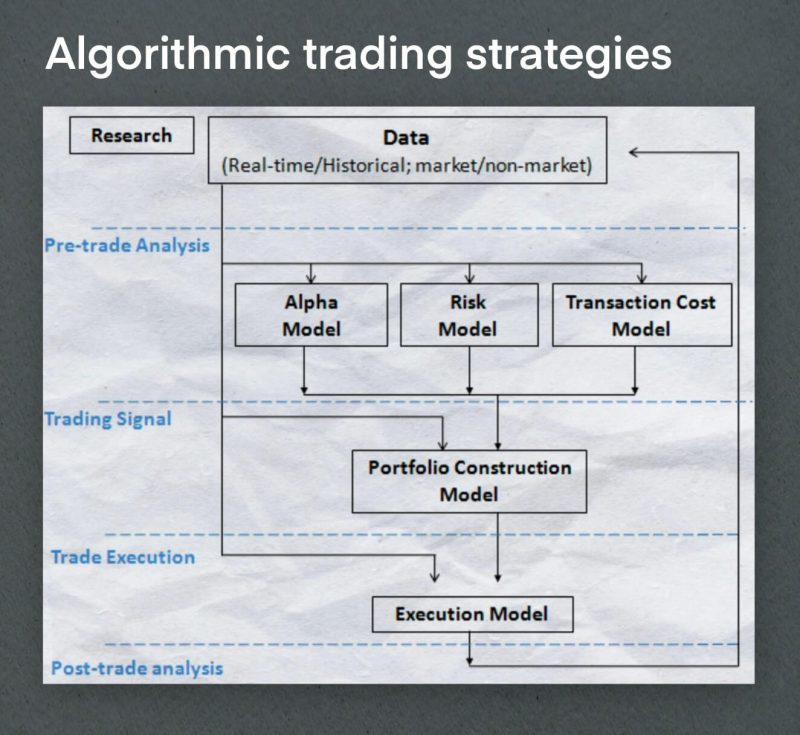
The key takeaway is that algorithmic trading itself is not inherently predatory. It is a tool for managing complexity and reducing costs. However, one specific application of this tool has fundamentally reshaped the market: the pursuit of speed.
High-Frequency Trading (HFT): The Game of Speed
High-Frequency Trading is a specialized type of algorithmic trading where the primary edge is not a better investment thesis, but superior speed. HFT firms use sophisticated algorithms and cutting-edge technology to execute millions of orders per day, aiming to profit from minuscule price discrepancies that exist for only fractions of a second.
To get a clear overview of what HFT is and how it differs from general algorithmic trading, watch the following video.
High Frequency Trading and its Impact on Markets
This video from The Plain Bagel provides an excellent primer on algorithmic trading and its subset, HFT.
First, watch the section that defines algo trading and notes its prevalence in the market. Then, focus on the definition of high-frequency trading, paying attention to its key characteristics: speed, short holding periods, and high order cancellation rates.
The core business model of HFT revolves around exploiting temporary pricing inefficiencies. This can take several forms, some beneficial to the market, others parasitic.
The HFT Playbook
-
Electronic Market Making: Some HFTs act as market makers, simultaneously placing buy (bid) and sell (ask) orders to earn the bid-ask spread. Their speed allows them to update their quotes thousands of times per second, providing constant liquidity to the market and generally contributing to tighter spreads. This is often considered the "good" side of HFT.
-
Latency Arbitrage: This is the strategy that generates the most controversy. HFT firms engage in a technological "arms race" to receive market data and send orders faster than anyone else. This includes paying exchanges for co-location (placing their servers in the same data center as the exchange's matching engine) and building private communication networks (like dedicated fiber optic lines and microwave towers) to shave milliseconds off data transmission times.
This speed advantage allows them to perform latency arbitrage: detecting a price change on one exchange and racing to trade on another exchange before its price has been updated. The diagram below illustrates a classic example.
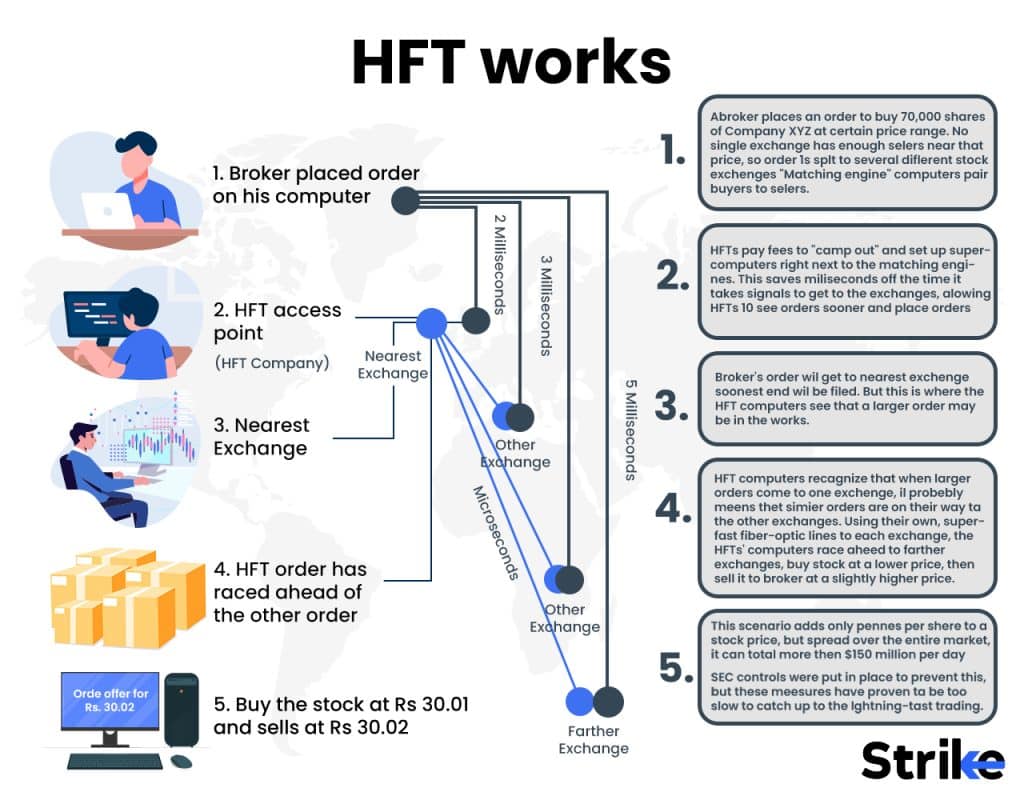
This strategy is not about fundamental analysis; it's a pure speed game. The following detailed paper discusses the characteristics and strategies of HFT firms.
High Frequency Trading and Dark Pools
This paper provides a deep dive into the mechanics of HFT. While academic, its descriptions are clear and relevant for understanding the operator's perspective.
First, read the section titled High Frequency Trading (starting on p. 11). Focus on the list of characteristics and the explanation of "latency arbitrage." This details the technological advantages HFTs use to get ahead. Next, continue to the section High Frequency Trading Strategies and Risks. Pay close attention to the list of strategies that can cross the line into market manipulation, such as spoofing and quote stuffing. These are the "phantom liquidity" tactics we alluded to in the last lesson.
The key risk from HFT, besides the parasitic costs imposed by latency arbitrage, is systemic instability. The complex interaction of thousands of competing algorithms can create unforeseen feedback loops, leading to events like the 2010 "Flash Crash," where markets collapsed and recovered in minutes, driven almost entirely by machines.
Dark Pools: The Institutional Response
Faced with the constant threat of being "front-run" by predatory HFTs, large institutional investors sought a safer place to trade. This led to the proliferation of dark pools.
A dark pool is a privately organized financial forum or exchange for trading securities. Unlike "lit" public exchanges (like the NSE or BSE), dark pools do not display order information (like bids and asks) to the public. They are opaque, hence the name.
Their primary purpose is to allow institutions to trade large blocks of shares without tipping their hand to the market and moving the price against themselves.
This next resource provides an excellent, detailed explanation of how dark pools work and how they fit into the broader market structure.
Dark Pools and Algorithmic Execution: How Institutions Hide Large ...
This article from Coincub is one of the clearest explanations of the modern interplay between dark pools, algorithms, and HFT.
Read the introduction to understand what dark pools are and their primary function: reducing market impact. Note the distinction between general off-exchange trading and specific ATS dark pools. Next, read the section The Microstructure of Opaque Liquidity. Focus on how dark pools operate, deriving their prices from the public markets (often at the midpoint of the NBBO). Finally, jump to the crucial section, Latency Arbitrage and Defensive Microstructure. This explains the cat-and-mouse game between HFTs and dark pools, covering "stale reference pricing," "pinging," and the defensive countermeasures like minimum order sizes and intentional delays (the "speed bump").
This "cat-and-mouse" dynamic is a core feature of modern market mechanics:
- The Hunt: HFTs don't give up just because an order is in a dark pool. They use strategies like "pinging" (sending small, rapid-fire orders) to detect the presence of large hidden orders. They also exploit "stale reference prices," using their speed advantage to trade against a dark pool's slightly delayed price information.
- The Defense: Dark pool operators fight back. They implement minimum order sizes to filter out pings and, most cleverly, introduce randomized micro-second execution delays to disrupt the deterministic timing that HFT arbitrage algorithms rely on.
For a trader, knowing that dark pool transactions are happening is vital. While the orders are hidden pre-trade, the executions are reported to the public consolidated tape post-trade, often with a special marker.
Why Prop Traders Use Dark Pools ❗ Trading Strategy Explained
This video from TraderTV Live shows the practical side of dark pools from a trader's perspective, focusing on how to spot and interpret their activity.
Watch the first part to understand what a dark pool print is and how it's different from a "lit" order. Notice how they appear on the time and sales tape, often marked with a 'D'. Next, see how a trader might utilize this information at key price levels (support/resistance) to gauge hidden supply or demand. Finally, learn about the importance of filtering your tape to focus on significant, large-lot prints, which helps separate meaningful institutional activity from noise.
The Impact on Price Discovery
The fragmentation of trading across lit exchanges and dozens of dark pools raises a critical question: does this structure help or harm the formation of accurate prices?
The debate is ongoing, but one compelling theory suggests a natural self-sorting occurs:
- Informed Traders (those with a real thesis or proprietary information) tend to trade on lit exchanges. They need guaranteed execution, and they are the ones moving prices.
- Uninformed Traders (those rebalancing portfolios or executing passively) are more price-sensitive and route to dark pools to save on the bid-ask spread.
This sorting can paradoxically make public prices more efficient, as the lit markets become concentrated with the most price-moving information. However, it comes at a cost. Market makers on public exchanges face higher "adverse selection" risk (the risk of trading with someone who knows more than they do), forcing them to quote wider bid-ask spreads. This means that while institutions save money in dark pools, retail traders may face slightly higher transaction costs on public exchanges.
Conclusion
You now see that the market is far from a simple auction. It's a highly complex, technology-driven ecosystem where different players with different incentives compete across multiple venues, both visible and invisible.
Key Takeaways:
- Algorithmic Trading is the broad use of computers to execute trades, often to manage large orders and minimize market impact.
- High-Frequency Trading (HFT) is a subset focused on extreme speed, profiting from tiny, fleeting price discrepancies through strategies like market making and latency arbitrage. It provides liquidity but can also be predatory and introduce systemic risk.
- Dark Pools are private, opaque trading venues used by institutions to hide large orders from predatory HFTs. They offer price improvement but no guarantee of execution.
- A Technological Arms Race exists between HFTs attempting to exploit dark pools (via pinging and latency arbitrage) and the pools deploying defensive countermeasures (like speed bumps and minimum order sizes).
- Price Discovery is Fragmented: This structure fundamentally changes how prices are formed, concentrating informed flow on lit exchanges while potentially increasing costs for retail participants.
In our next lesson, we will delve into the mechanics of another sophisticated market activity: Short Selling and Borrowing Mechanics. You'll learn how bearish bets are constructed, the risks involved, and how events like a "short squeeze" can create explosive price moves completely disconnected from a company's fundamentals.