Introduction
In our last lesson, we explored operating leverage—the double-edged sword that can supercharge a company's profitability or cripple it. We saw how a scalable business model can turn revenue growth into an explosion of profits. But what if the numbers fueling this story are an illusion?
This lesson is the defensive counterpoint to the last one. If operating leverage analysis is about identifying powerful businesses, this lesson is about spotting dangerous ones. Your goal is to develop the instinct to "smell" a stock that's not right, to see the cracks in the facade before the market does. To do that, you need to think like a forensic accountant.
We will systematically identify the common red flags in financial statements and corporate behavior. You will learn to spot the signs of earnings manipulation, questionable governance, and other tricks companies use to mislead investors. Mastering this skill is not just about avoiding losses; it's about preserving the capital you need to seize real opportunities.
The Anatomy of Deception: Why and How
Before we dive into a checklist, it's crucial to understand the motivations behind financial manipulation. Managers don't cook the books for fun; they do it under pressure or for personal gain. Understanding the why helps you anticipate the how.
FINANCIAL SHENANIGANS (BY HOWARD SCHILIT)
This video summary of Howard Schilit's classic book, "Financial Shenanigans," provides an excellent framework for understanding the motives behind accounting manipulation.
Watch the section on why companies engage in shenanigans. The video breaks down the motives into two primary categories: Inflating Current Earnings: To meet analyst expectations, secure loans, boost the stock price for an IPO, or hit bonus targets. Deflating Current Earnings: To create "cookie-jar" reserves for a bad quarter, lower the purchase price in an acquisition, or take a "big bath" in a bad year to make future years look better. This dual-motive framework is your first mental model. Always ask: what incentive does management have right now to make the numbers look better or worse than they are?
Now that you understand the motives, let's look at the common patterns of deception. These are the "tells" that give the game away.
The Forensic Accountant's Toolkit
A forensic accountant builds a case from evidence. Your evidence is the company's financial statements and regulatory filings. Let's build your toolkit, starting with the most powerful tools.
This article from Multibagger Shares is an outstanding, practical guide tailored to the Indian market. It provides a concrete, actionable checklist that we will use as the foundation for our analysis.
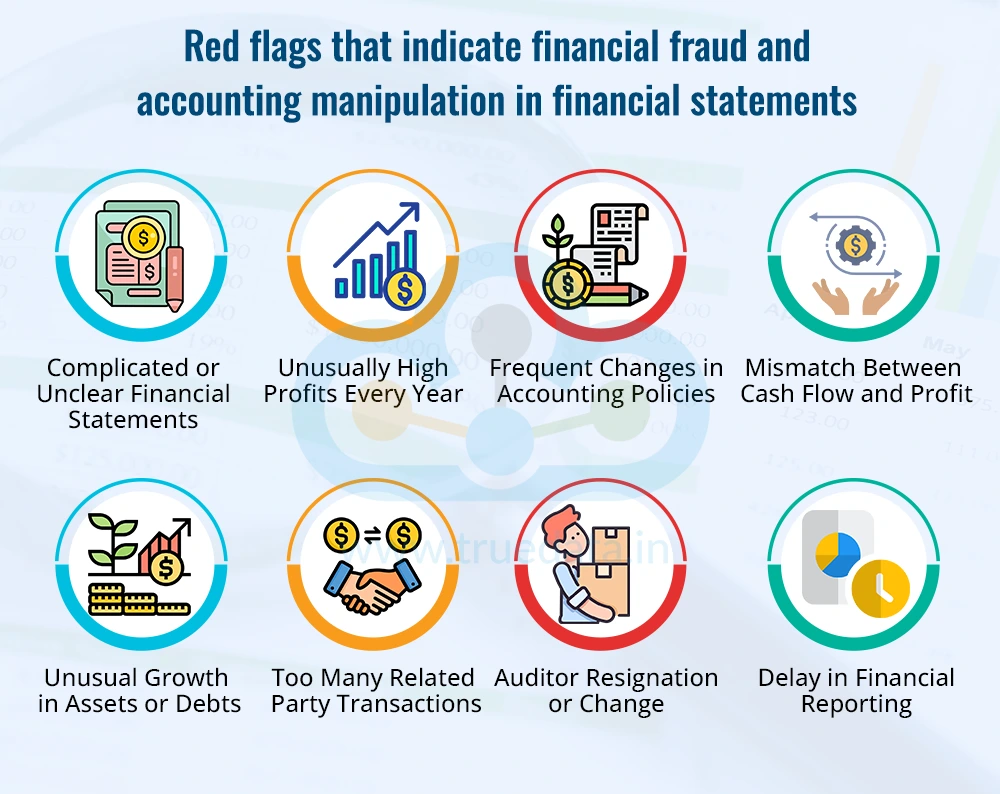
Read this article in its entirety. It is your primary guide for this section. Pay close attention to the Indian case studies (Satyam, DHFL, Manpasand Beverages) as they illustrate the real-world consequences of ignoring these flags. As you read, focus on internalizing the logic behind each red flag. Don't just memorize the list. Here are the key red flags from the article we'll be discussing: Cash Flow vs. Earnings Divergence Receivables Growing Faster Than Revenue Unusual Inventory Build-Up Capitalization of Expenses Related Party Transactions (RPTs) Governance & People Issues (Auditors, CFOs) Promoter Share Pledging Masking Weak Operations
Let's drill down into some of these critical areas.
1. Cash is King, Profit is Opinion
As we've discussed before, accrual accounting allows for significant judgment in recognizing revenue and expenses. Cash flow is much harder to fake. A persistent and growing gap between reported Net Profit and Cash Flow from Operations (CFO) is the single biggest red flag in finance.
It suggests that the profits being reported aren't turning into actual cash in the company's bank account. This could be due to aggressive revenue recognition, rising receivables that aren't being collected, or a buildup of unsold inventory. Over a long period, profits and operating cash flow must move together. If they don't, trust the cash.
2. The Beneish M-Score: A Quantitative Fraud Detector
Given your quantitative background, you'll appreciate that there are models designed to systematize the search for red flags. The most famous is the Beneish M-Score, an eight-variable model that produces a score indicating the likelihood of earnings manipulation.
The model was developed by Professor Messod Beneish by analyzing the financial characteristics of known manipulators versus non-manipulators. The table below shows the average values for each of the model's components for the two groups.
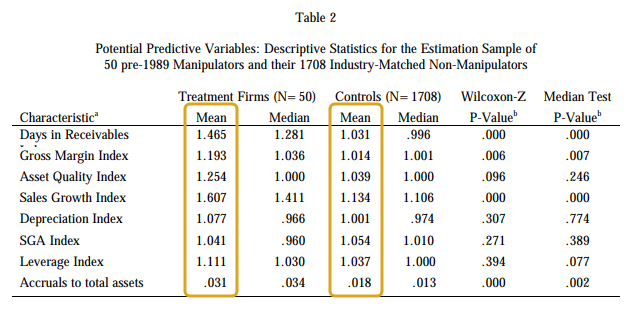
Look at the highlighted columns. For nearly every variable, the "Treatment Firms" (the manipulators) show a significantly different profile.
- Days in Receivables (DSRI): 1.465 for manipulators vs. 1.031 for controls. Manipulators show receivables growing much faster than sales.
- Sales Growth Index (SGI): 1.607 vs. 1.134. Manipulators are often high-growth companies where pressure to maintain momentum is intense.
- Accruals to total assets: 0.031 vs. 0.018. Manipulators rely more on non-cash earnings (accruals) to generate profit.
An M-Score greater than -1.78 is considered a strong indicator of potential manipulation. While you don't need to calculate this by hand for every company, understanding its components teaches you what to look for: deteriorating margins, asset quality, and disproportionate growth in receivables are all signs of a company under pressure.
3. A Parade of Shenanigans
Beyond the big-picture flags, you need to recognize specific accounting tricks. These are the "financial shenanigans" that distort the true picture of a company.
FINANCIAL SHENANIGANS (BY HOWARD SCHILIT)
Let's return to the "Financial Shenanigans" video to get a concise list of the seven most common tricks.
Watch the section that details the seven key shenanigans. This is a masterclass in accounting deception. The seven tricks are: Recording revenue too soon. Recording bogus revenue. Boosting income with one-time gains. Shifting current expenses to a later period (e.g., capitalizing costs). Failing to record liabilities. Shifting current revenue to a later period (cookie-jar reserves). Shifting future expenses to the current period (big bath). Focus on understanding the mechanism of each one. For example, "capitalizing costs" (Shenanigan #4) is the exact trick described in the 2c062 article under "Capitalization of Expenses."
4. Real-World Consequences: SEC Enforcement Actions
To see how these shenanigans play out in the real world, let's look at some examples from the US market where the regulator (the SEC) took action.
[PDF] CONTENTS FINANCIAL FRAUD Earnings Management Red Flags
This document from law firm Foley & Lardner discusses several high-profile earnings management cases. These cases provide concrete examples of the red flags we've been discussing.
First, read the case summaries for General Electric, Under Armour, and Rollins. General Electric (GE): Notice how they used improper accounting for locomotive sales and spare parts to meet analyst expectations. This is a classic example of "Boosting income" and "Recording revenue too soon." Under Armour: The company "pulled forward" sales from future quarters to meet current targets but failed to disclose this to investors. This is a form of revenue manipulation that hides weakening demand. Rollins Inc.: A pest control company made "unsupported reductions to their accounting reserves" just enough to round up their Earnings Per Share (EPS) to the next penny. This shows that even small, seemingly immaterial adjustments can be part of a fraudulent pattern. After reading the cases, review the section "Watch for These Red Flags." This list, written for corporate directors, is a powerful checklist for you as an investor. Pay particular attention to the first two points: discussions about "making our numbers" and "consecutive periods of closely meeting or exceeding analysts’ expectations." These are environmental red flags that suggest a culture where manipulation is more likely.
Conclusion
Spotting red flags is a survival skill. It's about pattern recognition, skepticism, and having a well-defined forensic checklist. Before you ever invest in a company, you must actively look for reasons not to invest. By putting the company's financials through this stress test, you protect yourself from the value traps and frauds that litter the market.
Key Takeaways:
- Trust Cash, Question Profit: A persistent divergence between reported profit and operating cash flow is the number one red flag.
- Know the Motives: Manipulation is driven by incentives. Understand if management is under pressure to inflate earnings (to meet targets) or deflate them (to create reserves).
- Check the Ratios: Rapidly growing receivables or inventory relative to sales often signals channel stuffing or weak demand.
- Watch the People: Sudden changes in auditors or the CFO are massive red flags. Scrutinize related-party transactions and high levels of promoter share pledging.
- Use the Forensic Checklist: Systematically check for the common red flags: earnings quality, receivables health, auditor stability, RPTs, inventory, pledged shares, and the quality of capex.
In our next lesson, we will pivot from defense to offense. Having learned how to assess business quality and spot deception, you'll learn how to synthesize all your analysis into a coherent Investment Thesis. This is where you move from being a critic to being an operator, forming a clear, defensible argument for why a particular stock is a compelling investment.