Introduction
In our last lesson, you learned to deconstruct a company into its core business model—the engine that dictates how it creates value. We identified the key archetypes like "make-and-sell," SaaS, and platforms, and the specific metrics that signal their health. You now understand the engine. Today, we build the fortress. A brilliant engine is useless if it can be easily copied or destroyed.
This lesson is about the economic moat—the structural competitive advantage that protects a company's profitability from the relentless assault of competition. Coined by Warren Buffett, the concept of a moat is central to separating truly great businesses from fleeting successes. Your objective is to learn how to identify the sources of a company's moat and, more importantly, to assess whether that moat is durable, narrowing, or merely an illusion. This is a critical step in moving from analyzing what a business is to forecasting what it can become.
The Castle, the Marauders, and Economic Gravity
Capitalism is a battlefield. If a company earns high profits, it's like a castle filled with treasure. This inevitably attracts marauders—competitors eager to take a share of those profits. Left undefended, competition will erode those high returns until they fall back to a mediocre average. This is the law of economic gravity.
An economic moat is the defensive barrier that protects the castle. It's a structural advantage so powerful that it keeps competitors at bay, allowing the company to defy economic gravity and sustain high returns on invested capital (ROIC) for years, even decades.
Michael Mauboussin's report, "Measuring the Moat," is one of the most rigorous and systematic treatments of this topic. We will use it as our foundational text.
Begin by reading the introductory page to grasp the core idea. Then, read the section titled "Economic Moats" on page 7. Pay attention to Buffett's framing: moats are not static. They are "getting a little bit wider or a little bit narrower every day." Our job as analysts is to figure out which direction they're heading.
A great product, a visionary CEO, or a hot market are not moats. These are temporary advantages. A true moat is structural, woven into the fabric of the business itself. Let's look at the four primary sources.
The Four Sources of a Moat
Pat Dorsey, a leading authority on this topic, has categorized moats into four main types. Understanding these archetypes gives you a powerful framework for identifying durable competitive advantages.
Pat Dorsey - Investment Strategies
In this talk, Pat Dorsey clearly distinguishes between a real, structural moat and a temporary advantage like a hot product or a cool piece of technology.
Watch his explanation from "great technology is not a moat". His examples of Crocs and Heelys are classic illustrations of how a popular product without a structural defense gets destroyed by competition.
Now, let's dissect the four legitimate sources of a moat.
1. Intangible Assets
This category includes brands, patents, and regulatory licenses that prevent competitors from duplicating a product or service.
- Brands: A brand is only a moat if it either increases a customer's willingness to pay or lowers their search cost. A recognizable logo is not enough. Think of Tiffany & Co. People pay a premium for the blue box, even for an identical diamond. That's a moat. Now think of Sony. It's a famous brand, but would you pay 15% more for a Sony TV over a comparable LG or Samsung? Probably not. That brand doesn't confer pricing power in a commoditized market.
- Patents: A government-granted monopoly for a period of time. This is a very strong moat, but it's finite. A pharmaceutical company with a single blockbuster drug has a powerful but brittle moat that will vanish upon patent expiry. A company with a deep portfolio of overlapping patents has a much more durable advantage.
- Licenses & Approvals: When a government or regulatory body grants a company the exclusive right to operate in a certain market (e.g., a landfill permit, a casino license, or the right to be a credit rating agency like Moody's). This can be a very powerful barrier, but it carries the risk that the regulator can change the rules.
Pat Dorsey - Investment Strategies
Dorsey provides a masterclass on intangible assets, particularly on what makes a brand valuable.
Watch his detailed breakdown from "the first one, intangible assets". Focus on his contrast between Sony and Tiffany, and his explanation of why Amazon's brand—built on trust—is so powerful.
2. Switching Costs
Switching costs are the expenses and hassles a customer incurs when changing from one product or service to another. When these costs are high, customers are "locked in," giving the incumbent company significant pricing power.
Your IT background makes this concept highly intuitive. Think about a large enterprise running its core operations on an Oracle database. Migrating to a new system, even a technically superior or cheaper one, would be a multi-year, multi-million dollar project fraught with risk. The cost of switching is immense. As a result, Oracle can raise its prices modestly every year, and customers will pay it.
Other examples include:
- Training & Workflow Integration: Learning new software (like moving from Adobe Photoshop to a new editor) requires retraining and disrupts established workflows.
- Data Portability: Moving your entire photo library from Apple Photos to Google Photos, or your business's financial history from one accounting software to another, can be a major headache.
Pat Dorsey - Investment Strategies
Dorsey explains switching costs using the Oracle example and then contrasts Apple's moat with Motorola's lack of one.
First, watch his explanation of switching costs. Then, watch his analysis of Apple from the audience question. He correctly identifies that Apple's true moat isn't its "cool hardware" (like the Motorola Razr); it's the high switching costs of the iOS software ecosystem.
3. Network Effects
We touched on this in the last lesson. A business benefits from a network effect when its product or service becomes more valuable as more people use it. This creates a powerful positive feedback loop that new entrants find almost impossible to overcome.
- Credit Cards (Visa, Mastercard): Merchants accept Visa because billions of consumers have it. Consumers carry Visa because millions of merchants accept it. A new competitor would have to solve this chicken-and-egg problem simultaneously, which is why no major new credit card network has emerged in decades.
- Social Networks (Facebook, LinkedIn): The value of LinkedIn is the size of its professional network. You're on it because everyone else is. A new professional network, even with better features, is an empty room.
Pat Dorsey - Investment Strategies
Dorsey's explanation of network effects is one of the clearest you'll find.
Watch the segment from "Network effect". He nails the core dynamic with the credit card example.
4. Cost Advantages
A firm with a structural cost advantage can either sell its product at a lower price than competitors, capturing market share, or sell at the same price and earn a higher profit margin. There are a few sources:
- Process Advantages: A unique, proprietary method of production that is hard to replicate. This is often the least durable moat, as smart competitors can eventually reverse-engineer processes.
- Scale Advantages: As a company gets bigger, its cost per unit can decline. This is common in businesses with high fixed costs, like manufacturing or logistics. UPS's dense delivery network means the marginal cost of adding one more package to a truck is nearly zero, an advantage a smaller competitor cannot match.
- Favorable Access to Resources: A unique source of cheap raw materials or a geographic advantage.
- Niche Markets (Efficient Scale): Sometimes a market is so small that it can only profitably support one or two companies. A third entrant would drive profits down for everyone. Constellation Software has built a massive business by acquiring these tiny "vertical market software" companies that dominate niches like ambulance dispatching or golf course management.
Pat Dorsey - Investment Strategies
Here, Dorsey breaks down the different types of cost advantages.
Watch his explanation from "Cost advantages". Pay close attention to the distinction between durable scale-based advantages (UPS) and less-durable process-based ones (Dell).
Assessing the Moat: Widening, Narrowing, or an Illusion?
Identifying a moat source is only half the battle. As Buffett says, moats are always in flux. Your real job is to determine the moat trend. A company with a wide moat that is narrowing may be a worse investment than a company with a narrow moat that is widening.
Economic Moats Explained: What They Are & Why They Matter - Part V
This article from Flyover Stocks is laser-focused on the practical task of assessing moat trend.
First, read the introduction, starting from the opening paragraphs to understand why a static view of a company is flawed. Next, read the section "Evaluating moat trend" to understand the core question we're trying to answer. Then, read the section "What moat trend isn’t," which provides critical context on how to avoid confusing cyclical tailwinds with a genuine improvement in competitive position. Finally, study the four-step process for analyzing moat trend. This is your operational checklist.
Applying this process, you must act like a detective, looking for clues in the numbers and the narrative. If a company claims a network effect, are user engagement and retention increasing? If it claims a brand moat, is it able to consistently raise prices without losing customers? If it claims a cost advantage, are its margins widening relative to competitors?
Moats in the Real World: Return on Invested Capital (ROIC)
How do we see the effect of a moat in the financial statements? The single most important metric is Return on Invested Capital (ROIC).
ROIC measures how much profit a company generates for every dollar of capital it has invested in its business (e.g., factories, technology, acquisitions).
A company with a strong, durable moat will be able to generate a high and sustainable ROIC, because its moat protects it from the competition that would otherwise drive returns down.
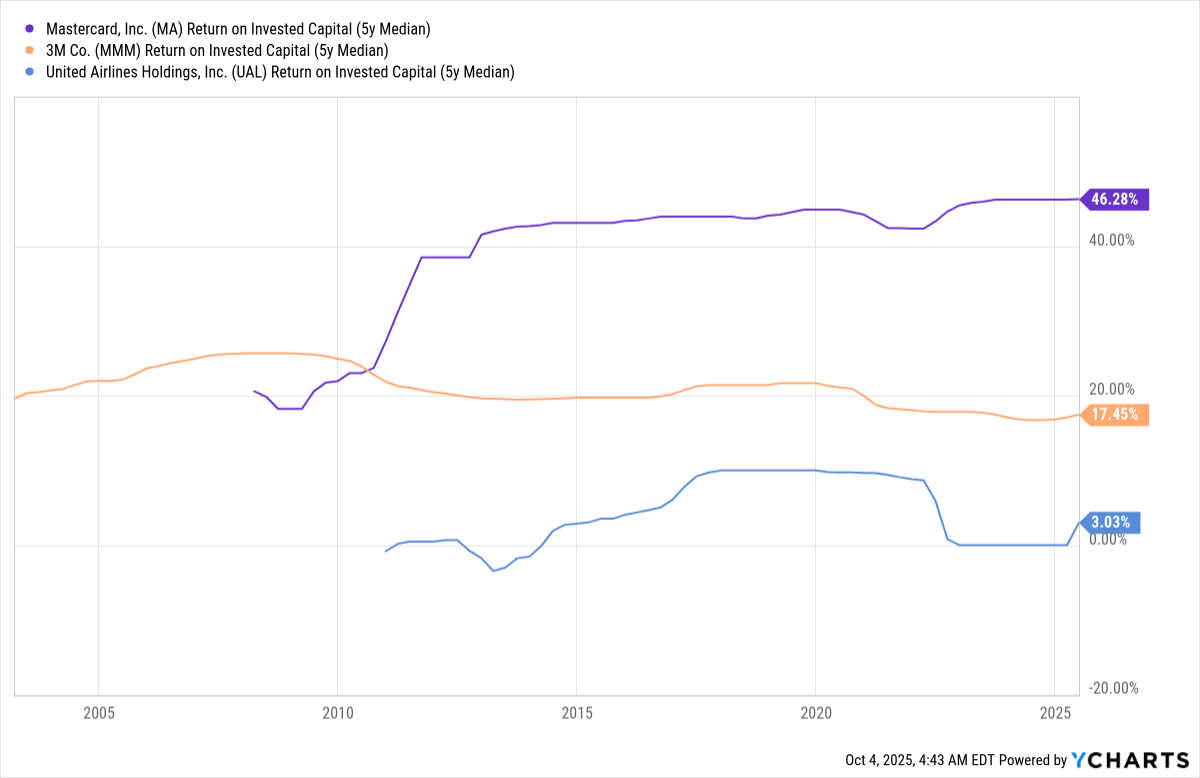
Analyzing ROIC over time is a powerful way to assess moat trend:
- High and Stable/Rising ROIC: Suggests a wide and stable/widening moat (e.g., Mastercard).
- High but Declining ROIC: May indicate a moat that is narrowing (a "quality trap").
- Low and Volatile ROIC: A clear sign of a business with no moat (e.g., United Airlines).
- Low but Steadily Rising ROIC: Could signal a company that is in the process of digging a moat. These are often the most exciting opportunities.
A crucial point, especially for technology and software companies, is that accounting rules can obscure reality. Investments in R&D or customer acquisition are expensed immediately on the income statement, depressing current profits. However, economically, they are investments that build future value (the moat). An analyst who understands this can see value where the market only sees losses.
Pat Dorsey: Competitive advantage Masterclass (Moats 2.0)
In this segment, Dorsey makes a critical point about the disconnect between accounting rules and economic reality.
Watch his explanation from "Investment also happens on the income statement". This is a high-level concept. The key insight is that for many modern businesses, GAAP profits can be a misleading indicator of value creation, and a deep, qualitative understanding is required to see the real picture.
Conclusion
You have now moved beyond the business model to the structural defenses that protect it. A moat is what separates the long-term compounders from the flashes in the pan.
Key Takeaways:
- Moats Defy Economic Gravity: They are structural advantages that allow companies to sustain high returns on capital by fending off competitors.
- Four Primary Sources: Moats arise from (1) Intangible Assets, (2) Switching Costs, (3) Network Effects, and (4) Cost Advantages.
- Moats are Dynamic: Your analysis must focus on the moat trend—is it widening or narrowing? Look for clues in KPIs specific to the moat source.
- ROIC is the Footprint of the Moat: The strength and trend of a company's ROIC are the clearest quantitative signals of its competitive position. A business with a wide moat and ample opportunities to reinvest capital at a high ROIC is the holy grail of investing.
In our next lesson, we will focus on Management Quality. The greatest moat in the world can be squandered by a poor manager who makes foolish capital allocation decisions. Conversely, a brilliant manager can take a business with a decent moat and widen it into an impregnable fortress. We will learn how to judge the people in charge of the castle.