Welcome. This course begins with the option contracts whose prices eventually feed into measures such as the VIX. Before asking what an option price says about volatility, you need to know what the option is worth when it expires—and why that amount can differ from what its buyer earned.
In this lesson, you will calculate expiration payoff for a call or put on a stock index, then subtract the premium paid to find the buyer’s profit or loss. Plan on about 40 minutes, including the short resources and time to work through the examples.
The contract and its two relevant prices
An option gives its buyer a right, not an obligation. A call gives the right to buy at a specified level; a put gives the right to sell at that level. The specified level is the strike, and the date on which the option ends is its expiration. The buyer pays an upfront price called the premium.
Read the Investor Bulletin’s opening explanation and “Basic Options Terminology” before continuing. It uses stock options to establish the vocabulary; we will apply the same payoff logic to index options.
Investor Bulletin: An Introduction to Options
Read this Investor.gov bulletin for the meaning of a call, put, strike, expiration, and premium.
In “What are Options?” and “Basic Options Terminology,” read the core terminology. Start at the opening definition under “What are Options?” and stop in the paragraph explaining the $2.20 premium and the stock-option contract size. Focus on the buyer’s right and on the distinction between a quoted premium and the total amount paid for a contract; the example’s specific expiration-calendar convention is not needed here.
For this lesson, let denote the strike and the index’s final level used for expiration settlement. First imagine that an index option has a contract multiplier of 100. A difference of one index point is then worth 100 currency units per contract. The multiplier scales both the option’s payoff and any premium quoted per index point; it does not mean that the buyer receives 100 shares of the index.
Keep two calculations separate:
- Expiration payoff is what the option is worth at expiration, before accounting for its purchase price. For a purchased call or put, it cannot be negative: the buyer need not use a right that has no value.
- Profit or loss is the payoff minus the premium paid. A positive payoff does not necessarily mean a profitable trade.
We will ignore fees and other trading costs so that this distinction stays visible.
Calls: a payoff above the strike
A call is valuable at expiration when the index finishes above its strike. If the strike is 100 and the final index level is 110, the right to buy at 100 has a value of 10 index points. If the index finishes at 98, that right has no value: buying at 100 would be worse than buying at the prevailing level.
Khan Academy’s brief call-payoff diagram makes the difference between option value and the buyer’s net result especially clear.
Call payoff diagram | Finance & Capital Markets | Khan Academy
Watch “Call payoff diagram” from Khan Academy to see how a call’s expiration value differs from its profit after the purchase cost.
Watch the two diagrams for the distinction between value and profit, then expiration value for why the call is worth zero below its strike. Finish with premium and profit; notice that an option can be worth something while its buyer still has a loss.
In symbols, the payoff per index point for a purchased call is
The “maximum” simply says to use zero rather than a negative difference when the index finishes at or below the strike. If is the premium paid per index point, then
The image below plots this distinction for a strike of 100 and a premium of 5. It depicts a stock call, but its per-unit payoff has the same shape as the index-call calculation we are using.
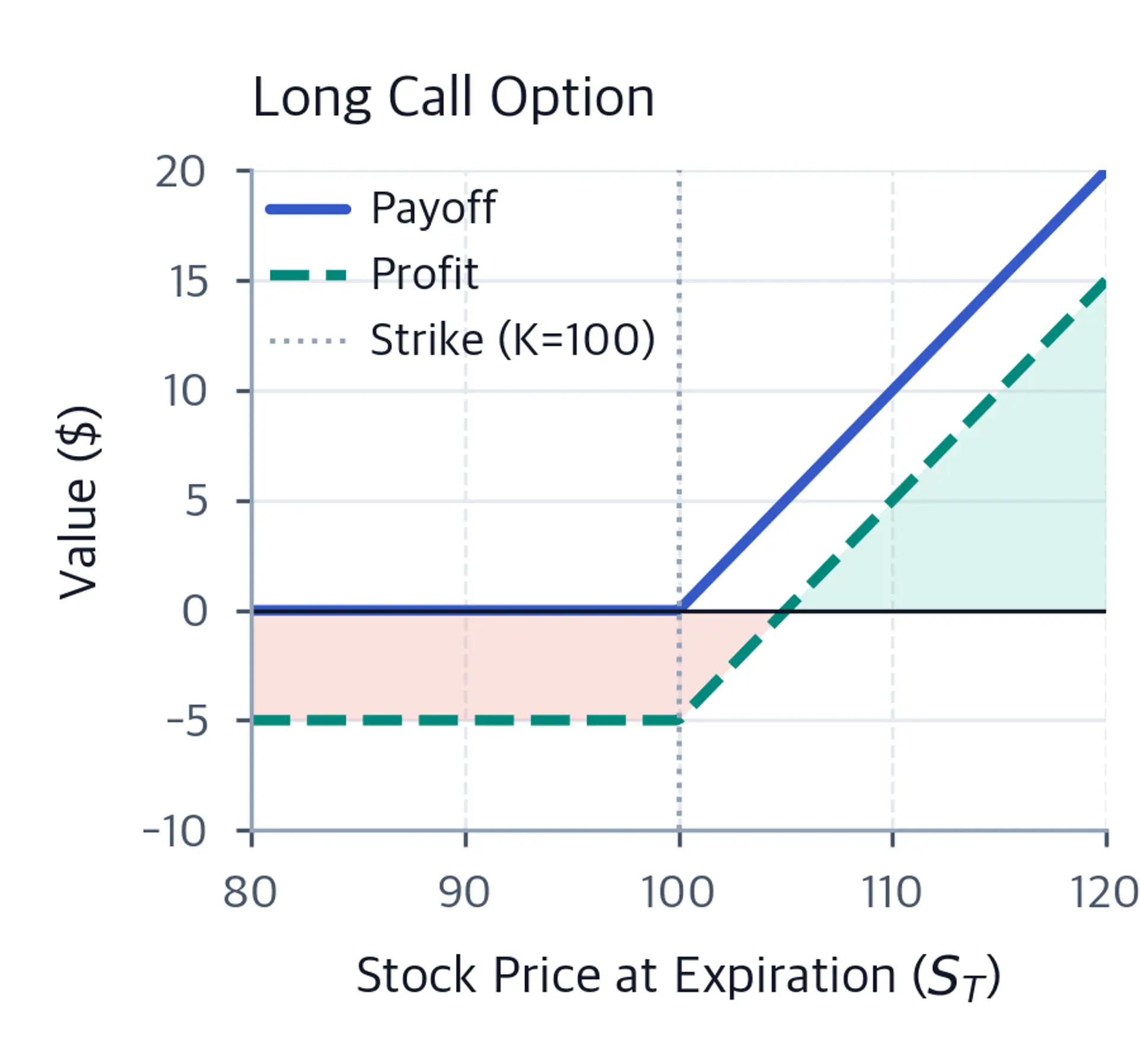
Suppose you buy an index call with , pay index points, and the contract multiplier is 100. If , the call pays 3 points, or 300 per contract. Its purchase cost was , so its loss is 200 per contract. The option expired with value, but not enough to recover its cost.
At , payoff and premium are both 5 points: profit is zero. This is the call buyer’s expiration break-even level, . At , the payoff is 10 points and profit is 5 points, or 500 per contract. If the final level is 100 or lower, payoff is zero and the buyer loses the entire 500 premium. Notice that crossing the strike creates a positive payoff; crossing break-even creates a positive profit.
Puts: a payoff below the strike
A put reverses which side of the strike has value. It gives its buyer a right to sell at the strike, so it is valuable at expiration when the index finishes below that level. With a strike of 100 and a final level of 92, the difference is 8 index points. If the final level is 103, the put has no expiration value.
An index-option example from Cboe adds an important practical detail: index options can settle in cash, using the relevant index-level difference rather than delivering a basket of shares.
Read the put example in Cboe’s “Understanding Index Options” to connect an index-level difference, a contract multiplier, and the premium paid.
On the “Example Trades & Outcomes” page, locate the put example with a 530 strike and a 137-per-contract premium. Near the end of that example, read the put outcomes, from “Market Falls” through “Market Rises.” Also find the “Convenience of cash settlement” benefit and read the settlement explanation. Focus on why a 10-point put payoff becomes 1,000 with a multiplier of 100, before subtracting the 137 premium.
For a purchased put, the corresponding formulas are
and
For example, buy an index put with , a premium of 4 points, and a multiplier of 100. At , its payoff is 8 points, or 800 per contract. The premium cost 400 per contract, leaving a profit of 400. At , it pays 2 points, or 200 per contract, but the buyer still has a loss of 200 after the premium. At or higher, it pays zero and the buyer loses the 400 premium.
The put buyer breaks even when the index finishes at : here, 96. As with the call, the strike and break-even are different thresholds.
One calculation method for either option
When reading an option example, establish the units before doing arithmetic. An index level, an option premium quoted in index points, and a currency amount per contract are not interchangeable.
- Identify the option type, strike , final index level , premium per point , and contract multiplier.
- Find the per-point payoff: for a call, take the positive part of ; for a put, take the positive part of .
- Subtract to find per-point profit or loss.
- If a per-contract amount is required, multiply the payoff and profit or loss by the contract multiplier.
Here is the same final index level applied to the two 100-strike options above. The call costs 5 points; the put costs 4. Every entry is per index point, before multiplying by 100.
| Final index level | Call payoff | Call profit/loss | Put payoff | Put profit/loss |
|---|---|---|---|---|
| 92 | 0 | −5 | 8 | +4 |
| 100 | 0 | −5 | 0 | −4 |
| 103 | 3 | −2 | 0 | −4 |
| 110 | 10 | +5 | 0 | −4 |
The table shows why a payoff diagram alone cannot tell you whether buying the option made money. At 103, the call has a payoff of 3, yet its buyer is down 2 after paying 5. For a purchased option held to expiration, the loss in this simplified calculation cannot exceed its premium, because an out-of-the-money option can expire with zero payoff rather than a negative one. That statement concerns the buyer; it does not describe the risks of selling options.
Key takeaways
A call’s expiration payoff is ; a put’s is . Profit or loss subtracts the premium, and a contract multiplier converts a per-point result into a per-contract amount. The strike marks where payoff can begin; break-even includes the premium. For an index option, a multiplier scales the cash result—it does not imply delivery of index shares.
The next lesson uses this payoff shape to explain why a wider range of possible future index levels tends to make options more expensive, even before anyone knows which direction the index will move.