Hello. Last lesson separated an option’s expiration payoff from its profit after the premium. A call pays when the index finishes above its strike; a put pays when it finishes below. That payoff shape explains why an option can become more expensive when the range of possible index outcomes widens—even if no one has a stronger view about which direction the index will go.
This lesson focuses on that pricing intuition. Plan on about 35–40 minutes, including the short video and reading.
Why an option costs something before expiration
At expiration, an option’s value comes from the final index level and its strike. Before expiration, its buyer is paying for what might happen. An option that has no value if it expired today can still have a positive premium because the index has time to move into a position where the option pays.
The portion of an option’s premium above its current intrinsic value is called time value, or extrinsic value. That name does not mean that the calendar alone determines it. The size of the moves that could occur during the remaining time matters too.
The following video uses stock options rather than index options, but the payoff shapes are the same. Focus on the distinction between current intrinsic value and the additional value attached to possible future moves.
How to Understand Option Prices SIMPLY
Watch “How to Understand Option Prices SIMPLY” by projectoption for its visual explanation of how time and expected price fluctuations affect an option’s value before expiration.
Begin with extra value, where options can cost more than their current intrinsic value. Continue through time and volatility: notice that, for a comparable strike and remaining time, wider anticipated swings are associated with a higher premium. The examples concern shares, but apply the reasoning to an index.
The Options Industry Council gives a concise written version of the same distinction.
Read “Options Pricing” from the Options Industry Council to connect time value with the effect of volatility on both calls and puts.
Under “Time Value,” read the explanation. Then, under “Major Factors Influencing Options Premium,” read the opening paragraph about implied volatility, beginning with “The effect of implied volatility can be difficult to quantify” and ending with “It is most noticeable with at-the-money options.” In particular, follow the pricing connection. You can leave the subsequent discussion of dividends and interest rates for now; we will hold those inputs fixed.
The key question is why wider swings can make both calls and puts cost more. The answer lies in the uneven shape of each buyer’s payoff.
A wider range, with no change in direction
Imagine an index currently at 100. Consider a call and a put that both have a strike of 100 and expire on the same date. Compare two simplified sets of possible final index levels:
- In a narrow-range case, the index finishes at either 90 or 110.
- In a wide-range case, it finishes at either 80 or 120.
For this illustration, give the two outcomes in each case equal pricing weight and ignore interest and discounting. Both cases are centered on 100: neither assumes that an upward finish is more likely than a downward finish. Only the distance from 100 changes.
| Possible final index levels | Call payoffs at strike 100 | Average call payoff | Put payoffs at strike 100 | Average put payoff |
|---|---|---|---|---|
| 90 or 110 | 0 or 10 | 5 | 10 or 0 | 5 |
| 80 or 120 | 0 or 20 | 10 | 20 or 0 | 10 |
Why does the call’s average payoff rise? When the index finishes below 100, the call buyer does not have to take a negative payoff: the call simply pays zero. When the index finishes above 100, a larger rise produces a larger payoff. Widening the outcomes from 90/110 to 80/120 deepens the unfavorable outcome for the index, but it does not push the call payoff below zero. It doubles the payoff in the favorable outcome.
The put works the other way around. A larger rise still leaves its payoff at zero, while a larger fall increases what it pays. Thus a wider range can raise the value of both rights without implying that the index is more likely to rise or more likely to fall.
These averages illustrate the pricing mechanism, not actual market quotes. Real premiums depend on how outcomes are priced, discounting, and other contract and market inputs. Nor is a higher premium a promise of profit: as last lesson showed, the buyer must earn back the premium paid.
What “all else equal” is doing
To isolate the effect of a wider expected range, keep the current index level, strike, time to expiration, interest-rate and dividend assumptions, and option type unchanged. Then compare the option under a narrower versus a wider distribution of potential index outcomes.
If instead you compare two options with different strikes or expiration dates, a premium difference cannot be attributed to the width of possible moves alone. More time, for example, gives the index longer to move. A different current index level changes how close an option is to paying off. “All else equal” is what makes the volatility comparison meaningful.
The chart below holds a hypothetical call’s other stated inputs fixed and varies the volatility used to price it. The rising line is the pattern we have just explained with payoffs; its nearly straight appearance over the displayed range is an illustration, not a rule that option prices always change linearly with volatility.
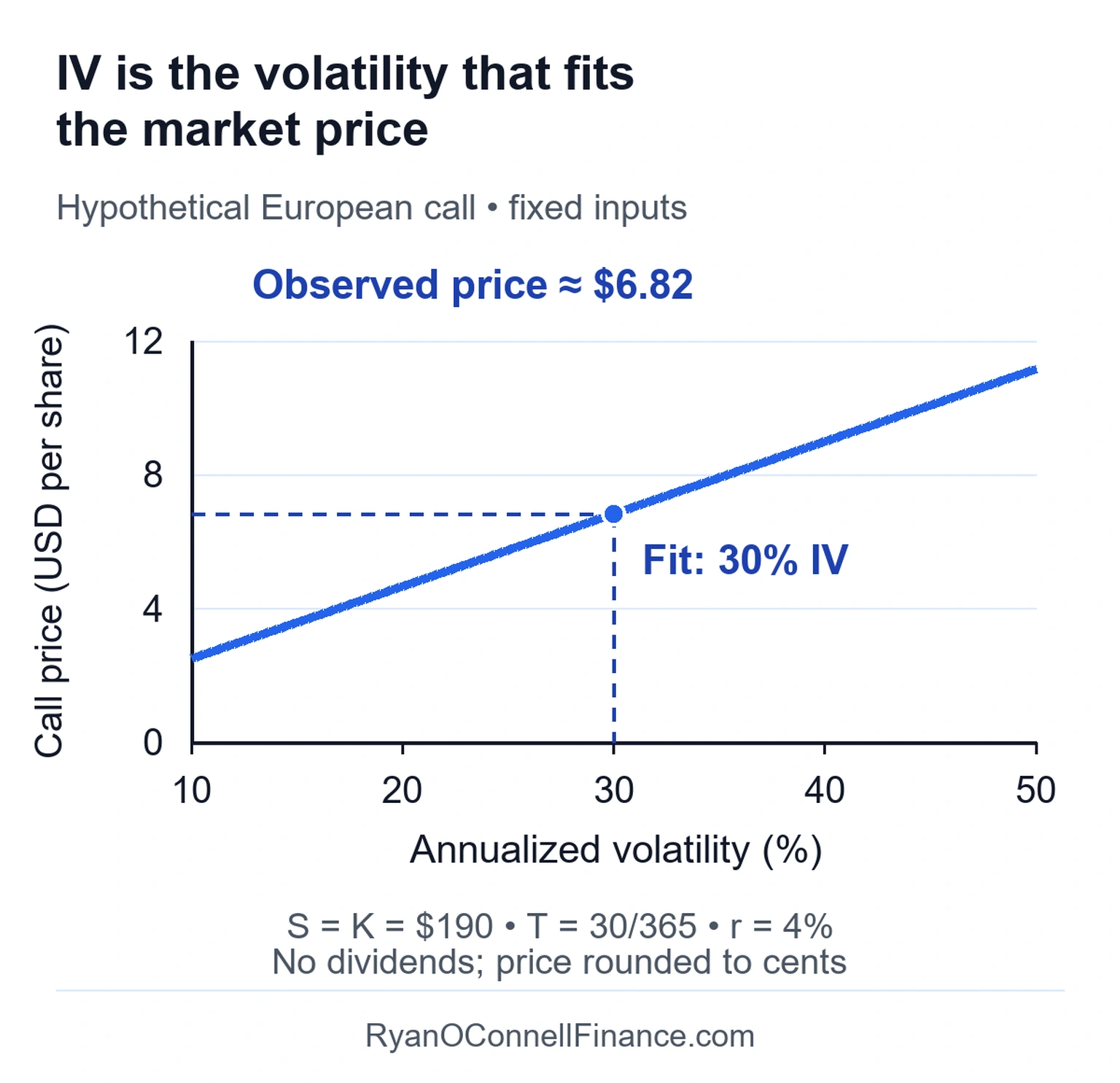
The lesson’s result is therefore a tendency under a controlled comparison, not a claim that every option premium must rise whenever markets seem unsettled. Actual quotes can also change because the index moves, time passes, or buyers and sellers alter the prices at which they will trade.
The payoff shape is the reason—not a directional forecast
It is tempting to say, “A call gets dearer because the market expects the index to go up.” That misses half the story. In our example, the wider range raised the call’s value while leaving the upward and downward outcomes equally weighted. It raised the put’s value as well.
A more useful statement is: a wider range increases the possibility of a substantial payoff on an option’s favorable side, while the buyer’s payoff on the unfavorable side stops at zero. For calls, the favorable side is an index rise; for puts, it is an index fall. This explains why greater anticipated movement can increase premiums for both, with the other pricing inputs fixed.
Key takeaways
An option can have time value before expiration because future index moves could give it a payoff. Holding other inputs fixed, a wider range of possible final levels tends to increase that value: a call benefits from larger upward outcomes without acquiring a negative payoff in downward ones, while a put benefits from larger downward outcomes without acquiring a negative payoff in upward ones. Higher premiums for both options do not, by themselves, predict the index’s direction.
So far, we have reasoned from a wider range of possible outcomes to a higher option price. The next lesson reverses that perspective: given an observed option price, what volatility is consistent with it—and why is that not a guarantee of what the index will actually do?