Hello! Welcome to your next lesson.
In our last session, you did an excellent job of learning to structure your thoughts and explain a decision-making process using the STEP method. That skill of organizing complex ideas into a clear, spoken narrative is a cornerstone of fluent communication. Today, we will adapt that skill for a different, but equally important, purpose: summarizing.
This lesson addresses the learning outcome: Summarize a short story or video clip in your own words in English. Being able to summarize effectively is crucial for both casual and professional conversations. It allows you to share the plot of a movie, recap a news article, or brief a colleague on a meeting you attended, all in a clear and concise way. This is another key step in breaking the habit of mental translation and learning to think directly in English.
Part 1: The Art of a Good Summary
A summary isn't just about making a text shorter; it's about capturing its essence. It answers the question, "What was it about?" in a way that is brief, accurate, and easy to understand. The goal is to convey the main ideas in your own words, not to repeat the source word-for-word.
As the author of the blog "The Other Things Matter" notes, summarizing is a crucial conversation skill that helps us talk about books, movies, and shows beyond simple responses like "It was good."
To help organize your thoughts before you speak, you can use simple frameworks. Think of these as mental checklists.
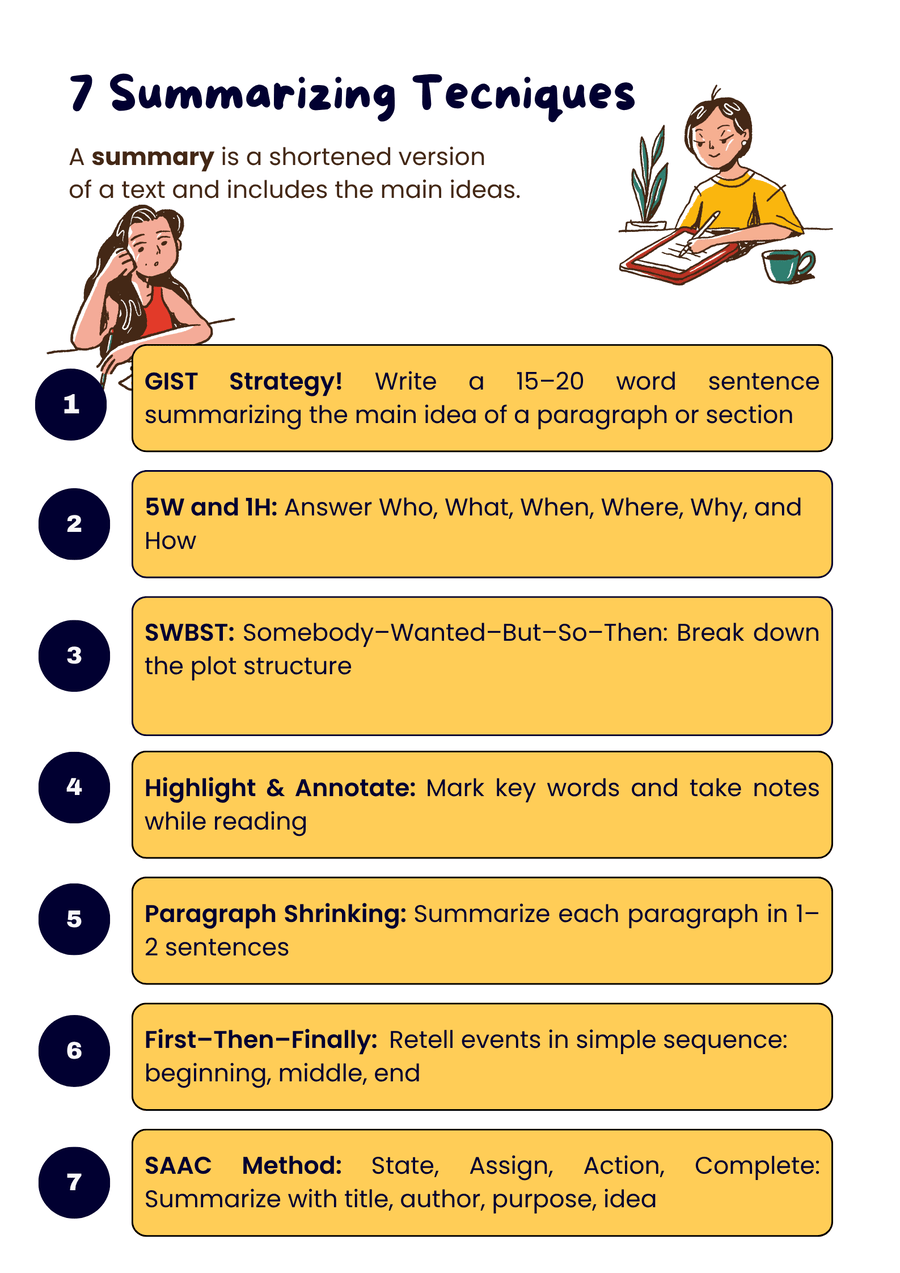
From the infographic above, let's focus on two powerful techniques:
- 5W and 1H: This method involves answering: Who? What? When? Where? Why? and How? This framework is perfect for summarizing real-world events, news stories, or factual reports. It ensures you cover all the critical information.
- SWBST: This stands for Somebody—Wanted—But—So—Then. This framework is excellent for summarizing narratives or stories with a clear plot.
- Somebody: Who is the main character?
- Wanted: What did they want to achieve?
- But: What was the problem or obstacle?
- So: How did they try to solve the problem?
- Then: What was the final outcome or resolution?
These frameworks, much like the STEP method from our previous lesson, provide a structure that builds confidence and helps you speak more fluently without getting lost.
Part 2: Practice with a Personal Story
Let's start by summarizing a simple, personal story. We'll use the SWBST framework because it's a narrative.
Speaking Practice Lesson | Tell A Great Story in English
This video from the "mmmEnglish" channel features the host telling a short, engaging story about a personal experience. It's a great example of natural, conversational storytelling.
First, listen to the story about an unusual trip to the supermarket. Pay attention to the sequence of events. You can watch from the beginning of the story.
Now that you've heard the story, let's break it down using the SWBST framework. Think about the answers to these questions:
- Somebody: Who is the story about?
- Wanted: What was she doing?
- But: What happened unexpectedly?
- So: What did she and her friends decide to do?
- Then: What happened at the café?
Take a moment to formulate the answers in your head. Now, try to connect these points into a short, spoken summary. Speak it out loud.
Here is an example of what a summary could sound like:
"The speaker in the video was doing her shopping when she bumped into an old friend she hadn't seen in ten years. But then, another old classmate also appeared, which was a huge coincidence. So, the three of them decided to go to a nearby café to catch up. Then, their reunion turned into a funny disaster where the cake was bad, the coffee never arrived, and a vase of water smashed all over their table."
Notice how this summary captures the main events without getting lost in minor details.
Part 3: Practice with a Professional Scenario
Now, let's apply this skill to a context that is more relevant to your professional life. We will summarize a conversation about a workplace dilemma. For this, the 5W and 1H framework is a better fit because we're focusing on the facts of an event.
Improve Your English Listening & Speaking Skills with Easy Conversations | English Speaking Practice
This video from "English Easy Practice" presents a short dialogue between two colleagues discussing an ethical issue at their workplace.
Listen to the conversation between Tom and Emma from this point. Focus on the problem Tom is facing and the advice Emma gives him.
After listening, use the 5W and 1H questions to organize the information.
- Who is involved? (Tom, his manager, Emma)
- What happened? (A worker was injured; the manager wants to cover it up)
- Where did it happen? (At a factory)
- When did it happen? (Today)
- Why is Tom worried? (He's facing an ethical dilemma and fears losing his job)
- How is the situation likely to be resolved? (Tom agrees to report it)
Now, use your answers to create a verbal summary of the situation. Imagine you are briefing a senior manager who needs to know what happened. Speak your summary aloud.
Here is a sample summary:
"The video shows a conversation about a workplace incident. A worker at a factory got hurt today after a machine broke. The manager told the employees to cover up the accident, likely to avoid trouble for the company. One employee, Tom, is conflicted because he knows it's wrong but is afraid of losing his job. His colleague advises him to do the right thing, and he decides he will report the incident."
This kind of concise, factual summary is an essential skill in any professional role, especially in HR.
Conclusion
Excellent work today! You have successfully practiced organizing your thoughts to summarize both a personal story and a professional scenario. This is a vital skill that moves you beyond just understanding English to actively using it to process and communicate information.
Key Takeaways:
- A good summary focuses on the main ideas and is delivered in your own words.
- Frameworks like SWBST (for stories) and 5W and 1H (for events) are powerful tools to structure your thoughts before speaking.
- Practicing with different types of content helps you become more versatile in your conversational and professional communication.
Daily Practice Plan:
- Summarize Your Day: At the end of each day, take 60 seconds to verbally summarize the most important thing that happened to you. Use the SWBST framework if it was a story, or 5W1H if it was an event.
- News in Brief: Find a short news clip (1-2 minutes) online. After watching it, pause and try to summarize the main points out loud.
- Entertainment Recap: The next time you watch an episode of a TV series or a movie, try summarizing the plot for a friend or just for yourself. This is fantastic, low-pressure practice.
In our next lesson, we will begin a new module, "Expanding Your Language Toolkit." Now that you are getting more comfortable structuring your thoughts, we will work on making your vocabulary more powerful and precise. Our first step will be to replace basic words with more varied and descriptive alternatives in your speech.