Hello. Earlier in the course, energy balance helped explain why a sustained deficit can reduce stored body energy. This module asks a different question: what can you actually learn from a scale reading? Today you will separate rapid changes in water and digestive contents from the slower changes in body tissue that may become visible over time. That distinction can prevent an ordinary fluctuation from being mistaken for evidence that a plan has succeeded or failed.
What the scale measures
A scale measures total body mass at one moment, not body fat. Its reading includes fat and muscle, but also water, stored carbohydrate, food moving through the digestive tract, and other body contents. These components do not all change at the same speed. A drink can affect the reading immediately; a change in stored body fat generally needs a sustained change in energy balance.
Watch this short explanation first. It covers the main sources of rapid change, but be careful with its suggestion that weight lost after cutting carbohydrates is merely water: water can account for much of an early drop without accounting for all of it.
Why Weight Fluctuation Is Normal | Nutritionist Explains... | Myprotein
Watch “Why Weight Fluctuation Is Normal” from Myprotein for a quick overview of why a changing scale reading does not identify a change in fat.
Watch common causes for the discussion of menstrual-cycle effects, digestive contents, carbohydrate stores, and salt-related fluid retention. Then watch the distinction between total weight and body composition. Focus on what each example adds to the scale, rather than trying to predict an exact change.
A useful way to interpret a reading is to distinguish a change in mass from a change in energy stored in tissue. If you drink a litre of water and weigh yourself immediately, the water has mass. That does not mean you have gained body fat. Conversely, a lower reading after losing fluid does not establish that you have lost fat.
Why water, carbohydrate, and digestion can move the number quickly
Water balance changes from day to day. Drinking, sweating, and changes in how much fluid the body retains can alter scale weight. A saltier-than-usual meal may temporarily increase fluid retention, though the size and timing of any change vary. Exercise can also change fluid balance, especially when sweating is substantial. None of these observations tells you by itself whether fat mass changed.
Stored carbohydrate, called glycogen, adds another layer. The body stores glycogen along with water. When glycogen stores fall—for example, after a substantial change in carbohydrate intake or activity—the associated water can fall too. Replenishing those stores can raise scale weight again. This is one reason an early drop after changing how you eat should not be labelled entirely “fat loss,” or a later rise entirely “fat gain.”
Digestive contents are more direct: food and drink have mass while they are inside you. Meal size, timing, and bowel movements can therefore change a reading without an equivalent change in body tissue. A larger evening reading than morning reading is not surprising when meals and drinks have been consumed in between.
The following research reading puts these mechanisms in perspective. It examined short-term weight variation in people not deliberately trying to lose or gain weight. That detail matters: its group result is evidence about short-term fluctuation, not a formula for calculating what fraction of your weight change must be water.
Composition of two‐week change in body weight under unrestricted free‐living conditions
Read the Results and Discussion passages in this research paper to see what investigators measured over two weeks, then connect their finding to water, glycogen, and intestinal contents.
In “Results,” find the paragraph reporting the combined dataset. Read the measured association. Here, FFM means fat-free mass; it includes water and is not another name for muscle. Then, in “Discussion,” find the paragraph beginning “Our results also indicate.” Start where it discusses body water—the water explanation—and continue into the next two paragraphs. Read the glycogen passage and the intestinal passage. Focus on why several changes in mass can occur faster than a meaningful change in fat stores.
In that study, changes in fat-free mass accounted for much of the variation associated with two-week weight changes across the group. Fat-free mass includes water; it does not mean participants rapidly gained or lost equivalent amounts of muscle. Equally, the reported proportion is not a universal rule. It came from a particular sample under near-energy-balance conditions and cannot tell you the composition of an individual reading or of weight lost during an intentional deficit.
Menstrual-cycle effects are another source of variation
For people who menstruate, changes in fluid retention across the cycle can make readings at different times difficult to compare. The figure below plots fluid-retention scores, not kilograms of body weight. In its upper panel, scores are higher around the start of menstrual flow than several days afterward. The lower panel shows scores relative to a rise in basal body temperature. It illustrates a pattern seen in the plotted data, not a timetable or amount of weight change that applies to everyone.
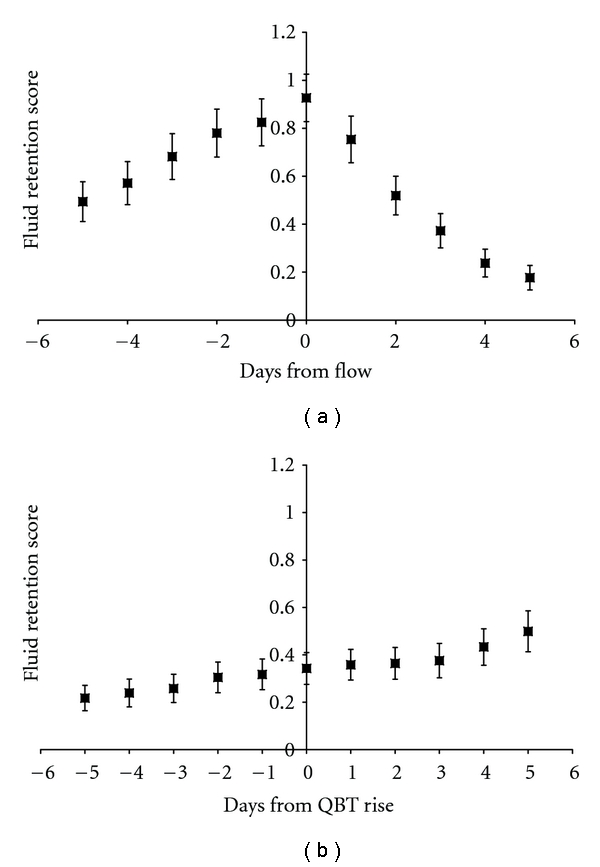
Cycle effects can overlap with the other causes already discussed. For instance, a higher reading around menstruation could reflect fluid retention alongside ordinary variation in meals and digestion. It cannot, on its own, establish that fat was gained. Nor should every unexplained change be attributed to the menstrual cycle: unusual or concerning symptoms warrant medical attention.
What would count as evidence of longer-term change?
A single higher or lower reading is weak evidence about fat change because several faster-changing components are mixed into it. Consider two interpretations:
- A reading falls markedly over a couple of days after a change in carbohydrate intake. Reduced glycogen and associated water are plausible contributors. Fat loss might also occur if there is a deficit, but the scale alone cannot assign the drop to fat.
- A reading rises after a salty meal or around menstruation, then settles again. Temporary fluid retention is plausible; the brief rise does not establish fat gain.
Over longer periods, a persistent shift in readings taken under comparable conditions is more informative than either isolated change. If weight remains lower over many weeks while an appropriate, sustainable deficit has been maintained, loss of body tissue—including fat—is more plausible than if one reading alone is lower. Even then, scale weight cannot prove exactly how much of the change is fat rather than other tissue or fluid. Likewise, a flat or temporarily rising reading does not prove that a deficit has stopped working.
This is why it helps to use cautious language: “consistent with fat loss” rather than “this reading proves fat loss.” The next lesson will show how to compare multiweek records more systematically. Weighing is optional; if it causes distress or encourages harmful restriction, it is not a requirement for taking care of your health. A sudden, substantial, unexplained weight change—particularly with swelling or other symptoms—should not simply be dismissed as normal fluctuation.
Key takeaways
The scale reports total mass, not fat mass. Water balance, glycogen and its associated water, digestive contents, and menstrual-cycle effects can all change a reading over a short period. A sustained pattern over weeks offers better evidence of underlying tissue change, but it still cannot specify body-fat change precisely. Next, you will learn how consistent measurement conditions and multiweek averages can make that pattern easier to interpret without giving any single number undue authority.